Wednesday, January 21, 2009

Running Shoes or Plodding on?

What’s Wrong With This Picture?

I am more convinced that a saying I like to describe New Mexico politically is truer than ever. “New Mexico; where Democrats act like Republicans and Republicans act like Democrats!”

Democratic State Senator Carlos Cisneros, left, of Los Alamos, Rio Arriba, Santa Fe and Taos Counties was poised to run for the top Senate job, against Sen. Timothy Jennings, of Chaves, Eddy, Lincoln and Otero.

Though Cisneros had on his running shoes and had the backing of the majority of Democratic Senate caucus members, eight crossed over to join all 15 Republicans in reelecting Jennings President Pro Tempore.

The eight Democratic Senators were: Jennings, Linda Lopez, of Bernaillo County, Lynda Lovejoy, Bernaillo, Cibola, Mc Kinley, Rio Arriba, and Sandoval Counties, Howie Morales, of Catron, Grant and Socorro Counties, George Munoz, of Cibola and McKinley Counties, Mary Kay Papen, of Dona Ana County, John Sapien of Sandoval County, and John Arthur Smith, of Hidalgo, Luna and Sierra Counties.

So what’s Wrong With This Picture?

There was a supposed shift in the Progressive Democratic wing of the Party when Republicans lost three seats and a “new breed” soundly defeated some incumbents.

Many Democrats were angry at Jennings, above, for what they saw as crossing Party lines to endorse Republican Senate Minority Whip, Leonard Rawson, of Dona Ana and Sierra counties.

The Party line was that it was all Party. Former NM Democratic Party Chairman John Wertheim, right, took the position that Jennings made an endorsement for Rawson against Party interests.

Blogger Matthew Reichbach on his, New Mexico FBIHOP, site posted the text of the Jennings radio spot:

JENNINGS: I'm Senator Tim Jennings, a Democrat from Chavez, Eddy, Lincoln and Otero Counties. And the elected Pro Tem of the New Mexico state Senate. The Pro Tem ensures that the Senate is run in a fair, efficient manner, and he must work closely with other leaders in the New Mexico Senate, such as Senate Minority Whip Leonard Lee Rawson. While Senator Rawson and I are from different parties and can disagree politically, I must take a stand against the incorrect character assassinations that are being lodged against Senator Rawson. The accusations against him are unproved and unfair.

RAWSON: I'm Leonard Lee Rawson and I approve this message.
Jennings took the position that Rawson, right, was attacked with lies as a sitting Senator, and that as leader of the Senate, he had a responsibility to defend the institution.

Wertheim’s examples of other attacks that he thought Jennings should have commented on were beyond the narrow position of protecting the Senate.

The best analysis of the infighting, I found, came from Professor Jose Garcia’s “La Politica: New Mexico! La Voz del Valle del Sur”

Rawson lost to Stephen Fischmann.

Republicans elected William Payne, right, Bernallilo County, Senate Minority Whip.

Despite the numeric imbalance between the Democrats and Republicans, the leadership tends to mirror the actual sense of the feelings of New Mexicans, stripped of the political cloth – moderate to mildly conservative. The Republicans will go along to assure that the more liberal wings of the Democratic Party, especially the Progressives, do not take control.

Tuesday, January 13, 2009

What you missed

What’s Wrong With This Picture?

I posted about Capitol Report New Mexico’s return and noted the Legislative Finance Committee’s report on the state of the projected budget.

In covering the story, I went to two meetings in Santa Fe last month, photographing the Dec. 8, LFC meeting and the Dec. 18, pre-session Legislative seminars and new member orientation.

With print medium, space is limited by the dimensions of the pages. There are events that occur which cannot be shown because of editorial considerations. The beauty of this blog; I can go deeper. Here's what you missed.

So what’s wrong with this picture?

There were two sessions on Dec 18: the consensus general fund report, given by Department of Finance and Administration Secretary Katherine Miller, followed by the current fiscal year solvency plan, where Legislative Finance Committee’s Director, David Abbey, joined Miller. Speaker of the House, Representative Ben Lujan, D, Santa Fe County, and Senate President Pro Tempore Timothy Z. Jennings, D, Chaves, Eddy, Lincoln and Otero Counties, sat with Miller and Abbey during their presentations.

The projected numbers seemed staggering and at least two legislators’ jaws dropped.

Newly-elected Sen. Eric Griego, D, Bernalillo County and Rep. Candy Spence Ezzell, R, Chaves County, responded to hearing the numbers during Miller’s briefing.

One can only imagine what great legislative initiative died in these legislators' minds as realization hit the ugly wall of truth; there is no money.

Monday, January 12, 2009

Spin Control at the Street Level

What’s Wrong With This Picture?

After posting the Matthew Astorga piece Dec. 30, 2008, I received comments, including the following anonymous offering, posted here without editing.
While it is importnat to remember that a life has been taken, I think it is also important to report the whole story. Mr. Rodriguez stabbed Matthew in the back twice, barely missing his artery only days before "they" say Matthew killed him. A couple of days after this stabbing, the family home of Matthew which he shared with his wife, mother, and two small children was shot at. Mr. Rodriguez was a member of "La Eme" A California Prison gang. What was he doing in Kansas anyway? Calling Matthew wife and threating her... threating to kill Matthews whole family... Why are these things not being reported?

Really... why is this making it to the Albuquerque media outlets? Because Michael is still awaiting trial? Seems the criminal justice system doesnt care about innocent until proven guilty. And neither does the media
(Anonymous) 1/4/09
Which led to my posting the follow up. I wanted the information to be brought into the public discussion.

The comment sections of the newspaper sites, both the Leavenworth Times and San Gabriel Valley Tribune, where there was a reporter written obituary, had discussions about the two men and their families. I realized that there was an effort to go beyond the news accounts, to put a face, a personality on the bare facts of the stories. The effort seemed to be the equivalent of spin control.

I threw down the gauntlet about posting comments anonymously.

I spoke with Leavenworth County Under Sheriff Ron Cranor. He had no direct information and did not think his Department had any contact with either Matthew Astorga or Ruben Rodriguez and directed me to the Leavenworth Police Department as the lead investigative organization.

I forwarded the anonymous allegations to the public information officer of the Leavenworth Police Department, Major Robert Smith. Smith responded:
We are well aware of all of these events. Although, your poster is apparently not concerned with accuracy of information. Matthew was not stabbed in the back twice, nor was he stabbed by Rodriguez. The stabbing was reported, but not by Astorga, he would tell us nothing. His wound was minor and he refused medical treatment. Astorga does not live in our city so the alleged shooting was not reported to us. It was called in but not reported to any law enforcement officials. When Sheriff's arrived they could find no evidence of a shooting and no one would talk.
The factual accuracy of the anonymous statements came into question.

I received another comment, this time signed by Christy Armell.
I am honestly tired of the media only showing one side of things. This is how the juctice system tries to ensure that the defendants do not receive a fair trial, which is a right that is guaranteeed by our consititution. So many people rely on the media for correct information. It is a blind person who beleives what they see on TV as the whole truth.

The man that Matthew is accused of killing, stabbed Matthew only days before this situation. A day after the stabbing, of which Matthew was air-lifted to a hospital to help save his life, the family home was shot at. This home included a wife and two small children.

The alledged victim is a known gang member for California. Why was he in Kansas to begin with? And why has the media not covered what the truth is regarding this man?

I am sorry for the loss of this man, but the truth is the truth. Threating phone calls to the family, and threats made of murder of family members in court need to be addressed as well.

I also wonder why this blog is even being maintained by someone in Albuquerque. This alleged crime occured in Kansas, and really has no bearing on what is happening in New Mexico. Matthews brother, Michael is awaiting trial in NM, and it seems that any type of media outlet will work to bring the Astorga name into the mud, and into the spotlight once again. These are the same people who argue that our justice system is fair and just! Nothing is fair about what the media has protrayed regarding this family.
(christy armell) 7:46 PM 01/06/09
So what’s wrong with this picture?

Armell is a full time student through the on-line campus of the University of Phoenix majoring in criminal justice who will graduate in May. She is also an Anti Death Penalty Activist.

In a telephone interview, Armell said she wrote the anonymous comment and rewrote the signed version to comply with this site’s policy.

Armell is a friend of Theresa Romero, mother of Matthew, his brother Michael Paul Astorga and another son, Anthony Lucero. She has provided moral support to Romero and her family; she attended court for Michael Astorga’s pre-trial hearings and says she writes or visits him on a weekly basis.

Armell went to Kansas after the shooting death of Ruben Rodriguez in Leavenworth. Matthew Astorga was arrested and charged with first-degree murder, felon in possession of a handgun and fleeing or eluding police. These are all felonies. 

Armell spoke with Matthew, but did not ask him who stabbed him. “He talked about it (the stabbing), but I didn’t ask questions,” Armell said.

Armell is concerned that local press coverage sensationalizes the brothers and makes it difficult to find an impartial jury in Albuquerque for the up coming trial of Michael Paul Astorga, who is charged with killing Bernalillo County Deputy Sheriff James Mcgrane Jr.

Michael Paul Astorga was already a fugitive at the time, wanted on another murder warrant for the November 2005 shooting death of Candido Martinez, described as a childhood friend, according to press accounts at the time.

Michael Paul Astorga’s Attorney, Gary Mitchell, has argued unsuccessfully for a change of venue in the case where the State, through local District Attorney Kari Brandenburg, seeks the death penalty.

Armell is not the only one trying to spin the personalities of the two men who came together on December 26, on the front lawn of 900 Cheyenne St. in Leavenworth, a house only five blocks from the federal penitentiary. She is attempting to shield the public from such news to protect Astorga’s brother.

The dead man, Ruben Rodriguez, 50, was a California native, from Asuza. According to family members, he was addicted to heroin and was arrested for bank robbery at age 17. After serving time, he was involved in trying to help rehabilitate gang members. He moved to Missouri, then Kansas to escape his past.

Analysis

Members of both families and their friends are using the comment sections of the media to express their thoughts, memories, feelings and loss.

The comments are found amongst hate filled accusations of all sorts of unsubstantiated rumors and speculation.

Armell asks some fair questions while embedding them in a less than candid recitation of what happened. She asserted that Rodriguez stabbed Matthew twice in the back. However, when pressed, she changed the story. Armell said she had conflicting information as to who did the stabbing; one source named Rodriguez, another did not know. Matthew told Armell that he did not know who stabbed him. She also changed the location of the stab wounds from, two in the back to one in the back and the other in the neck, just missing the jugular.

When asked about the police statement that the wound was minor and Astorga had refused medical treatment, she confirmed the part about refusing treatment by an ambulance and said that his mother, Romero, drove him to a local hospital where he was airlifted to a Kansas City trauma center. He was treated and released, according to Armell. She was unclear about when the stabbing occurred in relation to the shooting, but thought it was two or three days earlier.

Armell had only scant information about the house being shot at; she did know that it was not struck. Armell offered no information about the source or details of any threatening phone calls.

The First Amendment is a prohibition against government limiting speech and the press from having wide-ranging discussion on all manner of topics. Little has been deemed by the courts to be off limits.

The Sixth Amendment is the requirement that government provides an accused a fair trial.

The First and Sixth Amendments stand in stark conflict.

Government, through its police and prosecutors, may not try a case in public.

In emotional and high profile cases, it’s hard for some in government to exercise restraint. Yet, at the same time, government has an obligation to help inform the public through their cooperation with a free press. Disseminating facts about incidents are a critical part of societal needs. Even one of the principles of policing established by Sir Robert Peel was that crime news must be widely distributed.

What police and prosecutors write in documents filed in court are considered fair game for press coverage. What is generally considered improper is speculation or opinion about what facts might mean.

My Take

What I found fascinating is the level of spin placed on the stories that are meant to shade the public’s perception of the various participants.

The Internet levels access for the public that is usually filtered by the news media. The press is a filter on what is deemed important, necessary and newsworthy.

Much of the public will still rely on corporate media to act as their filter. Journalists have a duty to determine what news to report. It is a juggling act; determine what the public wants to know and also determine what the public needs to know. The authors of the First Amendment understood the crucial nature of open and public debate and the need to assure political speech. To protect political speech, the drafters of the Bill of Rights knew that all speech must be protected.

“Informed public discussion is essential to wise policy,” wrote the chief architect of the First Amendment, James Madison.

The press is simply an extension of speech. Thomas Jefferson in 1787, before the Constitution was written, himself wrote:
The basis of our governments being the opinion of the people, the very first object should be to keep that right; and were it left to me to decide whether we should have a government without newspapers or newspapers without a government, I should not hesitate a moment to prefer the latter.
190 years ago today, January 12, 1819, Jefferson who was also no great fan of newspapers, in a letter to Nathaniel Macon wrote:
I read no newspaper now but Ritchie's, and in that chiefly the advertisements, for they contain the only truths to be relied on in a newspaper.
“I am honestly tired of the media only showing one side of things,” Armell wrote.

News normally is not about the ordinary day to day lives of people going about their business. However, news is certainly about the deaths of people. In a paper of record, a common citizen may expect to see their name in print three times: for their birth, their wedding announcement, and as an obituary.

Matthew Astorga has been convicted, and he ultimately pled guilty, after an appeal of the murder conviction was overturned and returned to District Court for retrial, of the 1996 killing of Jose Maldonado Sigala in Martineztown, near downtown Albuquerque. His brother, Michael Paul who was present at the shooting, was also charged in that case and was acquitted by the jury. Subsequently, he’s been charged with murder in the two previously mentioned events. Astorgas’ half brother, Lucero is serving a life prison sentence for murdering a fellow soldier. Amongst three family members; they have been convicted of or charged in connection with five deaths. These facts alone constitute news when it comes to the attention of a local journalist.

News can also be personal. I am going to write about Matthew and Michael Astorga because they touched me. I stood over a complete stranger, Maldonado Sigala, and watched as his life ebbed away. I was helpless in any effort to stem the blood flow from the multiple shotgun wounds. He died shortly after being taken to the hospital.

I hope I’ve given as much of the other side of the story that Armell and others might want.

The criminal justice system will take up the allegations and juries will render their verdicts in due course.

Hopefully, the citizenry is adequately informed of what happens in our community or what our hometown residents are doing.

We’re Back

What’s Wrong With This Picture?

Publisher/Editor Harold Morgan announced the return of Capitol Report New Mexico after a one-year hiatus; we will be back as a newspaper.

CRNM was launched two years ago as a magazine and ran its course for a year.
The group working on the project then looked into the possibility of publishing on line.

The name Capitol Report New Mexico was kept alive as a blog, posted by Morgan.

Monday, Capitol Report New Mexico will be distributed to Legislators, government officials at the State, County and municipal levels, along with lobbyists and selected participants in the governmental process.

The tabloid-sized paper is funded with financial support from the Rio Grande Foundation, a think tank based in Albuquerque. Except for a page reserved for the Foundation, the editorial content is based on the original precepts of the magazine.

So what’s wrong with this picture?

We’re starting from a hole in the ground, literally and figuratively, just like the new Capitol parking structure. We have nowhere to go, but up.

As a niche publication, we tend to focus on the details of the legislative budget process and are first to publish the Legislative Finance committee’s report on their solvency plan for the 2009 fiscal year, officially released today .

The new edition has the same guest columnists as the magazine had: an analysis of the 2008 election by Lonna Atkeson, Tidbits from La Politica with Jose Z. Garcia, and Tax Policy Issues with Richard L. Anklam.

I provided the photographs. For all the fancy electronic media bells and whistles, there is something about black ink on “dead tree” newsprint that I like.

The paper will be posted in pdf form, later in the week, at Capitol Report NM.com.

Sunday, January 11, 2009

Yates Jr. Wins GOP Chair

What’s Wrong With This Picture?

The New Mexico State Republican Party’s Central Committee elected Harvey Yates Jr. as their next chairman, Saturday, to replace Col. Allen Weh, who did not run.

Yates beat Dr. Allen McCulloch, left, who ran for the U.S. Senate against Jeff Bingaman in 2006 and lost, and political novice Michael Meyer, right, who is a managing director of an Albuquerque investment advisory firm. Former State Legislator John Padoven withdrew from the race Thursday, throwing his support to Yates.

So what’s wrong with this picture?

There was no tally of the vote and numbers were not immediately available.

In addition to the election of the party leadership, six rules amendments were voted on and five failed, including the adoption of parliamentary order.

Further analysis will be posted when the Party provides the complete figures.

Though welcomed to cover the Central Committee event, I was ejected from a post meeting session called by Yates with Legislators and selected Party members by Communications Director and acting Executive Director Whitney Cheshire, left, with Weh, prior to the adjournment of the main meeting.

This is in conflict with Yates' campaign statements and the Rules Of The Republican Party As adopted by the 2004 Republican National Convention August 30, 2004.
BE IT RESOLVED, That the Republican Party is the party of the open door. Ours is the party of liberty, the party of equality of opportunity for all and favoritism for none.
It is the intent and purpose of these rules to encourage and allow the broadest possible participation of all voters in Republican Party activities at all levels and to assure that the Republican Party is open and accessible to all Americans.
I have no reason to believe that Yates was aware of Cheshire's action or that he would have approved. In his speech, accepting the nomination, he spoke of transparency.

Monday, January 05, 2009

Just Reporting the News

What’s Wrong With This Picture?

I have taken a position with this blogsite that I want to have a civil discussion.

However, part of my approach is that I won’t engage with the very prolific “anonymous.”

My site doesn’t generate a lot of comments, but about one in five are “anonymous.” A while back, I changed my policy by indicating that “anonymous” comments will no longer be posted.

Here’s the problem; some of the “anonymous” comments are worthy of sharing. I don’t need to know exactly who is responding on this site.

In the public square, one gets to see who is speaking and then judge from their demeanor just how much credibility to give the responder. Without having an identifier, any anonymous becomes every anonymous. Anonymous becomes a blur of multiple personalities.

I request that comment posters who are unwilling to use their name adopt a screen name so my readers and I have an idea of who is communicating.

Part of what I do here is to try to introduce my readers to the players in the public square, be they: politicians, journalists, those making news and the “every man story maker,” who are the topics of this blog.

So I ask that if you wish to add to the discussion, please adopt a screen name, so my readers and I can keep track of the participants. I revert to the program seller at sporting events hawking their product by yelling, “you can’t tell the players without a program.”

So what’s wrong with this picture?

What’s news? It’s more than just the products found under the kiosk sign of a newsstand, like this one at Washington National Airport. News is a wide range of information that people want to know about or should know about or need to know about in order to be a well informed citizen.

Mark Twain a newspaper reporter, editor and publisher may have said it best:
If you don't read the newspaper you are uninformed, if you do read the newspaper you are misinformed.
After posting the story on Matthew Astorga’s activities in the Leavenworth, Kan. area, I received an anonymous comment. The person relates a fractured story with little detail. It raises potential self defense claims that I will try to verify. It is journalistically unethical to publish unsubstantiated assertions.

This particular anonymous, who seems to be from Kansas, asks two questions about their claims of facts:
Why are these things not being reported??
Really... why is this making it to the Albuquerque media outlets?
The reason the allegations made by anonymous is not being reported is, no one knew until now.

Why the Astorga story made it to the Albuquerque media outlets is because crime, especially with a local hook, is always news.

I am not a great fan of the “news scoop,” the title given to the first media outlet to report a particular story. It’s partly based on human nature, of wanting to know what is happening right now, and part marketing ploy to bragging rights.

I believe that getting the story right and putting it into proper context is also important. Breaking news does not always allow for the time necessary to understand the deeper meaning of the headlines of developing stories.

The nature of the news business is changing. The local newspapers, though being challenged by the Internet, mobile phones and personal electronic devices, are still as viable products in our society as are the postal system. E-mail, text-messaging, and twittering may speed our written communications, but it hasn't made the post box obsolete. Contrary to any complaints about how hard it is for papers to survive in the current economic climate, they still are turning profits in the range of 15 to 20 percent. There are lots of industries that would love to bemoan such profit rates.

The Leavenworth Times posted this story Dec. 30, along with a follow up Jan. 2, on their website. Someone listed my story in the Times comment section. I was sent an e-mail by a Times reader, about the story.

Stories about the Astorga's of Albuquerque are news.

I believe I was the first local media with this story and posted a little before 1 p.m. MST, though Blogger time stamp indicated 1:57 p.m.

I gave the story to my buddy, Peter St. Cyr at KKOB. He went on air at 5 PM and posted to his site, “What’s the Word?” at 4:43 p.m. I provide images for his site.

In an ad-hoc unscientific experiment, to see how this story might spread, I also sent an e-mail to Sheriff Darren White. That evening, the only TV station to run the story was KRQE. White was a crime reporter at KRQE before being elected Sheriff.

The Albuquerque Journal’s T.J. Wilham ran the story the next morning citing the Times article.

I did some follow up with Leavenworth Times reporter John Richmeier and learned Wilham had called him after 5 p.m. Wednesday. Thursday, other media started catching up. My blogging colleague Sgt. Joe Schmedlap, who had his own previous contact with the Astorgas, posted his own story.

Though I credited my sources, nobody except St. Cyr did. Scooping is cutthroat.

Santa Fe Reporter's Editor Julia Goldberg, in her Blog, has repeatedly complained about her staff writing original stories that other media copy and rewrite without acknowledging their source.

I agree with Goldberg that source identification is important and should be done with greater regularity.

Sunday, January 04, 2009

Political News Flash: Full Stop!

What’s Wrong With This Picture?

New Mexico Democratic Governor Bill Richardson tapped by President-elect Barack Obama for Secretary of Commerce has withdrawn his nomination according to MSNBC’s Andrea Mitchell.

So what’s wrong with this picture?

Richardson is the subject of a secret grand jury, reportedly over charges of a possible pay-to-play scheme with a California investment company CDR Financial Products.

CDR, a contributor to Richardson’s political campaigns received a sole source contract in 2003 with the New Mexico Finance Authority and pocketed $1.4 million in fees over bond deals. The State claimed the deal had saved the public $8 million.

Richardson ran for the Democratic Presidential nomination and withdrew just under a year ago. The Gov. backed Obama and upset the Hilary Clinton campaign.

Richardson was the Ambassador to the United Nations and Secretary of Energy under President Bill Clinton. Previously he was elected seven times to Congress from the then newly created northern New Mexico District.

Richardson will remain as Governor and plans to complete his remaining two years.

His anticipated departure to Washington would have meant that Lt. Gov. Diane Denish, left, seen the day before the Nov. 5 election, would become Governor upon his confirmation.

This development will have political ramifications on both sides of the political aisle.

Tuesday, December 30, 2008

Matthew Astorga

What’s Wrong With This Picture?

There is no picture. However, picture this; Matthew Astorga of rural Lansing, Kan., was arrested in Leavenworth, Kan., charged with first-degree murder, felon in possession of a firearm and fleeing or eluding police.

So what’s wrong with this picture?

It has a familiar ring to it....

Leavenworth Times Reporter John Richmeier wrote of a Matthew Astorga being arrested.

Is this the same Matthew Astorga, brother of Michael Paul Astorga, who is accused of, and is awaiting trial in the death of Bernalillo County Deputy Sheriff James McGrane Jr.? McGrane was shot to death during a traffic stop on March 22, 2006,

Google search is a wonderful resource. Type in a name and voila, up pops a list of links to information on that request.

I got an e-mail from a man who had gone looking for additional information on Astorga.

My May 2006 posting was number one on the Google list. I posted the man's name, but he's requested anonymity. I'm breaking my rule on using an anonymous source; though he is actually an unnamed source. He was none-to-happy about the reported crime.

I read you article on title "Whats wrong with this picture" and the Astorgas. Last Friday, Matthew Astorga murdered a man in Leavenworth, Ks. He's chargd with 1st degree murder and has a 1 million dollar bond. I'm not sure the judge reaizes when this gets bail, he's gone! I was amazed that he is a former murderer with such an obtainable bond.

How our local law enforcement did not know this guy was living and no doubt "dealing" in our community and is a convicted felon amazes me!

The City of Leavenworth Police are of the belief that the man they have is the Astorga of Albuquerque.

Kansas City's KHSB NBC Action News reports Astorga was from New Mexico. Other Local television, KCTV 5 news reports give more details

Astorga was living in Lansing, a neighboring town of Leavenworth; just northwest of Kansas City.

Saturday, December 27, 2008

The Train, the Train… From the Outside

What’s Wrong With This Picture?

All the media, bloggers included, seem to have jumped on the RailRunner express show, including:

Journal North, Thursday, December 18, 2008, by Journal Staff Writers Kiera Hay and Phil Parker, "All Aboard the ABQ-SF Rail Runner."

Journal, Thursday, December 18, 2008, by Journal Staff Writer Leslie Linthicum, "One Joyful Ride Changed My Mind ."

Journal, Monday, December 22, 2008, by Journal Staff Writer Sean Olson, "Delays force agency to add train for Sunday service to Santa Fe."

Only in New Mexico, Monday, December 15, 2008, by Jim Baca, "Rail Runner."

Only in New Mexico, Friday, December 19, 2008, by Jim Baca, "Rail Runner and Road Tax."

New Mexico Independent, Tuesday, December 16, 2008, by Trip Jennings, "Guv takes valedictory lap on Rail Runner."

New Mexico Independent, Wednesday, December 17, 2008, by Trip Jennings, "Rail Runner Express kicks off its public schedule today," "Rail Runner sidetracked a bit with day one glitches."

New Mexico Independent, Wednesday, December 17, 2008, by Matthew Reichbach, "Rail Runner snags another high profile rider."

Weekly Alibi, December 18 - 24, 2008, This Week's News/Opinion, by Marisa Demarco, "The Northbound Train."

KRQE TV, Monday, December 15, 2008, "Rail Runner trains beat
 snowy I-25 Santa Fe service starts Wednesday."

KOB TV, Eyewitness News 4, Wednesday, December 17, 2008, "Rail Runner makes inaugural trip to Santa Fe."

KOB TV, Eyewitness News 4, Saturday, December 20, 2008, "Ridership overwhelms Rail Runner to Santa Fe."

Now I have an affinity for the rail; I like trains. It might be that when I was born, my parents lived in Alexandria, Va. next to the train yard. The constant sounds of trains being moved about a switchyard must have been my primary auditory sensation. We were also under the flight path for National Airport. Hence, the reason I also like aircraft.

I like trains even when I can't see them. When I hear a train whistle, I'll say, "There's a Train!"

I'm fascinated by all aspects of the rail industry.

In the summer of 2006, the Mid-Region Council of Governments’ RailRunner began the 18-mile run from Albuquerque to the north side of Bernalillo.

Later, the service was extended south to Belen.

When the original railroad came to New Mexico at the end of the 1870s, Bernalillo was the first choice for a rail yard. However, the cost of land became prohibitive, so the rail company moved 17 miles south.

The tale is told in an Aug. 1976, New Mexico Magazine article by John Sinclair, “The Place Where De Vargas Died,” that I helped illustrate. Sinclair called the demand by the then patron José Leandro Perea, the act, “…distinctive of as one of America’s first environmentalists, a man who didn’t like clatter and smoke, or gringos interfering in the affairs of a happy little Spanish village.”
An aside:
Our Lady of Sorrows church in Bernalillo was slated for demolition after the 1972 Fiesta because a new church was opened. As a result of my picture, taken from across the Rio Grande, a group, including architects, who told me they were inspired to try to save and rehabilitate the old church. For more than 30 years, work has slowly progressed on the old building.
The planned railroad yard's move from Bernalillo was the impetus for the growth of the little town of Albuquerque. On April 6, 1880, the first train came through town. Later that month, on the 22nd, passenger service began. Carrying mail by stagecoaches was rendered obsolete.

AMTRAK took over passenger service through New Mexico from the Atchison, Topeka and Santa Fe in May, 1971.

Things didn’t appear to change right away; the Santa Fe’s equipment and personnel were used, as seen here, below, on the first day of official AMTRAK service. It didn’t look any different than the day before.

Mail was moved in the same way, on and off the first westbound AMTRAK through Albuquerque.

AMTRAK has run two scheduled passenger trains each day from Chicago to Los Angeles and back.

The idea of commuter train service in the Rio Grande valley has been kicked around for more than 35 years.


Over the past year, I have been to Santa Fe several times and watched the progress of the construction in putting down new track along Interstate Highway 25.

So what’s wrong with this picture?

I went to Santa Fe with my publisher/friend Harold Morgan Thursday for the “2009 pre-session Legislative Seminars and new members orientation.” We had considered riding the RailRunner. However, our timetable went into free floating, in part due to the weather. We decided to drive.

Along the way, we came upon a northbound train stopped on a siding.

The southbound train was coming out of the City Different.

A couple of weeks ago, on the way to Santa Fe, to cover the Governor - Lt. Governor’s “press availability,” construction workers were making last-minute adjustments to the track and testing the signals.

All the effort apparently didn’t work out all the kinks.

The inaugural run went off without a hitch, but put more than one train on the track and the system seemed to have generated its own problems. Trains were late by more than an hour and a half from the scheduled arrival times.

The fault was blamed on signals between San Felipe and Santo Domingo Pueblos on the main line part of the route. A southbound train hit a cow on the San Felipe Pueblo, stopping the train for some time and delaying its arrival by more than an hour.

On the way back from the Legislature’s meetings, a mid-afternoon northbound train was on a different siding. The conductor was standing in the remnants of an earlier snowstorm. It is the sign of an anticipated extended delay.

Crews are known to get off of their trains when placed on a siding and having any kind of wait. Click to enlarge; note crewman in white shirt to right of freight train.

This eastbound Burlington Northern - Santa Fe freight crew dismounted while it waited for the westbound AMTRAK to pass, at Dalies junction, west of Belen on the main line. In excess of one hundred freight, and two passenger trains pass this point every day on one of the busiest train routes in the country.

Analysis:
Many are upset at the cost; $400 million, for the 100-mile RailRunner project.

Such transportation projects are not self-sufficient. However, this project has been supported by tax initiatives, although the bond questions were put to voters only after the project was started.

Some argue that the money is poorly spent, pointing to the relatively low numbers of persons carried on the train versus the numbers who use cars.

There are flaws in the argument:
The number of individual cars with single passengers on the road, while convenient, is extremely inefficient. In our car driven culture, the efficiency is seldom addressed.

Effective mass transit concepts are based on wide ranging networks that meet the needs of the public. Those needs must include timely, convenient, accessible and affordable service.

Former Albuquerque Mayor Jim Baca pointed out in his blog that there was not enough parking at the stations. Such a problem for the park and ride set defeats the purpose of getting people to use the train in the first place.

Road projects are not self-sustaining either. Gas taxes added at the pump don’t completely pay for road and bridge infrastructure.

Baca pointed out that Albuquerque’s ten-year transportation tax is due to expire shortly and questioned, “I can't understand why this deadline has crept up on the administration like this.” The administration of current Mayor Martin Chávez didn’t miss this deadline. To the contrary, his attempt to fund his modern trolley has been predicated on the continuation of the transportation tax.

Baca writes about the transportation tax having passed by 700 votes. He doesn’t speak about the effort he made to woo the Albuquerque Police Officers Association to not oppose this tax, as they had the public safety tax that they worked to defeat a couple years earlier. Baca did not understand why the APOA had opposed the first tax.

Albuquerque Police Officers Association negotiators met about the quarter percent Transportation Tax, on February 17, 1999, with Baca, center left, and his Chief Administrative Officer Lawrence Rael, right, who is now the Executive Director of the Mid-Region Council of Governments which runs the RailRunner. The cops, through the APOA, could have cared less about the transportation tax. The police had felt that Chávez was trying to manipulate them and the public by calling for the tax’s use to be for public safety.

Chávez continues to push for his trolley system, in part by claiming that all great cities have a trolley, light rail or subway system.

Looking at the capital of the poorest European Union country, Lisbon, Portugal, with a population density of 2.5 million in its metropolitan region; they have an intricate mass transit system.
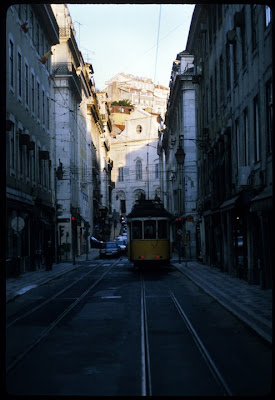
A fundamental part of Lisbon's transportation system includes rails with: electrified trolleys, trams, a subway, and several commuter light rail operations, in addition to a bus system.

Chávez claims, in a current report published by the US Conference of Mayors, “Ready to Go,” jobs and infrastructure projects report, that he needs $90 million for Phase I of the Central Street car. It will create 500 jobs.

According to an article in the Albuquerque Journal, "City's Wish List Is Fifth-Biggest," Chávez asked for $2.3 billion from President-elect Barak Obama’s newly proposed stimulus package.

A Forbes magazine article, “The Obama Boomtowns." Ranks Albuquerque’s request was the fifth highest.

The other cities ahead of the Duke City asking for more money are: Miami, Sacramento, Calif., Philadelphia, and Los Angeles.

Miami has a Metrorail with 27 stations on a single line and a free Metromover on a downtown loop with 20 stations. It also has almost 900 buses on 91 routes; some that operate 24-hours a day.

Sacramento's population is smaller than Albuquerque's, but is situated in a broader metropolitan community of over two million people.

The Sacramento Regional Transit District has a light rail system, above, with two branches and a downtown trackless trolley replica, below.

Sacramento 's RT has 32 million boarding passengers a year on 76 light rail cars; 277 buses, vans and trolleys.

Philadelphia's Southeastern Pennsylvania Transportation Authority serves a population of 3.9 million, with ridership of 325 million. SEPT uses 2,664 vehicles, of which half are buses; the rest are, light rail, subway-elevated, regional rail, and paratransit vehicles.

Los Angeles has a large system with 380,073,888 bus boardings. LA has five Metro rail lines

Chávez claims the amount is for $1,635,606,800 for 96 infrastructure projects that can be started right away creating almost 5,000 jobs.

Though Albuquerque is ranked 34, by city size, based on 2007 data, with population of 518,271, it can be easily argued to be a good city; but great is questionable. It certainly doesn't serve the population sizes of their economic rivals.

My Take
One might argue that starting projects without full public support by the legislature or local governmental bodies is the sign of leadership; while others might argue it's a sign of power politics, as usual. Both might be right.

There is a reality; the cost of driving to Santa Fe was substantially less than taking the train. The Rail Runner would have cost $8 per person for a day pass. The half tank of gas needed for the trip was four dollars less and we didn’t have to pay the downtown - parking garage at the main station, which is closest to us.

Cost alone is not the only factor. Once the RailRunner provides internet connection, there maybe an added benefit of being able to work while traveling.

Start up glitches have a way of working themselves out. Other problems, like a RailRunner Police Force with multiple jurisdictional authority, are only now being addressed. Such a force, represents a substantial cost. Security is a foreseeable issue. Political considerations of trying to expose all the costs, up front, might have dictated not addressing on-board security and to rely upon local law enforcement for protecting station parking lots and platforms. The decision is unconscionable for administrators and managers to wait more than two years to even come to a realization that policing is necessary.

I'm left with nagging questions:
Phase I of the Central Avenue Street Car is proposed to go from Nob Hill to the Biological Park, a distance of 4.59 miles. The construction cost is $28 million per mile or $128,520,000.

A couple of years ago, City Council shot down the trolley proposal. Now Chávez is asking Obama for $90 million for the same project. Was the original price grossly over calculated then, or is it radically under valued now?

The RailRunner Project cost $400 million dollars. It included buying about 280 miles of existing BNSF mainline track from Belen to Trinidad, Colo. About 15 miles of new track was constructed from Waldo canyon to the Santa Fe spur. Existing Santa Fe Southern track will complete the trip to downtown Santa Fe.

The total RailRunner line is a hundred miles. So why does less than five miles of lighter rail capacity of the Central Avenue Street Car cost almost a quarter of what the RailRunner did?