I love a good conspiracy. Not one of those where people sit around and conjure up stories about how events that are difficult to fathom, were actually complicated and massive plots or cover-ups, perpetrated on unwitting citizens by secret government cabals. Nor do I mean the kind found in the first definition of the word to conspire; to do something illegal.
No. What I’m talking about is a group of people who actually sit around, over a cup of coffee, talking and listening to each other’s ideas, and coming up with a collective way to make substantial governmental change.
The secondary meaning of the word conspiracy is working together or plotting to cause a desired result or change to the detriment of another.
 One such group in town is actually called, “ConspiracyBrews,” named, tongue in cheek, more for the coffee than any conspiracy. The detriment this group seeks, is towards closed and secret governmental power.
ConspiracyBrews is the brainchild of three-term New Mexico State Representative Janice Arnold-Jones, a Republican from Albuquerque’s Northeast Heights District 24, Bernalillo County.
 In the past two election cycles Arnold-Jones, here, with her husband, John, at the 2007 opening of the Legislature, has faced no opposition, in either the primary or general elections.
 As a matter of complete disclosure, a little more than two years ago I was introduced to Arnold-Jones by Harold Morgan, right, editor of Capitol Report New Mexico, who was then helping her campaign communications efforts.
 I aided her by making a campaign photograph. Since then, I have responded to her queries. She is a faithful reader of this blog.
About ten months ago, Arnold-Jones realized that she had no opponent for her legislative seat, but didn’t want the election to pass without the opportunity to campaign. I suggested that she run as if she had an opponent: to walk her district, meet with her constituents one-on-one, and to hold office hours, open to anyone. She had held a “community discussion on ethics,” on Dec. 6, 2007, that was deemed successful. Why not do more?
Without opposition, she was free to raise issues of public concern that might otherwise be politically sensitive in heated contested races. I promised I would attend her open meetings and would not allow them to get dull.
That was the start. Arnold-Jones gathered her small, but dedicated group of campaign volunteers and her district’s Party members and others she had met along the way, inviting them to coffee at Cup O Joe’s on Saturday mornings.
The weekly meetings started small, but the conversations were lively. The group was encouraged to bring a friend under each arm and the numbers slowly grew.
 The number attending fluctuates each week, but averages about 30; there are around 15 attendees who regularly participate. All are welcome, party doesn’t matter, neither does residency, you don’t have to live in the Representative’s district to be welcomed.
 The group has Republicans, Democrats, Independents, and Libertarians. Within those larger groups, we find the complete political spectrum. When was the last time you heard the theories of the John Birch Society espoused? We’ve even got them.
 The group brings together a divergent mix; here regular Mike Meyer, left, who announced his intention to run for the State Republican Party Chairmanship at the meetings, speaks with occasional visitor Harvey Yates, Jr., on Dec. 27, 2008, about his possibly entering the race. Yates would enter and beat Meyer, John Padovan, right, is another occasional visitor, and Dr. Allen McCulloch, from Farmington who has not attended, though he was invited.
 Public Regulation Commissioner Jason Marks, a Democrat, above, visited recently and spoke about attempts for his body to be more open through technology.
 Former Secretary of State’s elections chief Daniel Ivey-Soto, right, a Democrat, attends and contributes, especially on poll, election and ballot issues.
So what’s wrong with this picture?
In order to better understand, I present a roster of some of our group.
In no way do I mean to slight anybody who attends, by not mentioning them, because even the quiet ones add to the group dynamic.
I am going to limit this discussion to a group responsible for last couple of week’s number one legislative story; the use of a webcam by Arnold-Jones to show workings of the House Taxation and Revenue and the House Rules and Order of Business Committees.
The video coverage I present in this posting is not gavel to gavel, but an edited version of a selection of the full comments of members of the House Rules committee. I present the video this way to demonstrate that there are ways of presenting information without having the entire debate or being limited only to a television news sound bite.
 This is Ched MacQuigg, above, covering the House rules committee for the blog spot he writes, Diogenes' Six. I provide pictures for MacQuigg's site.
You’ll remember Diogenes from your Greek mythology. He was considered one of the great Greek Cynic philosophers. He lived naked in a rain barrel. Diogenes, it is told, wandered Athens, during the day, with a lantern seeking a human being, others say he sought an honest man. MacQuigg’s site pays homage to Diogenes and “Six” indicates guarding the philosopher’s back, a fighter pilots reference to location based on the face of an analogue clock.
 MacQuigg’s main focus is on his former employer, the Albuquerque Public Schools.

He has been most active in striving to hold the current Superintendent Winston Brooks, APS Board and top administrators accountable to ethical standards.
MacQuigg had a career as an APS shop teacher.
He also was an original member of Albuquerque educators who participated in a Character Counts, "train the trainers" seminar put on by the Josephson Institute's Center of California.
“It was a life altering event,” MacQuigg said. He has inculcated the philosophy of Character Counts and became an ethics advocate.
 He demands adults at APS live to the same standards that students are being taught.
Over time, the APS Board of Education has distanced itself from the fundamental philosophical underpinnings and refuses to hold themselves to the ethical standards identified by Character Counts.
MacQuigg challenged his school’s leadership for not enforcing rules against students.
He was disciplined and wrongly terminated. APS reinstated him, but about four months later he left APS when they bought out his retirement.
Two years ago, MacQuigg ran for the School Board but lost to current member Martin Esquivel.
 He takes every opportunity to call for ethical conduct and has used a variety of techniques to attempt to engage the Board in a civil conversation.
 "The Board was refusing to talk about the elephant in the room," MacQuigg said, so he wore a homemade mask in silent protest.
He has been arrested by APS police, though not charged, more than a handful of times, for raising questions that either an administrator, board member or bureaucrat, who gave the police the high sign after deeming his comments off limits.

 APS Board meetings are recorded and broadcast on the educational cable access channel. MacQuigg has had problems reaching the wider audience as technical audio gremlins have plagued him, in particular, when he speaks.
MacQuigg is on the right path; he just doesn’t have much of a public following.
Last summer before the Special Session of the Legislature, a ConspiracyBrews discussion was contemplating ways to get the public’s interest in the issues facing the state. If you recall, a tax rebate was the key issue, with Gov. Bill Richardson wanting to give money back to every taxpayer.
There was a concern that the idea was not very wise, as gas and oil revenues were very high, but there was an uncertainty about them staying at record rates.
MacQuigg suggested that thousands of angry citizens armed with torches and pitchforks storm the steps of the Capitol demanding openness and accountability. I suggested updated technology; video cameras throughout the galleries, edited together and posted on the Internet. There was an interest; though nothing was accomplished during the special session, an even newer technology emerged; webcasting.
A team of assistants helped Arnold-Jones acquaint herself with the Internet based technology.
 Arnold-Jones is practicing operating the webcam during a ConspiracyBrews gathering Jan. 24, with the assistance of Charlie Christmann, running his webcam while streaming through a laptop computer. Christmann’s website is CivicPlaza.Net, the catch phrase, “Taking Back Our Country One Politician at a Time,” hosts and archives both the ConspiracyBrews meetings starting Jan 16. and the legislative committees.
 Howard DeLaCruz-Bancroft, in the background operates his webcam at the Jan. 24, Saturday morning office hours meeting, ConspiracyBrews gathering. Arnold-Jones is being interviewed on her cellular phone about her planned webcasting of State Legislature activities. The interview was with radio talk show "Speaking Freely" hosted by Jim Scarantino and featuring Paul Gessing, last Sat. at 9 a.m. on JOY AM 1550, Albuquerque.
DeLaCruz-Bancroft opened a second website, NMGOV.TV to host Arnold-Jones’ webcasting efforts. The second site is a non-partisan hosting location.

New Mexico’s State Legislature is one of only three States that do not provide either audio or video coverage of their sessions, according to the National Conference of State Legislatures. The three are: Arkansas, West Virginia, and New Mexico.
Yet the University of New Mexico owned, KUNM FM 89.9. Radio started to webcast House and Senate floor sessions on their website.
A commercial venture, New Mexico Legislative Report, has also posted a free link to both the House and Senate audio. This service had been available by subscription.
Others argue that the number of states not webcasting or televising legislative sessions is higher. Cable-Satellite Public Affairs Network’s website indicates that, as many as nine states do not meet their definition of webcasting or televising. They are: Arkansas, Delaware, Hawaii, Massachusetts, New Mexico, Pennsylvania, Rhode Island, Vermont, and West Virginia.
“New Mexico is one of only six states that doesn't webcast legislative proceedings,” The New Mexican’s Political Reporter Steve Terrell wrote, January 19, in his article headlined, “Budget crunch delays session webcasting: New Mexico one of six states without service.”
 Sen. Mark Boitano, R, Bernalillo County, left, introduced Senate Memorial 45 in February 2008. The Memorial reinforced a 2005 piece of legislation instructing the Senate to start webcasting, but was never implemented.
Boitano’s Memorial stated:
…the New Mexico legislative council, at its January 14, 2008 meeting, declined to direct staff to issue a request for proposals to solicit bids so that webcasting could begin…The Senate’s roll call vote in February 2008, was 27-13.
…legislative council service be requested to proceed as expeditiously as possible with the necessary arrangements and contracts to ensure that the proceedings of the senate will be streamed on the internet beginning in 2009,
The Senate’s Committees Committee voted to delay implementation, citing the budget crunch. Those voting in the committee included the Senate’s Democratic leadership: President Pro Tem Tim Jennings, Chavez, County, below center, and Majority Leader Michael Sanchez, below left, Valencia County. Other Democrats voting against the cameras were Senators: Phil Griego, Los Alamos, Mora, Sandoval, San Miguel, Santa Fe, and Taos Counties, Linda Lopez, Bernalillo County, Mary Kay Papen, Dona Ana County, and John Sapien, Sandoval County.
 Minority Leader Stuart Ingle, right, Chaves, Curry, De Baca, and Roosevelt Counties was joined by fellow Republican Senators: Vernon Asbill, Eddy and Otero Counties, Gay Kernan, Chaves, Curry, Eddy, Lea, and Roosevelt Counties, and Carroll Leavell, Eddy and Lea Counties, in opposing the cameras.
Terrell, in his blog, Roundhouse Roundup, reported seeing a Capitol maintenance worker removing the cameras from the Senate chambers on Jan. 13, only a week before the opening of the regular 60-day session.
The physical removal of the cameras from the walls and the accompanying unstated message it sent, that there would be no open coverage; caused the ConspiracyBrews participants to focus interest on providing an alternative source of information to the citizens of the state.
 Arnold-Jones, with House Minority Leader Tom Taylor, R, San Juan County, at an off session Dec. 18, 2008, Legislative meeting, determined that she would step into the breach and provide streaming video from the legislature. She carefully selected how she would proceed; reading the rules and determining the best course of action. She decided she would stream only the committee meetings of which she is a member.
Stepping forward posed certain risks and likely criticism. To avoid possible recrimination, I recommended preemptively establishing internal rules for operating the camera.
Arnold-Jones asked me to wordsmith a statement to be used on the website accompanying the webcast. Using the 30-year old Cable-Satellite Public Affairs Network as a model, and based on my experiences with the Bernalillo County/City of Albuquerque’s government access cable channel GOV-TV 16, I drafted a statement.
This web cast is provided to my constituents to raise public awareness and help educate citizens on the Legislature’s activity.At the first Tax and Revenue Committee meeting Monday Jan. 26, Arnold-Jones set up her high tech equivalent of a “Dixie cup and a string,” communications device and streamed a live session of the Legislative committee.
Web castings protocol is simple:
It is nonpartisan,
The picture follows sound, meaning the legislator or witness viewed is the person recognized by committee chair or the Speaker of the House.
Nothing shown or recorded on the web cast will be used for political purposes or campaign.
Her effort was a hit with some, especially the media and most bloggers.
However, Tax and Revenue Committee Chairman Rep. Ed Sandoval, D, Bernalillo, below right, asked Arnold-Jones twice to shut off her webcam. Sandoval complained that she didn’t ask his permission.
Arnold-Jones stood her ground. Speaker of the House Ben Lujan, D, Santa Fe County, below left, a member of Tax and Revenue, feigned surprise and said he was offended by Arnold-Jones not having had the courtesy of informing him of her plan to stream.
 The next day, in a lightening strike response to the webcam, the House Rules and Order of Business Committee, chaired by Rep. Nick L. Salazar, D, Mora, Rio Arriba, San Miguel, Santa Fe and Taos Counties, above sitting to the right of Luján, held it’s first meeting of the session with two agenda items: allowing bolo ties as neckwear for male members on the House floor, and establishing a rule on webcasting.
 House rule 2 was cosponsored by the House leadership; House Majority Leader Ken Martinez, left, Cibola, McKinley and San Juan Counties and House Minority Leader Taylor.
The existing House rule reads:
9-5-7The rule would further amend existing rule 9-10:
Photography, video or audio recording or transmission of committee proceedings may be allowed with the permission of the chair.
The principal duties of the chairman of a committee are:New language would be added to subsection b:
(b) to preside over meetings of the committee, maintain order and decide all questions of order subject to appeal to a majority of the appointed committee;
...and to ensure that the decorum of the committee is preserved while maximizing the public's ability to observe, report on and participate in a meeting;
 There was a long discussion that included the now famous statement by Rep. Ray Begaye, D, San Juan County, where he was concerned that he might be caught sleeping and the video could be used for political purposes against him.
Begaye started with a privacy question, whether a legislator has a privacy interest while fulfilling his legislative duties. He worried allowed about the potential of video being available for sale, redistribution and ultimately used for political mischief by opponents. He said his was an after the fact concern.
Bloggers, print media and KRQE, in particular seized on Begaye’s sitting back in his seat and acting as if he were sleeping to make his point.
Here is Begaye’s entire comment:

"If it's worth doing, it's worth doing right the first time," Rep. Elias Barela, D, Valencia County, said. "I understand the frustration with some members, that we don't have this (webcasting), but just look at the havoc, if one member, of one party, with one ax to grind. And I'm not in any way insinuating that this particular member has that (pointing to Arnold-Jones, standing in the back of the room)." "But, what you're opening up is is something that could be used as a partisan tool."
 "Politics is a very open forum," Rep. John Heaton, above left, D, Eddy County, said, "and I think that by being here we have consented to whatever scrutiny anybody wants to apply to us."
"As of Jan. 31, the Albuquerque Journal has discontinued the contracts," Rep. Anna Crook, R, Curry County, said of the suspension of newspaper delivery to the Eastside of the state. "So here we are out here, we can't get the news on satellite, we can't get the newspaper delivery and all. So this is a convince. It's something my constituents, and they have brought this to me. We don't live in Texas."
"We in New Mexico, I, my personal perception, we always have this problem of always with trying to reinvent the wheel," Kathy McCoy, R, Bernalillo, Sandoval and Santa Fe Counties, said."
"Who would actually be doing the webcasting, would there be competition," Rep. Debbie Rodella, Rio Arriba, Sandoval and Taos Counties, asked? "Perhaps an independent third party, or whether it be the council service or somebody else that would take ownership of the webcasting and we wouldn't find ourselves on YouTube this afternoon or tomorrow," she said.
Rep. Keith Gardner, R, Chaves, Eddy, Lea and Roosevelt Counties, engaged Minority Leader Martinez in a discussion about a free press. You will find the debate further down in this posting.
Rep. Danice Picraux, D, Bernalillo County, asked if other states had established rules or guidelines to limit times for speakers in the presence of cameras to ensure decorum.
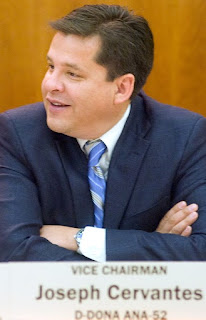
"I think there should be some mandatory language to the proposed rule which does recognize the discretion of the chairs," Vice Chairman Rep. Joseph Cervantes, D, Dona Ana County, said.
"I'm specifically not against wbecasting," Speaker Luján said.
Chairman Salazar accepted a motion to form a subcommittee to investigate the use of webcasting House activities.
Taylor made a motion, which was seconded by McCoy. He asked that the rule change be adopted in the interim until the sub committee 's report is returned. Adopting the rule would have given clear protection to Arnold-Jones' coverage. Salazar ruled the motion out of order. From a parliamentary stand point there is nothing improper about the motion. The chair chose to rule it out of order because it would officially impose a duty on him to make the previous motion effective.
 McCoy, right, and Gardner asked for the subcommittee to return with their report on a date certain. Speaker Luján said he would make the appointments expeditiously.
Based on a fiscal impact report prepared by the Legislative Finance Committee, there is no cost associated with adding the words to the rule.

Legislative Council Service Director Paula Tackett and Assistant Director for Legislative Affairs, John Yaeger, above center conferring with the rule's co-sponsors, Martinez, left and Taylor, right, were instructed to research what other states were doing and to propose a plan for New Mexico.
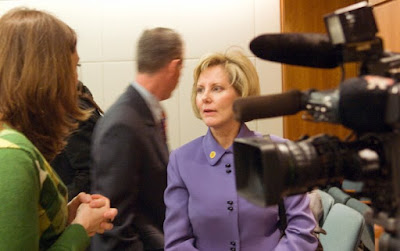

Arnold-Jones described her disappointment with the delay to members of the press, including KRQE's Kaitlin McCarthy, left.
Speaker Luján appointed a House rules subcommittee, with three Democrats and three Republican.
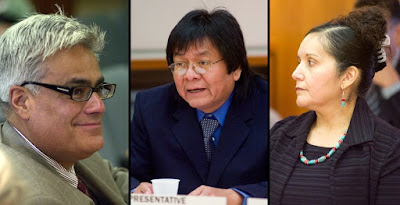
The Democrats, above, are: House Majority Leader Martinez; Reps. Begaye and Debbie Rodella, Rio Arriba, Sandoval and Taos Counties. The Republican subcommittee members, below, are: Reps. Richard Berry, Bernalillo County; Larry Larrañaga, Bernalillo County; and McCoy.
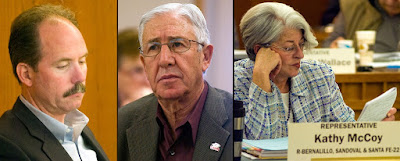
Speaker Luján appointed a House rules subcommittee, with three Democrats and three Republican.

The Democrats, above, are: House Majority Leader Martinez; Reps. Begaye and Debbie Rodella, Rio Arriba, Sandoval and Taos Counties. The Republican subcommittee members, below, are: Reps. Richard Berry, Bernalillo County; Larry Larrañaga, Bernalillo County; and McCoy.

During this debate, several things have happened beyond the legislative control. In addition to KUNM FM’s audio webcasting, the subscription service, New Mexico Legislative Reports, which acts as the legislative record detailing actions and votes from the floor of both chambers is offering audio webstream to its subscribers and is looking into also providing a video link.

Analysis
The C-SPAN Model
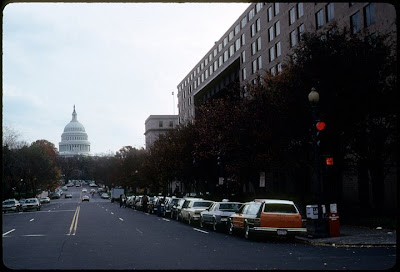 Cable-Satellite Public Affairs Network,housed at the end of this block, is a product of the nations cable operators has been broadcasting the direct coverage provided by the U.S. House of Representatives since 1979 and the Senate in 1986.
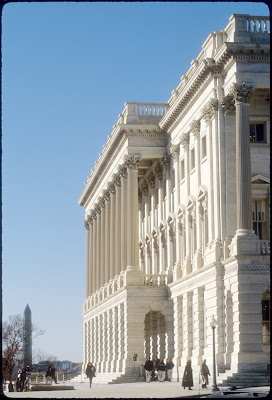
Broadcast Coverage of Congress,” are found under, “Rule V, Clause 1, Broadcasting the House.” The rule specifically outlines procedures to provide “complete and unedited audio and visual broadcasting and recording of the proceedings of the House.”
Though Congress has an exclusive agreement with C-SPAN to air the proceedings in the chambers of the House of Representatives and the Senate, nothing prohibits a State from providing coverage of its events directly through its own website, bypassing commercial outlets.
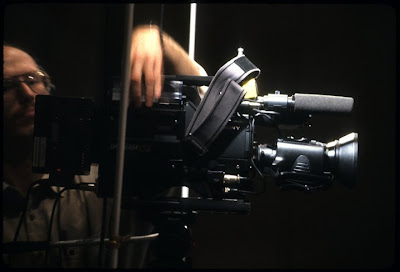 C-SPAN also does it’s own programming which it airs when not showing congressional floor activities.
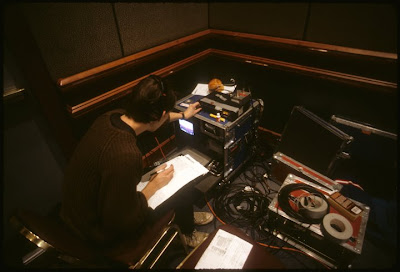 When you watch C-SPAN and see a committee meeting, White House Press conference, lecture, speeches, studio shows with analysis, call ins, or interviews, with the exception of the of the floor coverage; that material is usually produced by C-SPAN and subject to their own copyright.
Analysis
The C-SPAN Model
 Cable-Satellite Public Affairs Network,housed at the end of this block, is a product of the nations cable operators has been broadcasting the direct coverage provided by the U.S. House of Representatives since 1979 and the Senate in 1986.

Though Congress has an exclusive agreement with C-SPAN to air the proceedings in the chambers of the House of Representatives and the Senate, nothing prohibits a State from providing coverage of its events directly through its own website, bypassing commercial outlets.
 C-SPAN also does it’s own programming which it airs when not showing congressional floor activities.
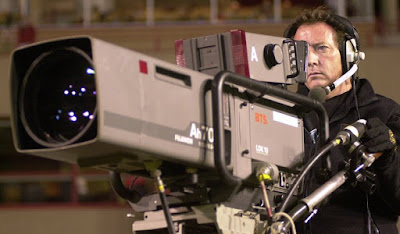
 When you watch C-SPAN and see a committee meeting, White House Press conference, lecture, speeches, studio shows with analysis, call ins, or interviews, with the exception of the of the floor coverage; that material is usually produced by C-SPAN and subject to their own copyright.

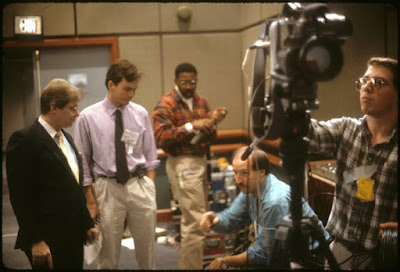
C-SPAN sends out crews, like the one above, to cover a 1989 Ethics in Government conference session moderated by Michael Josephson, left, of the Josephson Institute Center. The same Josephson that MacQuigg dealt with for Character Counts.
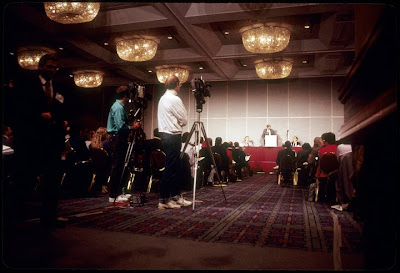

The crew used two cameras to record the event for later playback.
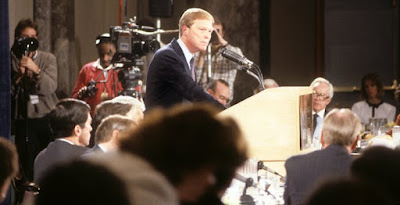

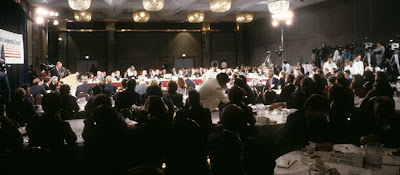
In the same Washington hotel, the same day, the Democratic Leadership Conference was holding a luncheon where Majority Leader of the U.S. House of Representatives Richard Gephardt, of Mo., above, was giving a speech. C-SPAN also had a two-camera crew covering that event. The camera to the left of Gephardt belongs to C-SPAN; the other is on the press riser, below to the right.
 In 30 years, most, if not all the concerns, such as Begaye’s fear, of being caught napping, have been addressed. C-SPAN does not show individual Representatives or Senators who are not addressing their respective bodies.
House rules dictate members behavior in using floor video. The most significant rules are:
 In 30 years, most, if not all the concerns, such as Begaye’s fear, of being caught napping, have been addressed. C-SPAN does not show individual Representatives or Senators who are not addressing their respective bodies.
House rules dictate members behavior in using floor video. The most significant rules are:
c) Coverage made available under this clause, including any recording thereof--In drafting the three rules: non partisan, picture follows sound, and not for political or campaign use, there is an exception to the rule two.
may not be used for any political purpose;
may not be used in any commercial advertisement; and
may not be broadcast with commercial sponsorship except as part of a bona fide news program or public affairs documentary program.

If you’re old enough to remember streaking, it took ABC’s Wide World of Sports and others several years to figure out that naked men running around sporting event grounds was not part of the sport. Sports television quit showing them; they were not news. Neither are hecklers. So the exception is, if a fight breaks out on the floor, like a Tiwanese debate, where their legislative body has been known to erupt in fisticuffs; then the events should be shown. It is a spur of the moment call that must judiciously be made by the technician who is sufficiently aware and informed to make an appropriate editorial decision
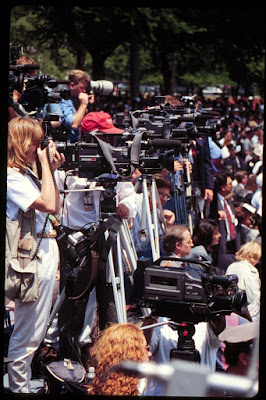

There is a distinction between coverage provided by the government and coverage by a free press. The government’s rules may be applied to their own technicians. However, the First Amendment prohibits government from making and enforcing such rules against a free press.
Rep. Gardner makes his comment and engages Rep. Martinez in a discussion of press rights under the proposed rule. This was the best debate of the day.
Martinez attempts to determine what the press is. He gives an example where he tries to determine that the press is independent. Listen to his story of challenging a person who was documenting a hearing and advocating at the same time.
I asked a person not to videotape, because I asked him, was he here as the press or was he here as an advocate. He said he was the press, then sat down in this chair to argue. I said, now I have a question, are you here to advocate for the bill or here to record it, I said you kind of have to make a decision, because it seems to me that an independent press person would be taking an advocacy position and he said something to the effect, I guess your right and he didn’t say anything and he moved back to videotape again.
Martinez, nor anyone else in government, has the authority to determine who the press is or how they operate. The First Amendment is a prohibition on government. The State’s right is even broader; a person is free to speak, write and publish his sentiments on all subjects. Inherent in the word publish, is the ability to report. Reporting is done through observation, using the five senses and may be augmented by technological devices, like recorders and cameras of all types.
Martinez, using a perverse logic that a person recording a committee meeting had to be the independent press, successfully challenged the man. In his own belief, Martinez had intimidated, bullied or convinced the man that he could not fulfill a dual role.
Note:
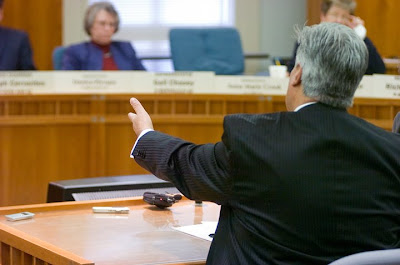
Martinez, has no problem sitting at the witness table with three digital recorders belonging to members of the press in front of him while advocating his rule change before his own committee. Why? Because he also, as a person, as well as a legislator, has the same right to freely speak, write and publish his sentiments on all subjects. It doesn’t matter where you sit or stand.
When Martinez intimidated the advocate he violate four of the six enumerated First Amendment rights: speech, press, assembly or association, and to petition government for redress of a grievance.
There are more publications and communications about issues that attract the general publics' interest than there are, what are commonly referred to as, main stream media outlets. Those who tell the stories or document events are just as protected by the First Amendment as are the more established "journalistic" endeavors.
Begaye’s privacy concern is real to him and to everyone who is in the public eye, but it fails because there is no privacy right in public.
Let me give an example. The following video would never be seen as a webcast under the control of a government. I would normally not run this, except it so aptly demonstrates so many points.
Prior to the start of the House Rules and Order of Business Committee meeting being called to order, while waiting for the arrival of a sufficient number of members to constitute a quorum after the published start time, a little humorous event happened. I was capturing extra video that might be necessary in the editing process to cover broad sweeps of moving from one speaker or to cover an editing of a shortened speech. This extra video is called B-roll and is a routine part of the news story gathering process to cover edits so the picture doesn't jump from one scene to another. Though my original intent was to webcast the committee meeting, one must be prepared for all possible eventualities.
Apparently bored with the wait, Vice Chair Cervantes, started joking. I’ll let the video speak for itself. The participants seen in the video are: Cervantes, Begaye, Salazar and the woman’s voice is Rep. Crook.

Martinez, using a perverse logic that a person recording a committee meeting had to be the independent press, successfully challenged the man. In his own belief, Martinez had intimidated, bullied or convinced the man that he could not fulfill a dual role.
Note:
The State of New Mexico’ Constitutional Bill of Right is equally clear:First Amendment to the U.S. ConstitutionCongress shall make no law respecting the establishment of religion; or prohibiting the free exercise thereof; or abridging the freedom of speech, or of the press; or the right of the people peaceably to assemble, and petition the Government for redress of grievances.
Sec. 17. Freedom of speech and press; libel.
Every person may freely speak, write and publish his sentiments on all subjects, being responsible for the abuse of that right; and no law shall be passed to restrain or abridge the liberty of speech or of the press. In all criminal prosecutions for libels, the truth may be given in evidence to the jury; and if it shall appear to the jury that the matter charged as libelous is true and was published with good motives and for justifiable ends, the party shall be acquitted.

Martinez, has no problem sitting at the witness table with three digital recorders belonging to members of the press in front of him while advocating his rule change before his own committee. Why? Because he also, as a person, as well as a legislator, has the same right to freely speak, write and publish his sentiments on all subjects. It doesn’t matter where you sit or stand.
When Martinez intimidated the advocate he violate four of the six enumerated First Amendment rights: speech, press, assembly or association, and to petition government for redress of a grievance.
There are more publications and communications about issues that attract the general publics' interest than there are, what are commonly referred to as, main stream media outlets. Those who tell the stories or document events are just as protected by the First Amendment as are the more established "journalistic" endeavors.
Begaye’s privacy concern is real to him and to everyone who is in the public eye, but it fails because there is no privacy right in public.
Let me give an example. The following video would never be seen as a webcast under the control of a government. I would normally not run this, except it so aptly demonstrates so many points.
Prior to the start of the House Rules and Order of Business Committee meeting being called to order, while waiting for the arrival of a sufficient number of members to constitute a quorum after the published start time, a little humorous event happened. I was capturing extra video that might be necessary in the editing process to cover broad sweeps of moving from one speaker or to cover an editing of a shortened speech. This extra video is called B-roll and is a routine part of the news story gathering process to cover edits so the picture doesn't jump from one scene to another. Though my original intent was to webcast the committee meeting, one must be prepared for all possible eventualities.
Apparently bored with the wait, Vice Chair Cervantes, started joking. I’ll let the video speak for itself. The participants seen in the video are: Cervantes, Begaye, Salazar and the woman’s voice is Rep. Crook.
A student of psychology might have a field day dissecting that minute or so.
One may see the back room deal expressed openly in the spontaneous utterances of the joke.
One may see the back room deal expressed openly in the spontaneous utterances of the joke.

Is there a weird deference to power? Cervantes, right, says, “Here comes the real chairman.” Salazar laughingly says, “he can’t do that.” Cervantes blames Begaye, saying, He took over; there was a coupe.”
As much as it might seem that the agenda for the meeting was about bolo ties and webcasting, there were some hidden agendas.
The bolo tie question came about because Sen. John Pinto, D, McKinley and San Juan Counties, tried to visit the House chambers, but was denied entry because he was wearing a bolo tie.
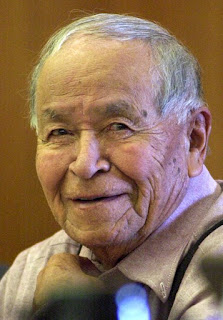 The second hidden agenda item was contained within Rep. Ray Beagaye’s comment about the fear of falling asleep and possibly being shown on a webcast. Beagaye may have been covering again for Pinto, left, who has been known to doze off in the Senate chamber. Pinto has been around since 1977, so he’s pretty much heard it all.
There may have been a third hidden agenda. The House Voters and Elections committee was scheduled to meet, but there was some mutterings from members who sat on both committees of not wanting to attend Voters. Delaying tactics are a common part of the political process and any excuse, good or not, often will do.
Arnold-Jones told the Jan. 31, ConspiracyBrews meeting that she requested the Republicans not attack Begaye’s “sleep” statement in a partisan manner, but the GOP sent House Democrats a basket of coffee with a mug that had a sticker on it, “WAKE UP! Vote Yes on HR-2, Vote yes on transparency. Paid for by the Republicans Party of New Mexico”
Arnold-Jones went on to say that Sen. Pinto was in his 80s and one of only two surviving Navajo code talkers.
I also offer Speaker Lujan’s initial comments on bolo ties.
As much as it might seem that the agenda for the meeting was about bolo ties and webcasting, there were some hidden agendas.
The bolo tie question came about because Sen. John Pinto, D, McKinley and San Juan Counties, tried to visit the House chambers, but was denied entry because he was wearing a bolo tie.
 The second hidden agenda item was contained within Rep. Ray Beagaye’s comment about the fear of falling asleep and possibly being shown on a webcast. Beagaye may have been covering again for Pinto, left, who has been known to doze off in the Senate chamber. Pinto has been around since 1977, so he’s pretty much heard it all.
There may have been a third hidden agenda. The House Voters and Elections committee was scheduled to meet, but there was some mutterings from members who sat on both committees of not wanting to attend Voters. Delaying tactics are a common part of the political process and any excuse, good or not, often will do.
Arnold-Jones told the Jan. 31, ConspiracyBrews meeting that she requested the Republicans not attack Begaye’s “sleep” statement in a partisan manner, but the GOP sent House Democrats a basket of coffee with a mug that had a sticker on it, “WAKE UP! Vote Yes on HR-2, Vote yes on transparency. Paid for by the Republicans Party of New Mexico”
Arnold-Jones went on to say that Sen. Pinto was in his 80s and one of only two surviving Navajo code talkers.
I also offer Speaker Lujan’s initial comments on bolo ties.

In praising Rep. James Roger Madalena, left, D, Bernalillo, Mc Kinnley, Rio Arriba and Sandoval Counties, for bringing the bolo tie issue before the rules committee, instead of being confrontational, Luján took another back handed slap at Arnold-Jones, for not having either; asked permission or informed him of her plan to webcast.
Speaker Luján would later end the 40-minute debate with the simple addition of a few words to the decorum rule to allow wearing bolo ties. His suggestion would be turned into a motion and unanimously accepted.
The conciseness of his motion displayed his experience and wisdom brought to bare; it would have been easy to perceive his action as raw political power, when in fact it was a distillation of all that had been said in the preceding 40-minute debate and earlier discussions.
My Take

With over a thousand bills introduced so far this winter, why would I cherry pick this House Rule?
Openness is the key to any ethics reform. The more the public can see, the better informed they are, the better they can understand, and then the better they can influence their representatives.
Fairness in the process is established when every aspect becomes more open.
The House is now halfway to completion of acceptable and appropriate webcasting; it is now audio feeding from the House floor. It has adopted a pilot project to audiocast from select committee rooms. The House still fails because it has not committed itself to video webcasting or creating an archive.
In spite of Speaker Lujan’s protest, in saying Heath Haussamen suggested that he did not support webcasting after initially attacking Arnold-Jones. Lujan’s actions, or more precisely his inactions, taking only a partial step then claiming to have done the proper thing, is much more telling.
““Funny thing is, I never said he 'personally opposed’" it,”" Haussamen wrote in an e-mail, when informed of Lujan’s statement. “I simply said he had killed it in the past by failing to spend the money that was appropriated to the House to purchase and install the equipment to webcast.”
Haussamen wrote, Jan.22:
Without forcing video webcasting through the House, Luján should rightfully be viewed as an obstructionist in the first step to ethics reform.
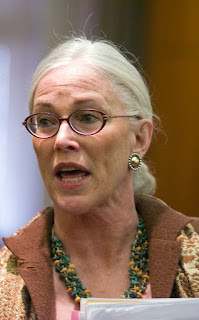 Legislative Council Service Director Paula Tackett was given the responsibility to research webcasting, by the House Rules committee.
In watching her respond to reporters’ questions, you’d think this was an issue that just hit her.
Tackett, right, was responsible, since 2005, for assuring that cameras be installed and operated on the Senate side. To feign ignorance is appalling behavior.
A new Senate Bill, the third introduced since 2005, by Sen. Boitano, is sitting on the Senate desk, meaning it’s not moving.
In defending the Senate committee on committees decision not to broadcast, Tackett told New Mexican’s Terell, “…the cameras won't be wasted. They will be in place when the webcasting starts in the future, she said. And they can be used as security cameras.”

There already are a couple hundred security cameras in the Capitol complex. There is a significant difference in picture quality between broadcast and security cameras.
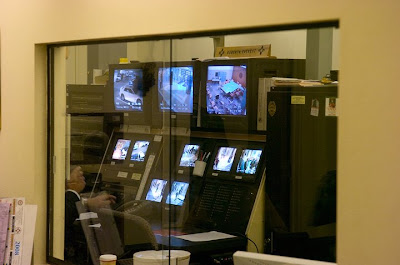 Upon entering the Capitol, citizens are seen on more cameras by security personnel than citizens, for governmental reasons, see legislators.
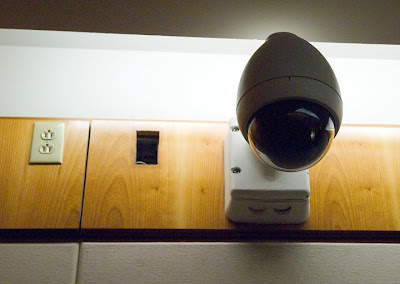 The issue is being blown out of proportion for political power reasons.
Those with legislative or bureaucratic power dread being forced to work in the light. It’s hard to strong arm and horse trade in the open.
Senate Majority Leader Sanchez is opposed to having the conference committee meet in open session.
The conference committee is arguably the most powerful group in the entire legislative body. Their purpose is to meet and work out the differences that occur in the two versions of a piece of legislation as they were passed in the House and the Senate. The conference committee is entrusted and empowered to negotiate a settlement on language. Members have broad latitude in negotiating.
Opponents to opening the conference committee argue that in order to properly negotiate, all ideas must be examined and sometimes something that might sound silly becomes the impetus to a solution. They contend that having the public eye on them inhibits open discussion.
Proponents of opening the committee sessions say that too often the intent of both bodies are changed so drastically that the original ideas are lost and that deals are made that never would have been acceptable to the public at large if they had been done on the floor of the House or Senate.
Sanchez says that if the conference committee sessions are forced open, members will simply meet outside the committee room prior to the convening and secretly agree to the solutions then act in a pro forma role in accepting what was decided without further public debate.
The House authorized audio webstreaming of its body. They are joining KUNM and New Mexico Legislative Report’s efforts. A problem remains; without knowing the voices of the individual legislators, one cannot tell who is speaking. Video streaming would help solve the problem.
In Congress every word in both chambers and at each committee meeting is copied down and published after every working day as the Congressional Record. When a Representative rises to speak they often ask unanimous consent to extend and revise their remarks in the record. A speaker is often limited to a minute, but then allowed a longer time to revise and extend their entire message. Often times research material, supporting data and reports are also included in the Congressional Record.
Unlike the US government, the New Mexico State Legislature does not create its own record. The Legislature keeps a journal and minutes in committees, which are not the same as a word for word record.
When Congress writes a law, a court may review the legislative history to try to determine the intent. A complete record is therefore very helpful. In New Mexico, courts are not permitted to go beyond the plain language of the statute; meaning they must determine from the law what it should mean. Therefore, having a record is of no assistance to the courts because they may not go and look. However, having a record may serve many other social and political purposes.
Video streaming may constitute the second best record, with an audio being third best.
For public consumption there seem to be two extremes; gavel to gavel coverage backed up with an archive to news coverage and accepting what journalists deem to be the important aspect of stories to be brought to their reader, listeners, or viewers.
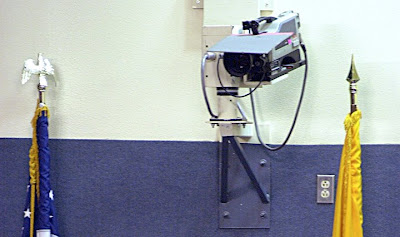
A commercial aspect of the national government’s televised coverage comes in the form of C-SPAN. Cable operators charge a fee from their customers, which goes to supporting C-SPAN and also to fund local public, educational and governmental cable access channels, like, GOV TV – Government Television Cable Channel 16, serving the City of Albuquerque and Bernalillo County. GOV-16 uses wall mounted cameras for live and rebroadcast sessions of: County Commission, City Council, City Ethics Board and Police Oversight Commission, among other meetings.
For those interested in attending ConspiracyBrews, here's how the invitation reads:
Openness is the key to any ethics reform. The more the public can see, the better informed they are, the better they can understand, and then the better they can influence their representatives.
Fairness in the process is established when every aspect becomes more open.
The House is now halfway to completion of acceptable and appropriate webcasting; it is now audio feeding from the House floor. It has adopted a pilot project to audiocast from select committee rooms. The House still fails because it has not committed itself to video webcasting or creating an archive.
In spite of Speaker Lujan’s protest, in saying Heath Haussamen suggested that he did not support webcasting after initially attacking Arnold-Jones. Lujan’s actions, or more precisely his inactions, taking only a partial step then claiming to have done the proper thing, is much more telling.
““Funny thing is, I never said he 'personally opposed’" it,”" Haussamen wrote in an e-mail, when informed of Lujan’s statement. “I simply said he had killed it in the past by failing to spend the money that was appropriated to the House to purchase and install the equipment to webcast.”
Haussamen wrote, Jan.22:
Luján's comment that he was surprised by Arnold-Jones' webcasting is highly questionable, especially if he was aware of of Haussamen's earlier posting.The only remaining question is whether legislative leaders, including House Speaker Ben Luján, will try to stop her.
Luján hasn’t returned a phone call seeking comment, but it’s no secret that he and other legislative leaders have killed attempts to begin webcasting from the House and Senate floors for years. The Legislature appropriated $75,000 in 2005 to purchase and install the equipment necessary to webcast, but neither chamber has ever appropriated the minimal funding that would be required to operate the equipment.
Without forcing video webcasting through the House, Luján should rightfully be viewed as an obstructionist in the first step to ethics reform.
 Legislative Council Service Director Paula Tackett was given the responsibility to research webcasting, by the House Rules committee.
In watching her respond to reporters’ questions, you’d think this was an issue that just hit her.
Tackett, right, was responsible, since 2005, for assuring that cameras be installed and operated on the Senate side. To feign ignorance is appalling behavior.
A new Senate Bill, the third introduced since 2005, by Sen. Boitano, is sitting on the Senate desk, meaning it’s not moving.
In defending the Senate committee on committees decision not to broadcast, Tackett told New Mexican’s Terell, “…the cameras won't be wasted. They will be in place when the webcasting starts in the future, she said. And they can be used as security cameras.”

There already are a couple hundred security cameras in the Capitol complex. There is a significant difference in picture quality between broadcast and security cameras.
 Upon entering the Capitol, citizens are seen on more cameras by security personnel than citizens, for governmental reasons, see legislators.
 The issue is being blown out of proportion for political power reasons.
Those with legislative or bureaucratic power dread being forced to work in the light. It’s hard to strong arm and horse trade in the open.
Senate Majority Leader Sanchez is opposed to having the conference committee meet in open session.
The conference committee is arguably the most powerful group in the entire legislative body. Their purpose is to meet and work out the differences that occur in the two versions of a piece of legislation as they were passed in the House and the Senate. The conference committee is entrusted and empowered to negotiate a settlement on language. Members have broad latitude in negotiating.
Opponents to opening the conference committee argue that in order to properly negotiate, all ideas must be examined and sometimes something that might sound silly becomes the impetus to a solution. They contend that having the public eye on them inhibits open discussion.
Proponents of opening the committee sessions say that too often the intent of both bodies are changed so drastically that the original ideas are lost and that deals are made that never would have been acceptable to the public at large if they had been done on the floor of the House or Senate.
Sanchez says that if the conference committee sessions are forced open, members will simply meet outside the committee room prior to the convening and secretly agree to the solutions then act in a pro forma role in accepting what was decided without further public debate.
The House authorized audio webstreaming of its body. They are joining KUNM and New Mexico Legislative Report’s efforts. A problem remains; without knowing the voices of the individual legislators, one cannot tell who is speaking. Video streaming would help solve the problem.
In Congress every word in both chambers and at each committee meeting is copied down and published after every working day as the Congressional Record. When a Representative rises to speak they often ask unanimous consent to extend and revise their remarks in the record. A speaker is often limited to a minute, but then allowed a longer time to revise and extend their entire message. Often times research material, supporting data and reports are also included in the Congressional Record.
Unlike the US government, the New Mexico State Legislature does not create its own record. The Legislature keeps a journal and minutes in committees, which are not the same as a word for word record.
When Congress writes a law, a court may review the legislative history to try to determine the intent. A complete record is therefore very helpful. In New Mexico, courts are not permitted to go beyond the plain language of the statute; meaning they must determine from the law what it should mean. Therefore, having a record is of no assistance to the courts because they may not go and look. However, having a record may serve many other social and political purposes.
Video streaming may constitute the second best record, with an audio being third best.
For public consumption there seem to be two extremes; gavel to gavel coverage backed up with an archive to news coverage and accepting what journalists deem to be the important aspect of stories to be brought to their reader, listeners, or viewers.
A commercial aspect of the national government’s televised coverage comes in the form of C-SPAN. Cable operators charge a fee from their customers, which goes to supporting C-SPAN and also to fund local public, educational and governmental cable access channels, like, GOV TV – Government Television Cable Channel 16, serving the City of Albuquerque and Bernalillo County. GOV-16 uses wall mounted cameras for live and rebroadcast sessions of: County Commission, City Council, City Ethics Board and Police Oversight Commission, among other meetings.

The local franchising authority normally controls public, educational and governmental cable access channels, also known as PEGs.
In the State of Texas, there is a bi-partisan move afoot from 97 members to create a statewide, C-SPAN like outlet.
There is no reason why, during our State’s Legislative sessions and for interim committee meetings, the cable franchises, statewide, couldn’t be compelled to air the State government in action.
The rallying cry is transparency, but that’s not quit accurate. The system is, for the most part, transparent by being open to the public. What is actually being called for is accessibility through a more convenient method.
There is another issue that some believe is critical, though it might not be; that is archiving. The congressional record is kept forever. Of course its storage is the primary reason for the Library of Congress.
Some can make the argument that archiving all state webcasts forever is overkill. The state does have a records retentions act that provides a timetable for purging documents.
Many agencies covered by this act already don’t always follow it. Maybe this discussion will bring to light such deficiencies.
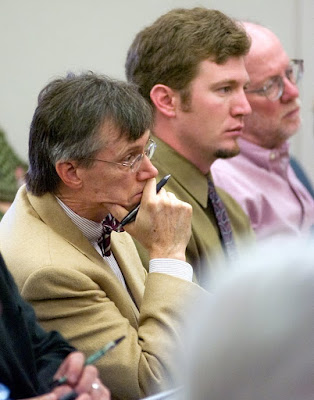 The press, here represented by: New Mexico's Associated Press Bureau Chief and Writer Barry Massey, should always have access to cover, including availability to adequate sound and unobstructed sight lines to provide independent views of the government at work.
One does not have to be reinvent the wheel. The US Senate and House have come up with rules on photographers in committee meetings; they are a little looser than what seems to be practiced in Santa Fe.
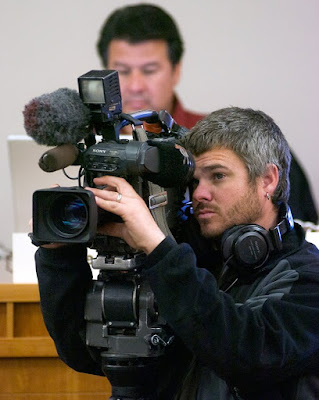 Though unobtrusiveness tends to be the guide for most photographers; some will cross over and have not been challenged.
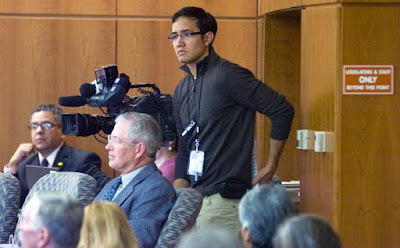 Here, KOB TV's Gadi Schwartz passed the "Legislators & Staff ONLY Beyond This Point" sign to get his shot at the Dec. 8, 2008 Legislative Finance Committee meeting; no one complained.
Final thoughts
Technology has changed since the 1973 Senate Watergate hearings, where New Mexico Sen. Joseph Montoya sat as the junior committeeman to the details of the break in at the National Democratic Party Headquarters in the Watergate complex, below.
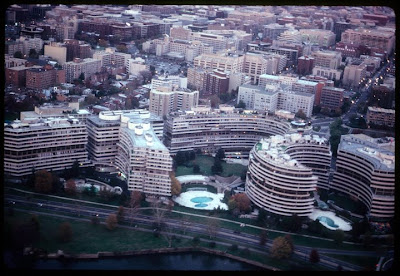 Watergate was not the first Congressional hearing to be televised, but it led to the resignation of President Richard Nixon. The public's ability to watch changed a lot of minds.
Today’s technology allows cameras to be less expensive. They are: smaller, more powerful, they operate with less light, and producer higher quality pictures than ever before.
As to the accusation that putting legislative activities on camera will encourage grandstanding; nothing stops legislators from grandstanding now.
Rookie U.S. Congressman Ben R. Luján, Jr. was on C-SPAN a week or so ago with a well prepared, perfectly timed, one minute speech, his first official public utterance from the floor; no grandstanding. Several local blogs: Monahan, Democracy for New Mexico, and NMFBIHOP offered his video:
One might argue that the recent postings of C-SPAN fed House controlled videos might violate the House rules when posted on what are clearly and unabashedly partisan Democratic blog sites; but I won’t. It looks political, but I doubt it violates the spirit of rule as it is also, and probably more accurately of public interest, thereby news.
To those who fear they maybe shown picking their nose, I offer what my Dad taught me; when wearing a suit, carry three handkerchiefs: one for show in the chest pocket, one for yourself, and one for the lady. You don’t have to know who the lady is when you put it in your pocket; you just have to be prepared.
If this State is serious about ridding itself of corruption, the first step is openness.
Anytime you hear anyone make an exception, excuse, or argues against openness consider them an ally of corruption. Don’t allow an advocate for a closed process to say another word until they correct themselves. Unlike the claims of the federal government, the State of New Mexico has no national security interest that must be heard in closed session. There is nothing that every citizen can’t hear.
“Sunshine is the best disinfectant,” Associate Supreme Court Justice Louis Brandeis said. The legislature has exempted itself from the requirements of the Open Meetings Act.
“The most important political office is that of the private citizen,” Brandeis also said.
Rep Heaton got it right, legislators work for us, the private citizen and we should watch carefully what they do.
Arnold-Jones experiment is a proof of concept. Anything short of a C-SPAN quality effort in both the House and Senate is proof of the most basic form of obfuscation for a corrupt purpose, the intentional deception of the public by keeping them ignorant.
In the State of Texas, there is a bi-partisan move afoot from 97 members to create a statewide, C-SPAN like outlet.
There is no reason why, during our State’s Legislative sessions and for interim committee meetings, the cable franchises, statewide, couldn’t be compelled to air the State government in action.
The rallying cry is transparency, but that’s not quit accurate. The system is, for the most part, transparent by being open to the public. What is actually being called for is accessibility through a more convenient method.
There is another issue that some believe is critical, though it might not be; that is archiving. The congressional record is kept forever. Of course its storage is the primary reason for the Library of Congress.
Some can make the argument that archiving all state webcasts forever is overkill. The state does have a records retentions act that provides a timetable for purging documents.
Many agencies covered by this act already don’t always follow it. Maybe this discussion will bring to light such deficiencies.
 The press, here represented by: New Mexico's Associated Press Bureau Chief and Writer Barry Massey, should always have access to cover, including availability to adequate sound and unobstructed sight lines to provide independent views of the government at work.
One does not have to be reinvent the wheel. The US Senate and House have come up with rules on photographers in committee meetings; they are a little looser than what seems to be practiced in Santa Fe.
 Though unobtrusiveness tends to be the guide for most photographers; some will cross over and have not been challenged.
 Here, KOB TV's Gadi Schwartz passed the "Legislators & Staff ONLY Beyond This Point" sign to get his shot at the Dec. 8, 2008 Legislative Finance Committee meeting; no one complained.
Final thoughts
Technology has changed since the 1973 Senate Watergate hearings, where New Mexico Sen. Joseph Montoya sat as the junior committeeman to the details of the break in at the National Democratic Party Headquarters in the Watergate complex, below.
 Watergate was not the first Congressional hearing to be televised, but it led to the resignation of President Richard Nixon. The public's ability to watch changed a lot of minds.
Today’s technology allows cameras to be less expensive. They are: smaller, more powerful, they operate with less light, and producer higher quality pictures than ever before.
As to the accusation that putting legislative activities on camera will encourage grandstanding; nothing stops legislators from grandstanding now.
Rookie U.S. Congressman Ben R. Luján, Jr. was on C-SPAN a week or so ago with a well prepared, perfectly timed, one minute speech, his first official public utterance from the floor; no grandstanding. Several local blogs: Monahan, Democracy for New Mexico, and NMFBIHOP offered his video:
One might argue that the recent postings of C-SPAN fed House controlled videos might violate the House rules when posted on what are clearly and unabashedly partisan Democratic blog sites; but I won’t. It looks political, but I doubt it violates the spirit of rule as it is also, and probably more accurately of public interest, thereby news.
To those who fear they maybe shown picking their nose, I offer what my Dad taught me; when wearing a suit, carry three handkerchiefs: one for show in the chest pocket, one for yourself, and one for the lady. You don’t have to know who the lady is when you put it in your pocket; you just have to be prepared.
If this State is serious about ridding itself of corruption, the first step is openness.
Anytime you hear anyone make an exception, excuse, or argues against openness consider them an ally of corruption. Don’t allow an advocate for a closed process to say another word until they correct themselves. Unlike the claims of the federal government, the State of New Mexico has no national security interest that must be heard in closed session. There is nothing that every citizen can’t hear.
“Sunshine is the best disinfectant,” Associate Supreme Court Justice Louis Brandeis said. The legislature has exempted itself from the requirements of the Open Meetings Act.
“The most important political office is that of the private citizen,” Brandeis also said.
Rep Heaton got it right, legislators work for us, the private citizen and we should watch carefully what they do.
Arnold-Jones experiment is a proof of concept. Anything short of a C-SPAN quality effort in both the House and Senate is proof of the most basic form of obfuscation for a corrupt purpose, the intentional deception of the public by keeping them ignorant.
For those interested in attending ConspiracyBrews, here's how the invitation reads:Rep. Janice E. Arnold-Jones · House District 24Invites You ToSaturday Morning Office Hours9:00 AM - 10:30 AMat Southwest Secondary Learning Center10301 Candelaria Rd NE(northwest corner at the intersection of Candelaria and Morris)(Questions? Call Janice -- 379-0902)--All Republicans, Democrats, Independents, Libertarians, Greens and others are welcome at all times.--


