Tuesday, July 25, 2006

Mayor Calling for Conflict of Interest Reform???

What’s wrong with this picture?

The Albuquerque Journal’s city hall Staff Writer Jim Ludwick wrote that the Mayor wants the ethics reform bills, now before city council, to contain strict conflicts of interest restrictions.

Hooray! I applaud him!! Just a second!!! I don’t see where the mayor is willing to have those conflicts of interest restrictions apply also to him….

Ludwick suggests that there is a battle brewing between Mayor Martin Chávez, left and Councillor Brad Winter, an Albuquerque Public Schools employee, over the mayor’s efforts to take control of the school system.

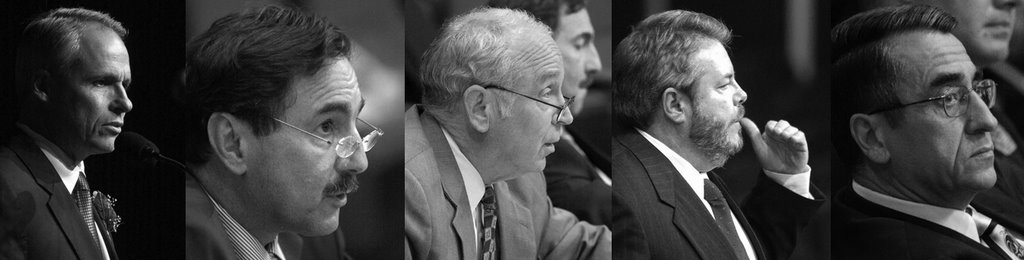
Chávez defeated Winter in last year’s mayoral race. At the beginning of the mayor’s 2001 term, his now Chief Administrative Officer Bruce Perlman, below, was then treasurer of Chávez’ campaign and he continued to gather money forming ABQPAC, “as a neat and nifty way to,” funnel money to Chávez for personal expenses.

Chávez and the ABQPAC were charged and found to have violated several sections of the city charter’s ethics rules.

Chávez received a public reprimand and returned some $69,000 to the ABQPAC. Clearly the ABQPAC was conducting illegal activities, though the Attorney General refused to look into the matter and the District Attorney failed to take jurisdiction.

Current Councilor Ken Sanchez also received a campaign contribution in his unsuccessful bid in the Democratic primary for New Mexico State Treasurer.

Ludwick quoted Perlman, about adding to the existing ethics proposals saying, “It's a big concern of the mayor. It also is a big concern of some of the councilors."

The city council has a long history of councillors working for other government agencies outside of the city while serving and voting on issues concerning conflicts of employers, family or personal interests without so much as publicly disclosing their connections during the particular debate.
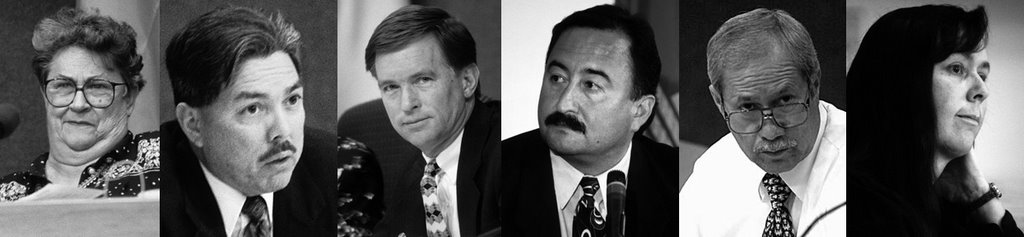
Councillors Ruth Adams, Alan Armijo, Michael Brasher, Steve Gallegos Vince Griego and Angela Robbins.

This is not an exhaustive list, but during two terms, the 11th and 12th councils from 1994-97, Councillors Alan Armijo, Michael Brasher and Angela Robbins were all employees of APS. Armijo lobbied for the schools at the state legislature. Brasher’s wife also worked for the city. Vince Griego worked for Bernalillo County and had several sons on the city’s payroll. Steve Gallegos was sergeant at arms for the State Senate.

I always thought that such cross-governmental relationships were conflicts of interest.

The most brazen conflict of interest on the council I ever saw displayed was by Ruth Adams. There was a discussion about a zoning waiver on a particular downtown city block. A citizen was testifying about a particular apartment building and he indicated a certain number of units in the building. Adams questioned him about how he had determined the number. He responded that he had counted the mailboxes. Adams told him he was wrong, He asked how she knew he was wrong and asked what the right number was because he wanted to be precise in his testimony. Adams said the number of units was two higher than he said and she knew because she owned the building.

The council dais was thrown into nothing less than a dither. The following discussion of the council gave a fascinating insight to how that particular term viewed conflicts of interest. Adams never perceived herself to be subject to any conflict and didn’t recognize it until it bit her and then she was shocked and surprised when her fellow councillors voted her to be in conflict. She left protesting that she still had the right to vote.

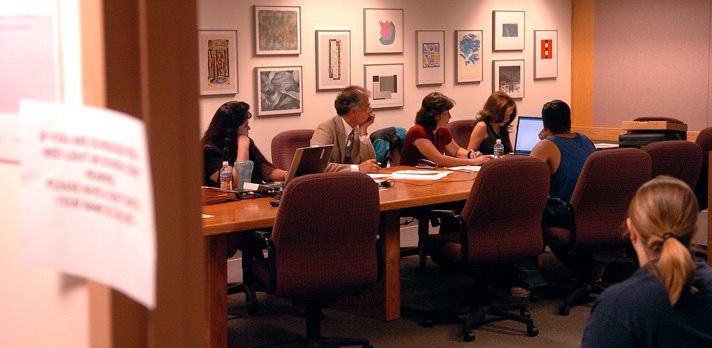
Here is Ruth Adams, after leaving the council with Sally Davis of Common Cause monitoring the Chávez-ABQPAC ethics board hearings. Common Cause was one of three complainants who filed charges of ethics violations of Chávez and the ABQPAC. Davis is now a council recommended member of the city’s ethics board.

Let’s not forget those who have potential conflicts of interest who sit on the current council.

The aforementioned APS link with Winter and Sally Mayer’s association with real estate and developers are examples. There are other considerations that many might try to dismiss having to do with councillors’ past associations with the city; Issac Benton’s architecture firm formerly being under contract; Don Harris having been an assistant city attorney and Loy having retired as a captain from the police department.

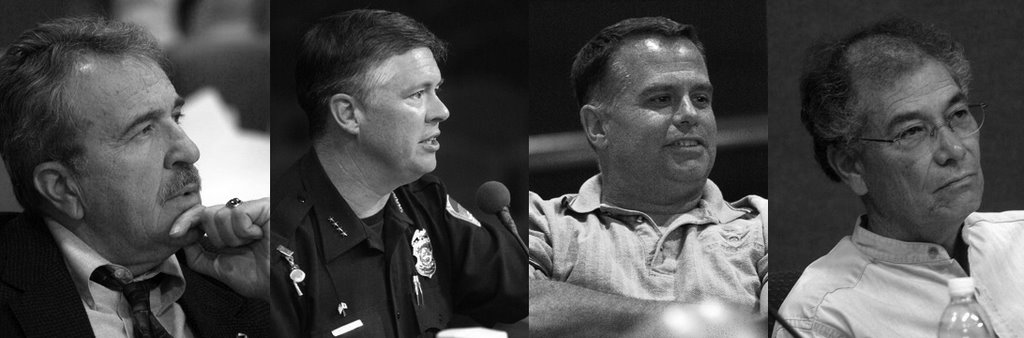
Councillor Michael Cadigan, left, should be singled out as frequently recusing himself from participation from matters where he, as an attorney or his firm, represents an interest that is or might give the appearance of being in conflict. This should be to his credit by removing himself, but it raises a question. If he has to recuse himself so often for potential conflicts, is he too close to begin with?

Councillor Craig Loy’s amendment reads;
“No member of the City Council shall… During their term of office participate in any debate or vote on any matter which will likely result in any benefit to the member which benefit is greater than the benefit to the public in general. A benefit for purposes of this paragraph shall mean a financial benefit or a benefit conferred by the City Council member’s employer as a direct result of the member’s participation in the matter.”

The mayor is not similarly constrained in such a way by the current proposed bills. He is only required to disclose any possible conflicts of interest by association with a campaign contributor when he recommends that person who has applied for a professional/technical services contract in excess of $55,000, when they are other than the top recommended offeror. The requirement to disclose is only limited to one and a half years after the contribution.

This neither provides full disclosure nor maintains a degree of political balance. By shifting the balance of political power towards the mayor and eliminating councillors participation in a debate or vote where there is a conflict, this does not hold the mayor to the same standard of disclosure.

At the right is Councillor Loy, whose amendment is possibly a step in the right direction. However, its implementation without the inclusion of the mayor to equal prohibitions will make matters worse, not better.

Ethics is a fine line. Determining campaign contributor and employer conflicts of interest can get tricky.

What is sorely lacking from all these proposals is any meaningful commitment to ethics in our community!

The Cub Scouts have a better ethics handbook than does the City of Albuquerque; and they teach it.

What is needed are serious discussions before drafting a comprehensive piece of legislation with accurate definitions, concise and precise prohibitions, guidance and an educational component for all elected officials, appointed committee members, city staff and employees at every level. A system of ethics counselors or ombudsmen that encourage all to determine, clarify and resolve ethical questions without threatening employees with punishment for seeking to do the right thing in exposing mischief, errors, inappropriate political influence, wrongdoing, corruption or illegality.

It’s time to scrap this knee-jerk reactionary approach to ethics reform that the city repeatedly engages in. Start from scratch with a diverse group of citizens and a few politicians to accurately study ethics, to find the best examples of programs around the country that work effectively. Take the burden off those who may be tempted by their elected and appointed positions to manipulate the rules to create personal and political advantages, loopholes, exceptions and privileges that can be exploited against the public good. Put the matter to a public vote so the people determine how their officials and employees should behave.

You do know what the difference is between the Cub Scouts and the City of Albuquerque? The Scouts have adult leadership!

Sunday, July 23, 2006

Down the Drain!

What's wrong with this picture?


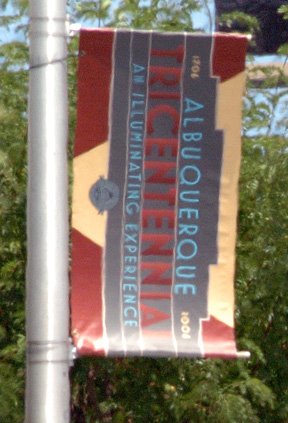
Happy Tri-Centennial!

The City renamed Tiguex Park just east of Old Town to Tiguex Tricentennial Park.

During the city council debate about the placement of the controversial Juan de Oñate statues at Tiguex Park, several Native American speakers told the story of the Tiguex pueblo. The story goes that when Oñate arrived in what is now New Mexico, in 1598, a pueblo was flourishing in the region. Twelve years later, when the pueblo revolt ran Oñate out of New Mexico, the people of Tiguex had vanished.

You see banners and logos everywhere. I’m not a party pooper, but are we taking this a bit too far?

Did you know there is an official online store at the City of Albuquerque governmental website? I thought government was about providing services in exchange for tax dollars and actual fees.

So why is there an Albuquerque City Store on the tax paid website? The store is an internal link to a city vendor, Zia Graphics, a local screen graphics store on Carlisle N.E. http://www.albuquerquecitystore.com/. Enough of a free plug for them.

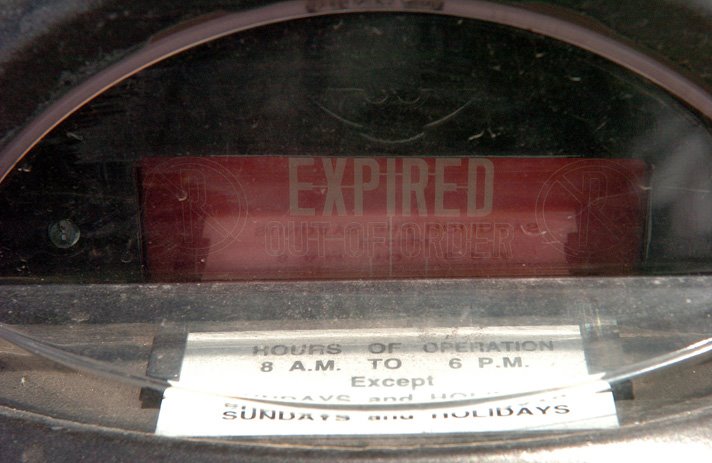
They sell T-shirts, caps, mugs, patches, pins and souvenirs of all shapes and manner. You can even buy an old parking meter. The tricentennial logo is a hot item.

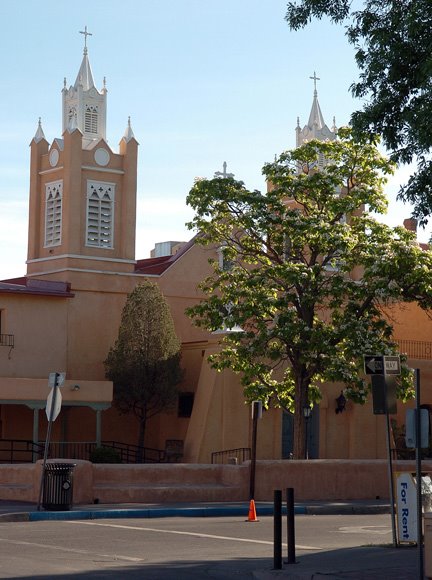
Three hundred-years ago, Spanish settlers built the first church where the San Felipe de Neri Parish church now stands in Old Town. Since then, Albuquerque has had several flags fly over it as displayed on the plaza across from the church.


From the left are; the Spanish, Mexican, United States of America, New Mexico and Confederate States of America’s flags.

Mayor Martin Chávez has made the Tricentennial Celebration a major occurrence for the city with parades, parties, art and cultural events. Though there is a token recognition of Native American arts, the focus of the year and a half long party is the domination of the landscape by mostly Europeans, specifically Spanish Conquistadors over the local indigenous people.


Why is the logo associated with waste, as it appears here on a public trash receptacle?

So what's wrong with this picture?

The domination of one people, celebrated over another people, from the same community, stinks.

I guess that’s why the tricentennial logo is on the “sanitary” manhole cover. In other words, it covers the sewer.

Why is He Here?

What's wrong with this picture?

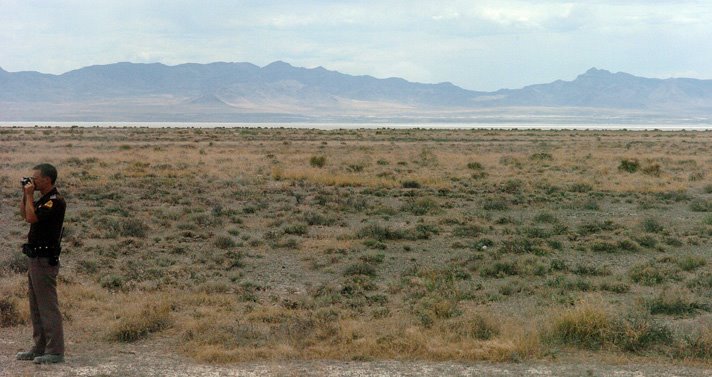
Here is a picture of Utah just east of the Nevada State line on US 50. It is known as "the loneliest route in America," with good reason.

The reason you haven't read anything here lately is because I was on an extended road trip around the Southwest.

So why is a Utah Highway Patrol officer standing in my vista shot?

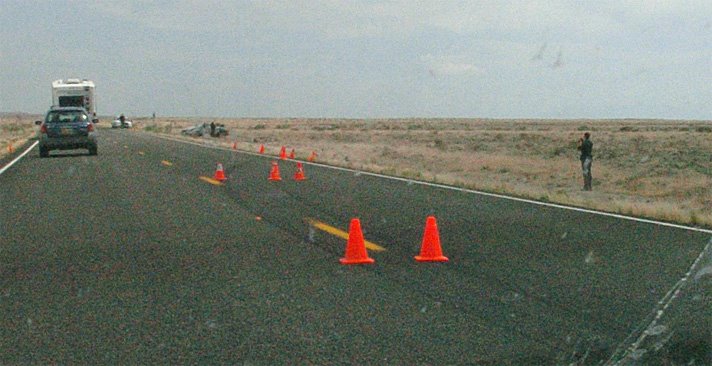
He was investigating a one-car rollover pickup truck accident.

It was 12:20 pm. It appeared that the accident may have occurred under the cover of darkness and no one noticed it until first light. These kinds of accidents happen with some degree of regularity in the West where the closest town may be more than 80 miles away.

There were three officers and a sergeant at this scene. It must have taken them a couple of hours for all of them to arrive, even running full speed, with lights and sirens.

There were a couple of heavy skid marks that swerved off the road. I could not tell what the cause of the accident was; whether the driver swerved to avoid wildlife or livestock on the road or if it was falling asleep, awakening and finding themselves heading into the opposing lane then over-correcting and driving off the pavement and subsequently rolling over. Result, it was a bad accident.

Utah is one of the few states that openly admits to the problems of drowsy drivers and encourages them to do something about it.

Tuesday, July 04, 2006

Fourth of July and Flags

What's wrong with this picture?

OK, I’ve eaten my hot dogs and engaged in my annual self-imposed ritual of reading the Declaration of Independence; I read the Constitution on New Years day. Now I can go on and listen to the illegal fireworks in the neighborhood. It seems that every neighborhood has its own bad boy pyrotechnic freak. At least mine doesn’t fire guns.

I got to thinking about the flag and the meaning of the Declaration, the Constitution and the Bill of Rights. This past week the Senate failed to approve a flag-burning amendment by a single vote.

I don’t have a problem with the act of flag burning as a political protest. Read “Flag” at theblueflyer.com. I have problems with a protester stealing someone else’s flag. I have problems with a protester burning the flag when it constitutes disorderly conduct by starting a fistfight. I just don’t have a problem with it being a demonstration of an act of free speech.

I have a bigger problem with those who profess their support for the flag and at the same time disrespect it.

There is a congressionally approved flag code. It carries no criminal penalties, yet it sets out proper conduct regarding the flag.

The code dictates that it shall not, among other things, be used in advertising, or worn as clothing, or that it should be flown at night unlit, nor be displayed soiled.

So what's wrong with this picture?


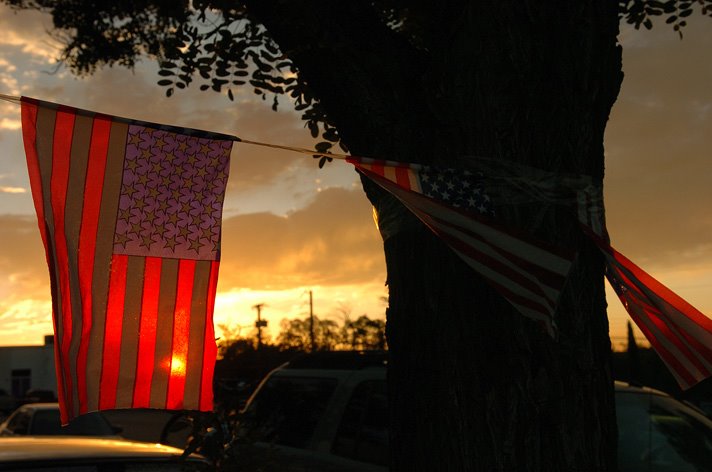
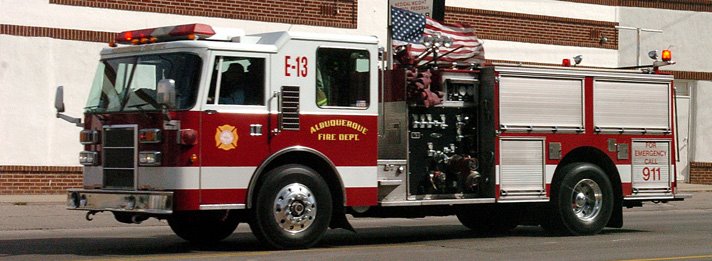
Albuquerque Fire Department’s Engine 13 flies an American flag night and day. It is dirty and frayed.

According to the code this display violates the code's requirements:

"When the flag is displayed on a motorcar, the staff shall be fixed firmly to the chassis or clamped to the right fender.

The flag, when it is in such condition that it is no longer a fitting emblem for display, should be destroyed in a dignified way, preferably by burning."

The hypocrisy of claiming to respect the flag by flying it improperly is as disrespectful as burning it in protest.

Sunday, July 02, 2006

Break! Zoom!! Click!!!

What's wrong with this picture?

The United States Air Force’s precision performance flying team, the Thunderbirds start their signature final maneuver, the “starburst” on the command of their flight leader. Flying identical F-16’s, Saturday afternoon over Kirtland Air Base, Lead Pilot Lt. Col. Kevin J. Robbins in the number one airplane barks, “Break!”

Pilot of the number three right-wing position, Maj. Nicole Malachowski, raises the left wing to start her move to the right. Maj. Scottie Zamzow, pilot of number two left-wing position, is a split-second late breaking to his left. If it weren’t for the high-speed nature of this photograph, the faux-pa was otherwise imperceptible.

Flying in the number four slot position below and behind the lead in the diamond formation is Maj. Steve Horton. He is followed by Lead Solo Pilot Maj. Brian Farrar in number five. Farrar spends so much time upside down during the show that the number five is inverted on the side of his aircraft. Opposing Solo Pilot Maj. Ed Casey in number six followed well behind to spiral upwards through the “starburst.”


Casey is shown here landing.

So what's wrong with this picture?

I have to admit that this is simply flying envy. They also get paid to fly fast! It has to be the ultimate flying “dream job.” I’m sure the recruiting tent did a brisk business.

Since first seeing the Thunderbirds when my dad took us to his Amarillo Air Force Base Headquarters office building in the early 60s, when they were flying F-100 Super Sabres, through the F-4 Phantoms, the T-38A Talons and now the F-16 Fighting Falcon, “electric jets,” they have always put on a jaw-dropping show. WOW!

Saturday, July 01, 2006

Scattered Thoughts and Thunder Showers

What's wrong with this picture?

This little boy, in front of the National Hispanic Cultural Center of New Mexico, covers his head as he unsuccessfully tries to protect himself from what looks like a famous New Mexico six-inch rain; a rain drop every six-inches.

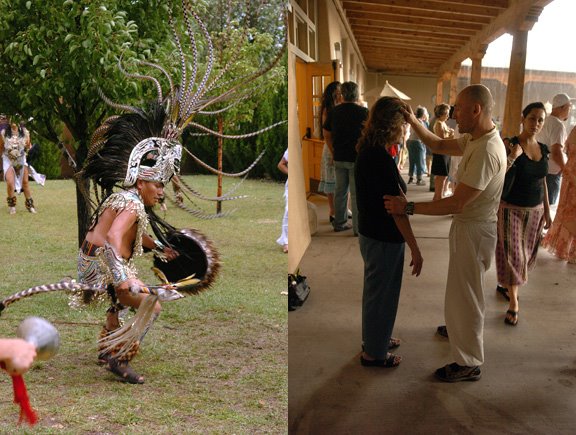
The activity Thursday evening was a demonstration and performance of healing sessions by curanderas and other traditional healers.

The rains came! It was the same cloudburst that hit the airport and the National Weather Services’ official rain gauge, which recorded 0.74 inches in less than an hour and a half. That more than doubled the amount of rain to date this year.

The center is a beautiful, relatively new facility, dedicated to education, preservation, research and showcase of traditional and contemporary forms of cultural arts, crafts, music, humanities and other interpretive aspects of social life.

It has an impressive list of supporters whose names are attached to their funded projects. They range from; the Intel Center for Technology and Visual Arts, to the Roy E. Disney Center for Performing Arts, to the Bill & Melinda Gates Foundation gallery, to the Albuquerque Journal theater and the Pete V. Domenici Education Building. Other major contributors include Sandia/Lockeed.

The facility is now slightly troubled. It has had six executive directors in its six-year history. The director of the visual arts program was recently forced to leave. Now it seems that three quarters of the visual presentation staff has left.

Part time contractors have filled the void and new permanent staff will be hired this month.

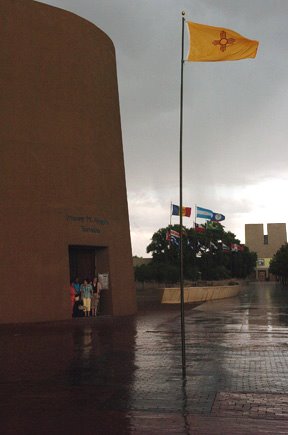
There are little indications of problems. This is part of the row of national flags honoring countries in front of the center just south of downtown Albuquerque.

Note the flags in clockwise order from the top; Paraguay, Peru, Philippines Portugal, Argentina and Venezuela. Besides already being tattered, in the first gust before the rain, they indicate a loss of direction.

Look at the green and red Portuguese flag which has a heraldic shield in the center surrounded by gold straps and ring. It has been metaphorically described to represent a compass rose in honor of their adventurous seafaring tradition.

So what's wrong with the picture? The flag is upside down.

Despite the rain, a troupe of Aztec dancers danced and the healers healed through it all.

Though a bit tattered and temporarily losing its direction, like the cleansing rain and the healing, I am sure the center will also just dance through it all. A new set of flags should help make it all better.

Friday, June 30, 2006

Ugliest Thing I Ever Saw!

What's wrong with this picture?

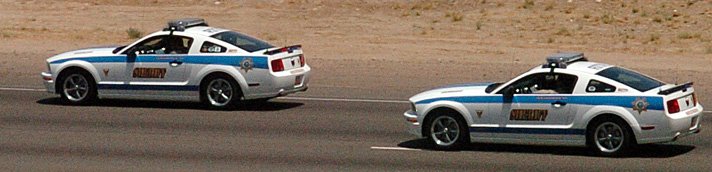
Sheriff Darren White ordered a new paint scheme for the Bernalillo County Sheriff’s Department’s marked units.

He said he wanted feedback on what the deputies thought. Here are two of the current Sheriff’s Traffic units. No, I’m not a deputy, only a resident. I am not an art critic, having dropped out of an art history class when I had a personal crisis.

But I’m going to borrow a quote from President Lyndon B. Johnson who said of his official portrait, painted by famous New Mexico artist Peter Hurd; “That’s the ugliest thing I ever saw!"

As police cars go, in my opinion, Johnson got it right.

White thinks that the California Zebra car is the epitome of police car styling.

It’s time for the Sheriff to head west.

Now it’s true that every Sheriff wants to leave his mark on the public. This one is best demonstrated by the yellow streak down the car. The public may view this as the big dog hiking his leg or misperceive it as a sign of cowardice.

For what its worth, I’m voting for keeping the classy blue and white over the butt ugly…

Sunday, June 25, 2006

STOP This Nonsense

What's wrong with this picture?

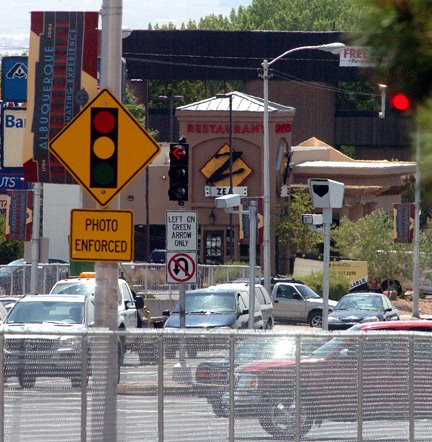
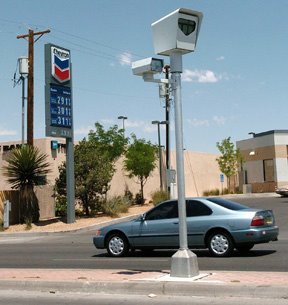
This is a photo red light camera at Montgomery and San Mateo Boulevards.

It was the first of five intersections where red light cameras have been installed. The other locations are Montgomery and Eubank Boulevards, Eubank and Lomas Boulevards, Paseo Del Norte and Coors Boulevards, and at Montgomery and Wyoming Boulevards.

A single van with a photo radar camera recorded more than 2,000 speeding violations in school zones in a four-month period prior to school recessing for the summer. The city is now obtaining two more and expanded their use from just school zones to anywhere in the city.

Mayor Martin Chávez claims in a Journal article that the use of red light cameras is all about public safety.

So what's wrong with this picture?

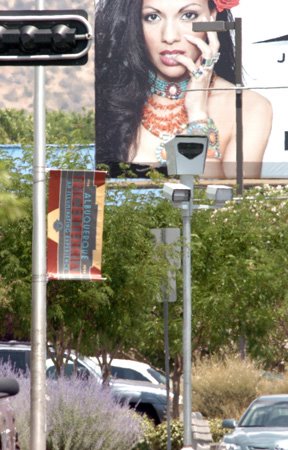
Big Sister, Big Brother. This bejeweled woman on a billboard for a local jewelry manufacturer appears apprehensive as she looks over the city’s pole-mounted photo red light camera array at the intersection of Montgomery and Wyoming.

“We the People” is the basis of our form of government. It is not just the rules that we follow but a philosophy we maintain.

Where are the people; the people of the government?

The United States Constitution divides our form of government into three branches: legislative, executive and judicial. The State of New Mexico has its own Constitution that mirrors the federal Constitution. The state also has provided for municipal home rule. It allows Albuquerque to form a government, within certain limitations, by adopting a charter. The charter and city ordinances may not exceed either the federal or state constitutional limits.

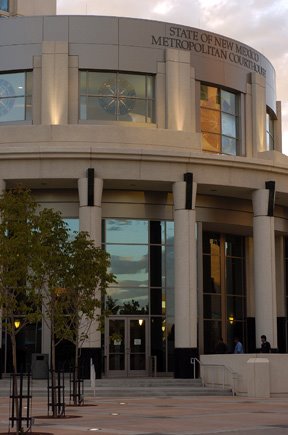
One of the limitations on the city is that they may not have their own judiciary. Up until 1979, the city of Albuquerque had a municipal court system, but the state abolished it.

Courts generate revenue from fines and fees for convictions of violations of statutory law, ordinances and traffic offenses.

When Albuquerque had its own courts, it was able to control the revenues generated for violations of their ordinances and traffic offenses. New legislation took effect July 1, 1980 with the opening of the Bernalillo County Metropolitan Court. The City of Albuquerque’s Municipal Court, Bernalillo County Magistrates’ Court and Bernalillo County Small Claims Court were consolidated. Under the state judiciary, all fines, fees and other revenues went to the state treasury before a portion was returned to the city. This system represented a major loss of revenue to the city.

In part, in an effort to regain control over the loss of revenues to the state, Mayor Martin Chávez and his legal department convinced the city council to expand their notion of using criminal nuisance abatement laws as a way to circumvent the state’s courts and make money.

The Safe Traffic Operations Program or STOP ordinance established the use of unmanned electro-mechanical photo red light and photo radar camera devices as the evidentiary gathering and charging instruments.

STOP declares that a vehicle is a criminal public nuisance for which the registered owner is responsible.

The city went on to create an administrative hearing officer process to adjudicate challenges to the notices sent to the registered owners of vehicles based on the license plate depicted in a digital image photographed by the cameras.

The photo red light and photo radar units are owned and maintained by a private vendor. A police officer reviews the video and photographic images to assure there is an apparent violation of state statute or city traffic code. However, it is the vendor who handles the notification and collection of all fines and fees.

Several issues instantly arise.

Though the state permits the city to establish what a public nuisance is and may set a penalty as a petty misdemeanor punishment – a maximum $500 fine or 90-days in jail – the city may not establish its own adjudication process.

The city exceeds the maximum penalty when it allows for the seizure and forfeiture of the vehicle if the registered owner fails to respond to the city’s notice.

The Constitution of the State of New Mexico in Article X, County and Municipal corporations, Section 6 on Municipal home rule, Subsection D, states, “A municipality which adopts a charter may exercise all legislative powers and perform all functions not expressly denied by general law or charter. This grant of powers shall not include the power to enact private or civil laws governing civil relationships except as incident to the exercise of an independent municipal power, nor shall it include the power to provide for a penalty greater than the penalty provided for a petty misdemeanor….”

Several sections of the state statutes make it absolutely clear that in Bernalillo County, the adjudication of all criminal, civil and traffic offenses under state statute and municipal codes are handled by Metropolitan court which shall have jurisdiction within the county boundaries over all: offenses, complaints and violations of city ordinances. Further, state statutes establish original exclusive jurisdiction over all Motor Vehicle Code or municipal traffic code violations.

There are two exceptions: the Metropolitan court shall not have jurisdiction over uncontested municipal parking violations, meaning, the city may keep all those fines, and “A civil action to abate a public nuisance may be brought, …in the district court of the county …where the public nuisance exists.”

The STOP ordinance, in theory, most closely parallels the city’s parking violations code. The state legislature granted a specific exception for gathering of uncontested municipal parking violation fines. Parking tickets are issued by agents of the parking enforcement division or by police officers upon their observations of offenses; yet, the jurisdiction for contested violations is still Metropolitan court.

The STOP ordinance was not the first or only law the city established for criminal nuisance abatement. It started with attempting to control deteriorating motels and has expanded to the seizing and forfeiture of vehicles operated by people arrested for driving while under the influence of alcohol or drugs if they have a prior DWI conviction.

Nor will the STOP ordinance be the last. There is currently a proposed ordinance that will decriminalize some 72-city ordinances, making them subject to the city’s theory that they can adjudicate criminal nuisance abatement.

The ordinance is being carried by request of the administration through City Councillor Sally Mayer. Mayer, in an e-mail to her political supporters, countering the recall petition, writes about the penalties of her animal control “HEART” ordinance, “…In fact all violations of city ordinances are petty misdemeanors except for our red light camera violations which are civil.” Her statement belies her lack of understanding of her legislative authority and the criminal justice system’s procedural requirements.

This lack of understanding is not all her fault. Her fellow Councillors, Michael Cadigan and Don Harris are attorneys and former Albuquerque Police Captain Craig Loy fail to understand their basic civics lessons. They, if anyone, should know better.

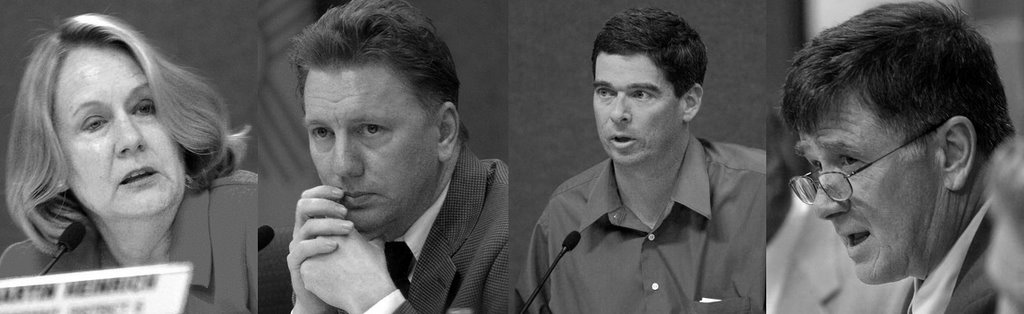
Councillors Mayer, Harris, Cadigan and Loy

At a recent council meeting, I challenged an amendment of increasing fines they were deliberating, to the existing STOP ordinance’s “civil” designation and its lack of jurisdiction. Harris, who was an assistant city attorney, said he too was concerned about the city’s jurisdiction. Assistant City Attorney Greg Wheeler assuaged council’s concerns by misstating the fundamental concepts of our democratic form of representative government.

The executive, here in the form of the mayor, appoints all the actors. The enforcement personnel, the administrative hearing officer, the assistant city attorney, the city clerk and the contracted vendor all now work within the executive branch.

This effectively eviscerates the judiciary. The separation of powers is obliterated by the theory.

The Constitutions, federal and state and the city’s own charter, recognize an independent judiciary. An accused is guaranteed a; presumption of innocence, right to reasonably obtain evidence, right to a fair trial, right to confront an accuser, to cross examine, and to bring in witnesses on their behalf, the right to have a minimum burden of proof, that each and every element of a statutory violation is proven “beyond a reasonable doubt” and the right to appeal to a higher court.

The city’s nuisance abatement ordinances eliminate several of those rights by convoluting their ordinances to allow for what they call a civil process. They do not have the authority to create a civil process. Even if they did, the adjudication of the issues still belongs exclusively to the judiciary.

The city argues that they can have administrative hearing officers. I agree. Except the hearing officer is limited to determine facts related only to the administration of city issued permits, like public health standards for restaurants, issuing of building permits, enforcement of building codes, zoning and licensing businesses as required under their various ordinances. Even then, the hearing officer’s ruling may be appealed, ultimately to District court.

The hearing officer does not represent an independent jurist, but the executive. Hearings take place in the executive’s building, again not the neutral setting of an independent judiciary.

“We the People” also means that enforcement of our social requirements that we call laws, statutes, ordinances and codes are a human interaction, not just a technological exercise. Though there are and always have been some inherent problems associated with people administering justice, it is a civil human process that assures that justice is served.

Is the goal for the city to eliminate any and all procedural, legal or budgetary impediments between alleged offenses and the inside of their citizens’ wallets?

It is the people, in “We the People,” who will make the process work, not some machine that treats a person simply as computer data and minutiae without the human qualities of heart or head, experience, wisdom or understanding. Guilt is reduced to just yes or no, a mechanical lightning-strike determination, made at a diminished level of proof, with none of the legal protections guaranteed by our great documents.

It has always been my understanding that the purpose of law was to hold individuals responsible for their specific acts of a criminal nature. So, how does a vehicle that is totally legal one second, become a criminal public nuisance in another and then is totally legal again?

Someone is going to have to explain to me very convincingly, how the progression and adoption of the Anglo-Saxon common law to the American justice system over the past 900 years is all of a sudden changed to a game of “Gotchya!”

Both the state’s motor vehicle statutes and city’s traffic codes require all traffic offenses be made by arrest by an officer, upon personal observation, in a marked police unit, while in uniform displaying the badge of office. The exception is, when there is an accident, the officer need not witness the event. The state legislature, in its wisdom, decided that officers should stop motorists as soon as they observe a traffic violation. There are excellent reasons for doing this including; when it comes to court, the identity of the driver is already established.

The arrest is terminated when the driver signs the citation promising to answer the charge. It begins the process of separation of powers, because the next step for the citizen is with the courts.

The use of radar by officers was not meant to be used as a fish net, but more like a fly cast, directed at a specific target. Court cases ruled that officers needed to visually identify a vehicle as speeding before using radar to confirm how fast it was going.

Government is to leave its people alone. It’s called freedom; you know, like in, “…the land of the free and the home of the brave,” and “…Liberty and Justice for all!”

It’s encapsulated in that pesky fourth amendment. An officer must be able to articulate facts in developing probable cause, or the lesser test of reasonable suspicion, before government is allowed to look closer at its citizens’ behaviors and to conduct a reasonable, yet warrant less search or seizure, a stop. Using the always-on passive radar or the unblinking eye of cameras constitutes a governmental intrusion of the populace. It is guilt until proven innocent, not the required presumption of innocence until proven guilty.

This is technology for technology's sake.

There is this one other little problem before the mayor and his henchmen and minions can try to exercise their grand scheme. We must start at the beginning. The notices of violations are predicated on violations of traffic control devices: red lights and speed zone signs. They are legal instruments allowed only through a legal process. The process is the state motor vehicle code. The mayor may, after conducting a traffic safety study, authorize the placement of traffic control devices. The only allowable way to enforce those legal instruments is through the same motor vehicle code that allowed for their placement. To do anything else brings into question the initial reasoning for their existence.

What is this noise, Mayor?

“…He has obstructed the administration of justice, by refusing his assent to laws for establishing judiciary powers.

He has made judges dependent on his will alone, for the tenure of their offices, and the amount and payment of their salaries.

He has erected a multitude of new offices, and sent hither swarms of officers to harass our people...

...He has combined with others to subject us to a jurisdiction foreign to our constitution, and unacknowledged by our laws; giving his Assent to their Acts of pretended Legislation:

…For imposing taxes on us without our consent:

For depriving us in many cases, of the benefits of trial by jury:

… For taking away our charters, abolishing our most valuable laws, and altering fundamentally the forms of our governments:

…In every stage of these oppressions we have petitioned for redress in the most humble terms: Our repeated petitions have been answered only by repeated injury. A prince, whose character is thus marked by every act which may define a tyrant, is unfit to be the ruler of a free people…”

Where have we heard this before? In a couple of weeks we will celebrate these words. It is hoped that Mayor Chávez, Chief Administrative Officer Bruce Perlman, City Attorney Bob White, Assistant City Attorneys Wheeler, Pete Dinelli and Dennica Padilla, Chief Public Safety Officer Nick Bakas, Chief of Police Ray Schultz, Lt. Robert Haarhues, APD’s STOP coordinator and City Administrative Hearing Officer Albert Chavez consider the similarities of the offenses they engage in today in light of Thomas Jefferson’s words of the Declaration of Independence some 230 years ago.

Chávez, Perlman, White, Wheeler and Dinelli
Bakas, Schultz, Haarhues and Chavez

Before you listen to the beautiful sounds of Linda Ronstadt at the city’s Fourth of July concert, go back and read the beautiful words of revolution!

Here, have a firecracker, puff on it, while I light it for you.

Thursday, June 22, 2006

Republican Bullies

What's wrong with this picture?

I don’t usually talk about how I voted, but what the heck, with so few contested positions how could you not figure out what was going on?

There was only one contested race on the republican primary ballot, United States Senator.

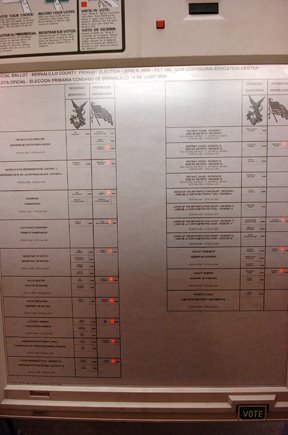
I went and did my civic duty. It wasn’t a problem. There were a lot of people at the election site. Unfortunately, most of them were poll workers. Like usual, it was a no-waiting affair and I read every name and considered what to do about people who were on the ballot, but not on my mind. I had read each name before, but I didn’t know them. Candidates hadn’t even bothered to get any name recognition in the weeks before Election Day.

It was an anemic affair and though I had dutifully read and watched the news about the Republican Party’s nomination process, I felt no better informed. No matter. No choice. So I held my nose and voted for the local guy, Joe Carraro. Though I’m not enamored with his stance in representing his constituency on what I see as unrestrained and unplanned growth in his district, I poked his name. He lost.

So now the Republican Party’s state central committee replaces their gubernatorial nominee. Dr. J.R. Damron is out; former flame-thrower party boss John Dendhal is in.

I had lunch the other day with an old acquaintance, with whom I worked in journalism almost 40 years ago. He had relocated me through this blog and it was the second time since that we had lunch. We share a few common interests, including journalism and politics. He has been active in the Republican Party and even ran unsuccessfully for office.

So, when we met at lunch, my first serious question was, how did the party’s central committee, which has 350 members, manage to make this mid-stream switch with only 100 members present? I thought that, like most organizations, a quorum consisted of 50 percent plus one, in order to conduct business?

His answer, “they probably broke party rules.” He went on to say that the issue of replacing the gubernatorial nominee wasn’t even on the agenda. He said he had been a member of the central committee, the last time they met, but he didn’t get a call this time. He wasn’t sure if he’d been “kicked off,” but thought he was still a member.

He lives in my neighborhood. I called the Republican Party office and confirmed he is my ward representative on the state central committee.

He was not notified and I was not represented….

So what’s wrong this picture?

Pundits have bemoaned the lack of interest in the primary election and its low turn out. The Democratic choices at the top of the form weren’t much better, though they did have some races “down ballot.”

Considering all the chatter about the Damron-Dendhal switch, in the news and blogs, I have decided to throw in my two-cents worth.

It’s about process. I voted for Damron, didn’t have a choice. Had Dendhal been on the ballot against him, I would have voted for Damron. More precisely, I would have voted against Dendhal. I don’t like his uncivilized style.

But I voted and now a faction of my party met in a backroom and took my vote away. The only one I had.

Now, I’m not saying that the party can’t replace a man who is unwilling to run or that Dendhal was not the person who would have ultimately been chosen to pick up the mantle. However, when only 100 of the 350-member central committee meet, that is not my party. My party normally advocates strict compliance with rules and laws. Those who were called to the meeting were the bullies in my party.

No wonder my fellow citizens don’t vote. They are disillusioned with politics. They have every right to be.

Monday, June 19, 2006

Anyone Want to Play a Little Hardball?

What's Wrong With This Picture?

This is Governor Bill Richardson after throwing out the first pitch several years ago at the Mountain West Conference college baseball tournament.

He was a right-handed pitcher at Tufts University. Last year, his status as a drafted player with the Kansas City Athletics’ in 1966 came into question. He later admitted he had not been drafted.

However, unlike many politicians who are asked to throw out the first pitch, Richardson got the ball over the plate.

As an aside, he’s not the only politician in the state who can throw; U.S. Senator Pete Domenici was a pitcher for the University of New Mexico.

Richardson, a Democrat is running for reelection and seems to be eyeing a run for the White House two years from now.

So what's wrong with this picture?

It seems the Republican party threw a curve Richardson’s way this weekend when they accepted the resignation of their gubernatorial candidate, Dr. J.R. Darmron, who excused himself because he could not fulfill his medical and political commitments at the same time. Darmron’s campaign was having serious problems raising money against Richardson’s $7 million war chest.

The New Mexico Republican Party’s State Central Committee replaced Darmron with former State Republican Chairman John Dendhal.

Dendhal received a “unanimous” vote supporting him as the new gubernatorial candidate from the 100-committee members present at their emergency meeting Saturday in Albuquerque. The Central Committee is made up of 350 delegates.

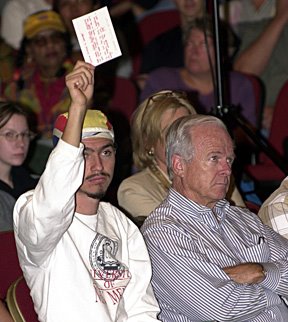
This is Dendhal, seated next to Stephen Calvin-Miller, a sophomore in Latin-American Studies at UNM, who holds up a card with his question for New Mexico Governor Gary Johnson at the Continuing Education building on September 10, 2001. Johnson and Administrator of the Drug Enforcement Administration Asa Hutchinson debated national drug policy.

Johnson had proposed that drug treatment programs be part of any drug offense sentencing to attempt to treat the public health issue rather than solely rely on criminal punishment. He proposed decriminalizing, as opposed to legalizing certain drugs.

The debate was taped for the National Public Radio program "Justice Talking." Calvin-Miller’s question asked whether Johnson had been able to bridge the parties with his drug reform initiatives. Johnson responded that as many Republicans disagreed with him as Democrats.

Dendhal supported Johnson’s decriminalization plans. Democrats are quick to attack him for that stance. He is not a soft and cuddly campaigner, but a harsh spoken attacker who gives no quarter to opponents.

Dendhal fought his way into the leadership position and fought to keep it. He was ousted by the party in 2003 when he lost the chairmanship to former state Senator Ramsey Gorham.

There is a saying that fits here, “If you want to play hardball, then ‘Batter Up!’”

Now the gubernatorial election is a whole new ball game.

Sunday, June 18, 2006

Father’s Day!

What’s wrong with this picture?

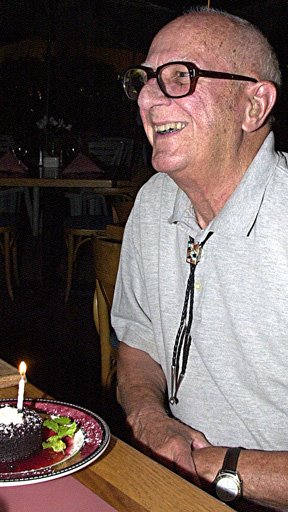
This is my father, Walter S. Bralley. The picture was taken while we celebrated his 82nd birthday in August of 2001.

So, what’s wrong with this picture?

Nothing, except he passed away about 17 months ago and I haven’t written about him.

He was my best friend. I didn’t always realize that, but he was.

He was my greatest supporter and harshest critic.

He could lecture, but seldom did.

When he did, you knew exactly what he thought.

I think he knew all the swear words, but didn’t use any of them… he didn’t have to.

He had a command of the English language, but didn’t abuse it.

He could hold an opinion strongly, but didn’t try to force you from holding yours just as strongly.

When I started a professional life, his firm guidance of my youth changed to a coaching style.

When I got my master’s degree, his coaching seemed to come less frequently. He listened a lot more in the last years and I missed his input. He thought that his pre-World War II college education was overtaken by the modern world. It wasn’t and he functioned just fine in it.

He didn’t use a computer, but he wore out more than one typewriter. He had numerous friends around the world with whom he would regularly correspond.

He could hardly say the word love, but there was never any doubt that he loved each and every member of our family.

His greatest gifts were his time, wisdom, and example. He shared them freely.

I pay tribute to him, this father’s day, as I’m sure the rest of my family does. I speak for all of them when I say we miss him.

If your father is still with you, tell him how you feel about him, thank him for raising you, guiding you, being there and for throwing the ball back and forth, even if he’s 80.

If you are a father, hug your kids, even if they are 50.

If your father is gone, remember him and speak well of him.

Saturday, June 17, 2006

Can We See George?

What’s Wrong With this Picture?

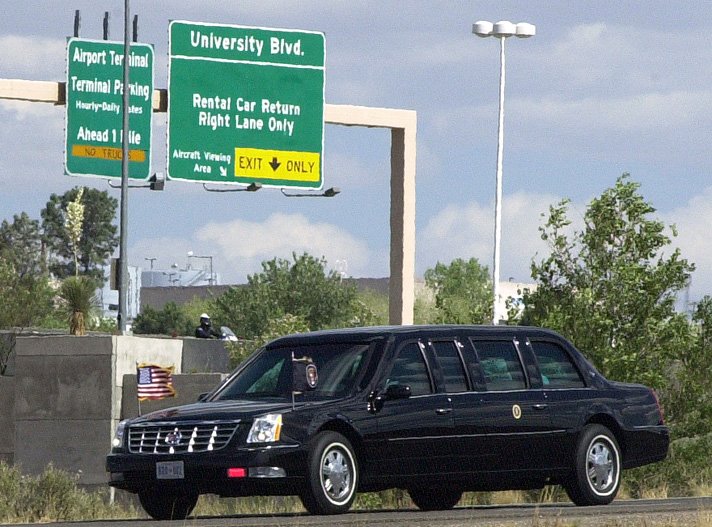
President George W. Bush came to town yesterday to campaign for Congresswoman Heather Wilson (R-NM). However, this is about all you could see of him, as he sped by in his motorcade.

Let me back up and tell you of my day.

My friend Ken Coolidge flew in from California Thursday, in his private plane. He was with a fellow retired US Air Force pilot, Lt. Col. John Sullivan to peruse the real estate situation here in Albuquerque.

After their Air Force flying days, they both became chiefs of police on separate bases. Both were assigned to Kirtland Air Force base in the early 1980’s. After retiring, they worked in corporate security in Southern California and both have retired a second time.

They both own rental homes in town and were just checking on them. OK, they really just needed an excuse to make a long cross-country flight.

Coolidge made arrangements to get a tour of the Eclipse Aviation facility and invited me to join them. We were to meet at Eclipse, on the south side of the Sunport at four pm.

Traffic was extremely heavy on southbound I-25. There was no traffic northbound because state, local and county law enforcement units were closing down the highway for the presidential motorcade.

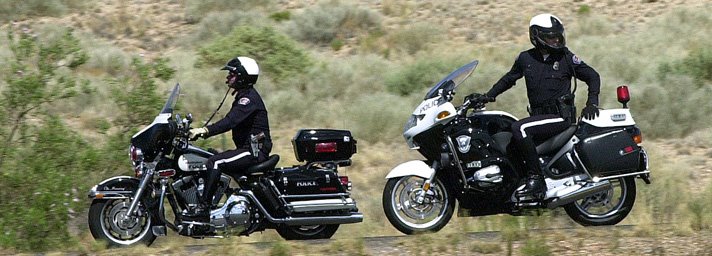
Coolidge called to say he was hung up in traffic and would be delayed a few minutes. I was exiting I-25 at Sunport Boulevard, but there were officers at the top of the ramp holding traffic. I pulled off the pavement, got my cameras and photographed the “stack” of tandem police motorcycles preceding the presidential limousine for traffic control.
The limousine was followed by a long motorcade of secret service, White House staff, national press corps, White House communications, rescue/ambulance and additional law enforcement vehicles.
I arrived at Eclipse Aviation, met Coolidge and Sullivan and had a wonderful tour of the sales showrooms.The Eclipse jet is built here in Albuquerque.

It is amazing and will be in production as soon as the Federal Aviation Administration approves the certification process. It is going to be a hot-rod executive plane. Eclipse has taken over 2,000 orders, at about $1.3 million each.

This is John Sullivan, left, with Ken Coolidge looking over the E500.

After the tour, we decided to go see the president depart on Air Force One.

Coolidge drove onto Kirtland and passed the gate by showing his military ID card. We drove towards the base operations building where Air Force One was parked. As we neared, two female military police stood in the roadway and stopped us. One air police approached and said, “We’re under lockdown, you have to turn around.”

We did, “mutter mutter, spit spit.” Sullivan stated that there was something fundamentally wrong when American citizens can’t go to the airport to see their president board their tax-paid $325 million airplane and watch it take-off.

Air Force One was already taxiing to the east end of the Sunport to take off to the west.

It was then that I learned that Sullivan had been the pilot of Air Force Two for Walter Mondale, Jimmy Carter’s vice president, in the late 1970s.

He spoke of the no-expense-too-great attitude for transporting the president. There were also two C-17 Globemaster III transporters supporting the trip parked on the ramp.

The total time between the motorcade entering I-25 and Air Force One, wheels up, was about an hour and a half.

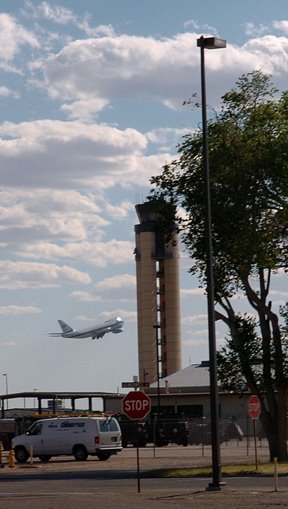
No… you can’t see George! Unless you contribute $1,000 to Wilson's campaign. To get a picture with the president, cost another $5,000. Bush's visit swelled Wilson's campaign war chest by about $375,000. It probably cost nearly that much to transport the president and all his support in three Air Force planes including all the local costs associated with his protection.

The operating cost of the Eclipse is a dollar per seat, per mile; hardly what it cost for a presidential visit.