Monday, June 14, 2010

Flag Day 2010

It’s Flag Day again.

For my regular readers, you know I’m not a big flag waver. I'm not wild about having the flag thrust in my face by those who think doing so bolsters their political arguments giving them some special weight.

I found this ironic image of this veterans group's honor guard leader that regularly present colors during various functions at the State Capitol in Santa Fe.

The vet got his own face full of flag outside the Roundhouse during a day at the legislature event for veterans during this year's session.

So what’s wrong with this picture?

For those so inclined, this is just a friendly reminder to fly your colors proudly today.

If you want to practice being a vexillologist, then check out this PBS post.

Friday, June 11, 2010

St. Cyr – Award Winner, Again

What’s Wrong With This Picture?

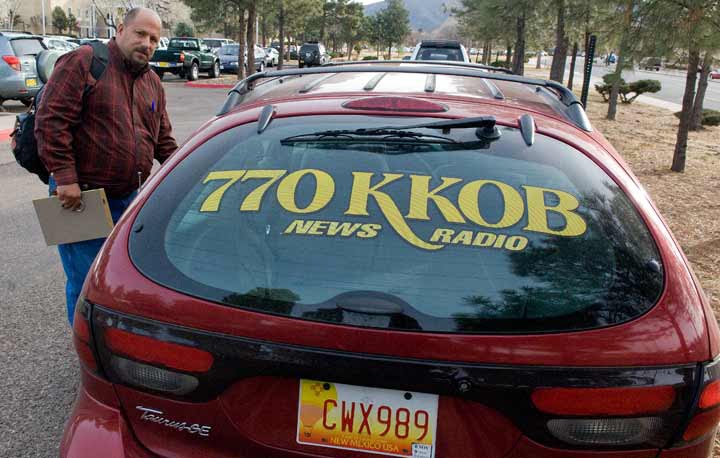
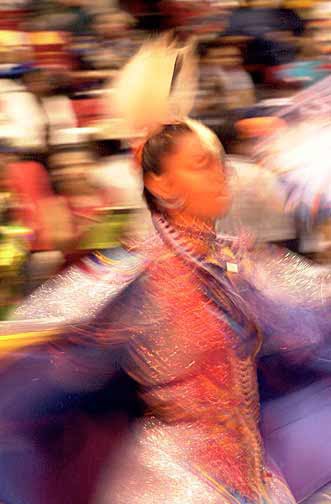
At the New Mexico Broadcasters Association NMBA/AP Excellence in Broadcasting awards dinner this evening, my former blogging buddy, of What's the Word?, and still my friend, Peter St. Cyr was announced as winner of the Radio Division 1 Single Topic Event News Coverage KKOB-AM – Pow-Wow Peter St. Cyr, Reporter.

It's the third year in a row for St. Cyr to win a radio news award.

So what’s wrong with this picture?

This is a picture of a swirl of color and movement of a contestant performing the fancy shawl dance during competition at the 20th Annual Gathering of Nations Pow Wow at the University of New Mexico Pit in Albuquerque, April 26, 2003. The Gathering of Nations is the largest Pow Wow in North America.

Work broadcast during 2009, was judged by former news directors from Alabama and Kansas, local advertising agencies and the Associated Press, according to NMBA’s website.

St. Cyr moved from being chief political reporter at 770 KKOB AM News Radio about three months ago to KOAT TV Action 7 NEWS where he now is the evening assignment editor.

"I've stopped blogging to focus on my new assignment and job, and I hope to start blogging again for them," St. Cyr wrote in an e-mail response after the event.

KOAT has passed up a great opportunity to benefit even more from St. Cyr’s extensive list of contacts than they already are now, "KOAT is utilizing my contacts. I call up my people and ask them if one of my reporters can talk to them,"St. Cyr wrote.

If he blogged, St. Cyr could add depth to their on air stories which, are limited by the short amount of time available to develop more complex stories.

However, such extensive stories are reduced to a headline and a paragraph during their broadcasts.

The political insights and news sense represented in St. Cyr's former blog should now be an indispensable part of KOAT's website.

Saturday, June 05, 2010

Coach John Wooden 1910 – 2010

What’s Wrong With This Picture?

University of California at Los Angeles’ former Basketball Coach John Wooden, who was a member of the 1932 national champion Purdue Boilermakers and as a coach led UCLA to 10 national championships, passed away of natural causes. He was 99.

So What’s Wrong With This Picture?

I saw Wooden coach UCLA at the 1968 NCAA’s Western Regional Championship at University of New Mexico’s two-year old PIT in Albuquerque.

I don’t have a picture of Wooden, but I do have pictures UCLA playing New Mexico State University in the sweet sixteen game winning 58 – 49.

In the low scoring event, UCLA’s Lew Alcindor #33 Blue, above, was battling under the boards for rebounds all evening.

UNM was also in the tournament losing its first game to Santa Clara 86 – 73

The next night UCLA beat Santa Clara 87 – 66 to advance to the final four. New Mexico State beat UNM 62 – 58.

UCLA would go on to win the national championships in Los Angeles by beating the only team they lost to during the regular season, University of Houston, in the semifinal round and went to beat North Carolina in the final game. UCLA’s Alcindor was named the tournament's Most Outstanding Player.

He got my vote also.

While sitting cross-legged on the floor at NMSU's end of the court, Alcindor, in trying to secure a rebound was pushed out of bounds, directly at me. Alcindor was seven feet tall coming down on top of me. I rolled onto my back, with my legs still crossed, pressing my camera to my chest, trying to protect it, and closed my eyes; I knew what was about to happen was going to hurt, but it didn’t. There was a collective gasp from the crowd and as I opened an eye I was nose to nose with Alcindor. He was spread-eagled over me. He pushed himself back onto his feet with his hands then stood upright. He never touched me until he reached down, offering me a hand to help me right myself.

Later in the spring, April 4 – 6, Albuquerque hosted the US Olympic Basketball Trials. Alcindor, who would later change his name to Abdul Kareem Jabbar, and several other African-American university level players, boycotted the trials. Remember 1968 was a very tense time in the civil rights era; the Rev. Martin Luther King, Jr. was assassinated in Memphis, Tenn. on the opening day of the trials.

Note the sparse attendance in the then 16,000 capacity seat PIT. This was one of the better-attended games. Albuquerque showed it did not support world-class sports, unless a home team was involved.

The team sent to the 1968 Mexico City Olympics was considered an underdog until Yugoslavia upset the USSR. USA had beaten Yugoslavia in an earlier game and did so again in the finals. USA won all nine of their games.

Wooden, though he was the best coach in the nation for several years in a row, was not the Olympic team’s coach.

Tuesday, June 01, 2010

Monday, May 31, 2010

Memorial Day – 25 Years

What’s Wrong With This Picture?

This was Memorial Day 1985 at Schofield Barracks, Oahu, Hawaii.

I was attending a family reunion; it was the last time the family was totally gathered together. The growth of the family wasn’t quite finished. My older brother, Guy, a Navy officer, was stationed at Barbers Point Naval Air Station and my sister, Alison was in the “Tropical Lightening” Army Band at Schofield Barracks; both facilities are on Oahu. My parents and younger brother, Neal, who was an artillery officer in the Army, and all of the spouses and their siblings, were present.

Here, the “Tropical Lightening” Army Band forms up at the Schofield Barracks Post Cemetery.

An Army field artillery unit fires a 21-gun salute.

At the end of the ceremony an “echo” taps was performed. The first bugler, left, starts the tune, the second bugler, right, is hidden by a tree while playing the echo. The unit’s flag bearer and artillery officer render a salute.

So What’s Wrong With This Picture?

In the 25 years since this event there are so many more military personnel memories to hold. We do so with the greatest appreciation.

Sunday, May 30, 2010

Dennis Lee Hopper: 1936 – 2010

What’s Wrong With This Picture?

Part time New Mexico resident: actor, director, producer, artist, and photographer, Dennis Hopper has died in Los Angles of prostate cancer. He was 74.

Hopper, as a young film actor, played in two movies: Rebel Without a Cause (1955), and Giant (1956), with his friend James Dean who died in an automobile accident before Giant's release.

Hopper may be best remembered as the director - actor of the 1969 independent film Easy Rider, of which parts were filmed in New Mexico. Hopper made a second home in Taos.

His last project was a cable television series Crash, filmed in Albuquerque.

So what’s wrong with this picture?

This is Hopper speaking before the Albuquerque Press Club about 1970.

Saturday, May 08, 2010

Kent State Repercussions Remembered

What’s Wrong With This Picture?

Forty Years Ago today there was a critical incident at the University of New Mexico.

President Richard Nixon announced a U.S. military incursion into Cambodian during the Vietnam War on April 30, 1970, to interdict North Vietnamese troop movements on the Ho Chi Mien trail.

The announcement set off anti-war protests across the country, many at up to 350 college campuses.

On May 4, 1970, the Ohio National Guard killed four Kent State University students. Two of the victims shot were not participating in the demonstrating of the incursion.

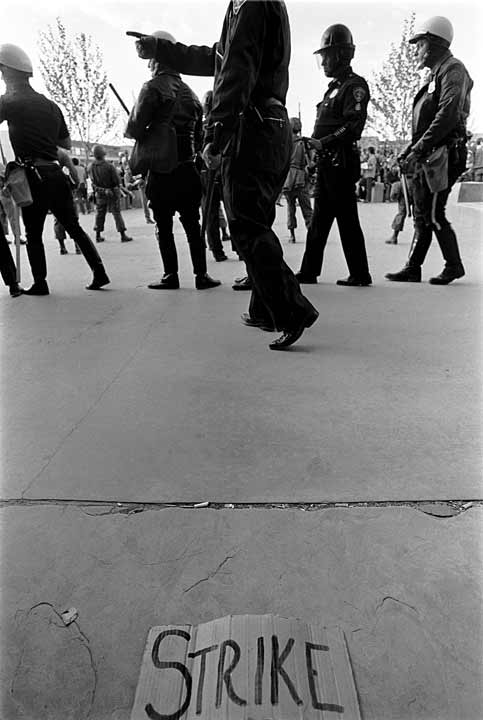
The killings escalated and widened protests. Students at the Albuquerque UNM campus, engaged in demonstrations, marches past federal buildings, above, and ultimately causing the suspension of classes after a fight over the lowering of the American flag to half staff in front of Johnson gym and the take over of the Student Union Building, ended in governmental violence four days later, on Friday, May 8.

Local law enforcement beefed up its patrols, including the use of four man cars, this one, above, monitoring one of the marches is headed by a sergeant.

After the initial “takeover” of the SUB, there were very few students in the building. Early Friday afternoon I observed only six people in the SUB. Tensions were subsiding as the weekend approached.

However, Lt Gov. E. Lee Francis, was acting governor because David Cargo was visiting in Michigan, called out a National Guard unit from Socorro, who along with UNM Police, New Mexico State Police, and Albuquerque Police descended on the SUB. When students and other protesters learned of the law enforcement presence, they reoccupied the building.

As the first ranks of Albuquerque and State Police lined up between the Student Mall and the SUB, there were few protesters outside. Here a man collects badge numbers from Sgt. Norm Courtney and other officers.

APD Traffic Officer Fred Sweitzer with a squad of motorcycle officers are armed with riot sticks as they initially lined up facing the SUB before the crowd grew.

Officers, including APD Capt, Sam B. Romero, above left, converged fully prepared in riot gear of the day while traffic Sgt. Courtney, right, is armed with a shotgun propelled tear gas launchers.

Inside, about 150 anti-war demonstrators occupied the ballroom.

New Mexico State Police Major Hoover Wimberly read the protesters, "the riot act" ordering them to disperse. UNM and NMSP officers affected about 156 arrests. Most, if not all charges, were eventually dismissed, some upon conditional discharge; where after a plea the sentence would be dismissed after a period of unsupervised probation.

The New Mexico National Guardsmen swept up the east side of the student mall with bayonets unsheathed.

There was plenty of press coverage including KOB TV news cameraman Bill Norlander who was seriously wounded when he was one of several people stabbed by the troops. The bayonet strike missed Norlander's aorta by about a quarter inch.


What had started as a student strike ended up being a massive and excessive use of force against students who would have probably returned to class had university leaders announced that classes would resume three days later on Monday.

National Guard troops surrounded the SUB as the first line backed up by civil law enforcement, as the state police helicopter circles overhead.

Wimberly spoke with demonstrator marshals, wearing white headbands, and students in front of the SUB before a crowd that grew to thousands.

So what’s wrong with this picture?

About a half-year earlier, I covered a press conference of the Cambodian Ambassador to the United Nations who detailed an earlier ground incursion. I never saw any coverage in this country for at least a couple of years.

If you Google, US military incursion into Cambodia or US military attack on Cambodia you will find articles that admit there were secret B-52 bombing raids over Cambodia in 1969, but do not address ground attacks. In one post the "historian" suggested that Cambodian Chief of State, Prince Norodom "Sihanouk did not object to these raids." Sihanouk had been overthrown by a pro-American right-wing general in March.

This picture, above, proves otherwise that the Cambodians complained. The American people were left in the dark.

Only weeks earlier, Nixon gave his first speech before the UN's General Assembly invoking Vietnam 24 times, but not once did he mention Cambodia.

Many years later, I met more than one military veteran who admitted they were involved in the 1969 ground raids.

My Take

Four Kent State students were shot for protesting, two killed at Jackson State University in Mississippi, and nine stabbed on the UNM campus, while 24 other campuses where violence erupted. Eleven other students were killed between 1968 and 1971 protesting.

To this day, the question of why the National Guard units resorted to using deadly force in non-deadly force situations against students who, at worse might have been trespassing and or disrupting the educational institution, while claiming their First Amendment right to petition government for their redress of grievances, still eludes us.

Thursday, April 01, 2010

Congratulations Commander Huntsman

What’s Wrong With This Picture?

There are times in your life that someone you know just makes you proud. You have the ability to say I was there when...

Tomorrow is one of those days.

So what’s wrong with this picture?

These officers: Homicide Detective Damon Fay, Lieutenant Robert Huntsman, and Sergeant Jeffery Ferner were uniformed up to provide security for President Bill Clinton‘s February 3, 1998 visit to Albuquerque. It was the second trip out of Washington for Clinton after being acquitted in his Senate impeachment trial.

These three officers were representative of the finest the Albuquerque Police Department had to offer.

In October 1983, I was a Field Orientation Officer working out of the Northeast Area Command and had three newly sworn in officers straight out of the academy to train and acclimate to street duty.

It was a task I truly enjoyed. My first recruit was Doug Shawn. He was faced with a steep learning curve. At the end of our month together he had satisfied me that his progress was sufficient to pass him on. He would end his career as a very successful homicide detective.

During our time together, after the shift I would answer any question he might have. A couple of other trainees would join the conversation; one of them was Huntsman.

Several years later Huntsman and I were involved a life-threatening event involving a knife wielding drunk.

Huntsman and I went through a promotional process together and he scored very well and was promoted to sergeant. Being the most junior sergeant promoted he was assigned to be the Metropolitan Court Liaison. He wasn’t happy with the assignment, he wanted a squad of officers in the field and he sought out my counsel. I suggested that he was so young that the assignment inside would serve him well. Rookie sergeants are assigned to a squad and he could have a number of veteran officers who might not appreciate such a young supervisor. When the next bidding process, where officers get to choose their next six month assignments, new sergeants most likely end up working graveyard shift and the rookie often ends up with the most junior patrol officers, The rookie officers are often overly eager to do police work and make “rookie mistakes.”

I suggested to Huntsman that the Metro Court was a perfect place for him in several ways: he wouldn’t have a squad of rookies trying to get him into trouble, he would have contact with every patrol officer who came to court and they would get to know him, he would be in a position to solve the day-to-day problems that come up in court, which would help him build a good reputation, and when he left the assignment to work the streets he would have gained some seniority on a number of more recently promoted sergeants giving him a better choice of his own assignment and his reputation would serve him well.

Huntsman spent a few years at the courts and when he went to the field he had a squad of more senior officer bid to work for him.

I work at the Academy in the early 90’s when he was the cadet training supervisor and I was in the advanced training unit – video productions.

I could tell some other stories, but won’t. He has spent almost 27 years on the Department and has seen a lot of changes to the city and the department.

Huntsman and I had one more important police moments when after having dinner with him, while I was assigned to the Telephone Report Unit, we answered a shots fired call and were the first unit on the scene of the shotgun shooting where two men were injured. One died and Matthew and Michael Paul Astorga were charged with the murder. Michael Astorga was acquitted while his younger brother Matthew was convicted. He appealed and the court of appeals reversed the conviction because he had claimed self-defense but the judge had not allowed the jury to consider the charge of voluntary manslaughter. Instead of going to a retrial, Matthew Astorga pled guilty to second-degree murder.

He was later promoted to Lieutenant and for the last 10 years been assigned to Metro Division as the Special Weapons and Tactics commander.

Tomorrow, Chief Ray Schultz will promote him to Commander and he will be assigned to the Northeast Area Command.

The third officer in the photograph, Ferner was my third officer during the training cycle. He was ready to work but I didn’t try to cut him loose early. He went on to have a very successful career retiring as a Lieutenant.

Huntsman has done well, congratulations.

Monday, March 22, 2010

Stewart Udall

What’s Wrong With This Picture?

Stewart Udall
1920 – 2010

Udall passed away at home in Santa Fe at the age of 90.

His life has been noted on so many other sites that I have little to offer other than the dignity in this portrait of an elder statesman.

So what’s wrong with this picture?

The photograph was taken November 11, 2007, during the announcement for Senate of his son, then US Congressman Tom Udall, and wife, Jill, to right and the Congressman's step-daughter Amanda Cooper, to the left and her husband Jim Noel far left.

Stewart Udall was more than a man of his party. As Secretary of Interior during the administrations of Presidents John Kennedy and Lyndon Johnson, It was a time when I was becoming aware of the importance of conservation and of environmental issues. He transcended the partisan divide.

Under his administration a number of National Parks were added:

Massachusetts’ Cape Cod National Seashore, August 7, 1961.

California’s Point Reyes National Seashore, September 13, 1962.

Utah’s Canyonlands National Park September 12, 1964; this is Mesa Arch at sunrise.

This location is a favored photographic spot. This image denotes a problem inherent to the protection of wild places. The bush had been broken on the left side; probably by some photographer who wanted to rid them self of a distracting element.

Arizona’s Petrified Forest and Painted Desert National Monuments were created on December 8, 1906. They were designated a single National Park on December 9, 1962. These Petroglyphs are at Puerco Pueblo. The Painted Desert shows off a wide range of colored layers of earth. The park is near his birthplace, St, John's.

Washington states’ North Cascades National Park October 2, 1968.

California’s Redwood National Park, October 2, 1968.

During Udall's tenure, Texan J.C. Hunter, Junior, sold his Frijole Ranch to the National Park Service in 1966 and it was combined with land that was given to the park service in 1959. The Guadalupe Mountains National Park was established in 1972.

Sunday, February 28, 2010

Paparazzi?

What’s Wrong With This Picture?

More than 40 years ago, I took a photojournalism course from one of the all-time worlds greatest, W. Eugene Smith. He gave the class an assignment; photograph your neighborhood.

This is the opening picture of my essay on Staten Island, looking east on Forest Ave. from Hoyt Ave.

The assignment was based, in part on his “Dream Street: W. Eugene Smith's Pittsburgh Project,” and a personal project of pictures of the building where his loft was located. He made a series of photographs, published in Life magazine including what was seen out of his window. Smith’s early work on the Pittsburgh Project came to a bad end when his negatives of the better part of a year’s worth of work were stolen in an auto burglary.

Smith received a Guggenheim Grant and completed the two-year long photo essay.

The man had some obsessions and wanted to pass them on. When I moved into the house I now own, I revisited Smith’s obsession. I have been taking pictures of activity in the park across the street for years. There is a lot of varied activities: folk dancers, picnics, school outings, sports ranging from five-year old soccer practice, to para-gliders, to university runners.

When it snows, the hill is worn bare by the tobogganors and makeshift sleds made from cardboard boxes. This KOB TV photographer shoots his kids in the park.

Then there are the film productions. I’ve photographed Diane Denish and her husband Herb and a daughter making a TV ad for her 2002 run for Lieutenant Governor. And the Cialis commercial with a man and woman running through the park and the man jumping in the air off a mini trampoline…

My current personal project, “From My Porch,” is a work in progress. I’ve used a few images on this site. I don’t know if I will ever compile a collection for general viewing, but it is continuously interesting, watching the world go by.

The other day I was photographing activity in the park and got called Paparazzi.

So what’s wrong with this picture?

This is a story about State tax credits. Confused? So am I.

There are a few Hollywood theories that help inform this post.
You must have a suspension of disbelief to accept what you see on the screen.
A band of gypsies took over my neighborhood.

It started with a man wandering the street. The cop in me said he was out of place and looking for an accomplice. I was right and wrong at the same instance. He was looking for his accomplices; they just weren’t up to anything criminal. They were an advance element of electricians setting up a temporary electric system.

It was the production crew of the locally filmed television show, In Plain Sight, seen on the USA Network.

They brought a bunch of trailers and parked in the local church’s parking lot.

The streets were blocked off by three off duty police officers working what is known as Chief’s overtime, $42 an hour, paid for by the film company.

There was a playground swing set in the corner of the park across the street from a recently remodeled house that has a spectacular view of the Sandia Mountains. The house was being used as part of the set for interior and exterior shots.

Actress Mary McCormack, above, plays US Marshal Mary Shannon with Actor Frederick Weller, below, playing her partner, US Marshal Marshall Mann.

I got out my long lens that I use to photograph birds and sports and things that are a long ways away and took pictures of the filming process.

My activity attracted attention and this heavily tattooed man came over. For all his looks, he was a mild mannered messenger; “You can’t take pictures,” he said.

“It’s a public park,” I responded.

“It’s a copyrighted production,“ he said.

“What you put on film of your actors is copyrighted, what you do, as a film production crew, in a public park isn’t,” I said.

He wandered off, returning a few minutes later to ask if this was my residence about the same time my mailman came by greeting me by name. I told the assistant that if I got into their scene to let me know because I didn’t want to disrupt their production.

A few minutes later a group of grips put up a 15-foot by 15-foot reflector/screen to block my view.

Then they took a lunch break.

I came back an hour later with my Reflex-Nikkor 500mm f/8 catadioptric lens with a two-time tele-extender.

A production guy walked by on the sidewalk, looked at me and called in on his walkie-talkie, saying, “he's shooting with a short lens, don't worry.”

Ok, so it's the equivalent of 1,500mm on a 35mm piece of film. The 500mm rig is a third the length of the 800mm; it isn't all that sharp, but I got something.

Back in November, I stopped by the Gibson Medical Center Pharmacy to pick up a prescription.

Breaking Bad, another locally filmed television show was shooting at the abandoned Emergency room and entryway.

“You should be discrete with your photography,” Key Assistant Location Manager Roderick Peyketewa said, walking up to me.

“I thought I was.”

“I caught you,” Peyketewa said.

I certainly wasn’t trying to hide, though I didn’t walk up close to where some bystanders were.

Our conversation was then about the need of the production company being able to maintain their storyline from the fans of the show. He said that the paparazzo often shot scenes the production crew wished remained secret until the episode aired.

Standard response, it’s a public place. He shrugged and said I’m sure you’re a fan.

I admitted I didn’t watch the show. Peyketewa wandered off.

I had an interesting discussion with another production assistant who was making sure that people passing by didn’t inadvertently walk though a camera shot. She talked with actor Aaron Paul, left, who plays character Jesse Pinkman while a movie prop car was refueled.

Another Hollywood myth:
It doesn’t have to be, it only has to look like it is.
I’m not Felice Quinto, nor one of his aliases, from the 1960 Federico Fellini, directed movie, La Dolce Vita. Quinto, who passed away recently, was the model for the character of a 1950s tabloid photographer in Rome named Paparazzo. What Paparazzo did in the movie was stalk celebrities and royals in public places. Now Paparazzi is a name that is used with contempt and disdain for many photographers. However, it is not always accurately applied. Many celebrities crave the attention even while complaining about the photographers.

The banks of photographers at red carpet events are not Paparazzi. Taking pictures from 150 yards away of a movie set of the film crew in a public park does not make me a stalker or a Paparazzi.

It is foolish thinking that something happening in my park won't get photographed for my personal project "from my porch."

McCormack recently made herself an item of local news interest when she made a comment about Albuquerque on a December 29th 2009 E! Network cable talk show, Chelsea Lately, which is billed as a comedy. McCormack later apologized by saying she loved Albuquerque, her home for the past four years.

I could post Paparazzi like pictures of McCormack with her two cute small children, whom she talked about on the TV show, playing on the prop swing set, between takes, but I won’t. I'll just show her working.

This post is not about the stars particularly; my interest is political from the tax relief standpoint that the film industry is receiving from our state.

Gov. Bill Richardson pushed legislation through the State legislature giving the film industry a 25 percent off-the-top tax-rebate. There is also a 50 percent reimbursement for on-the-job training salaries.

The question is whether 25 percent is an appropriate tax break for the film industry. New Mexico had the largest state supported tax initiatives of 30 states offering aid and competing for film productions.

There are various arguments about the return to the state on their tax investments.

Rep. Dennis Kintigh, left, R - Chaves, Lincoln, and Otero Counties, has twice introduced legislation that would repeal the film production tax credit. In the 2009 Regular Session, it was HB 725, which died after the action was postponed indefinitely and in the 2009 Regular Session it was HB 52, which died without being heard in the House Labor and Human Resources Committee.

There have been dueling studies with widely varied conclusions.

An August 26, 2008 New Mexico State University Arrowhead Center, Office of Policy Analysis report, “The Film Industry in New Mexico and The Provision of Tax Incentives,” by Anthony V. Popp and James Peach was submitted to the Legislative Finance Committee.

The report found:
25% Production Rebate: During fiscal year 2008 the NM government granted $38.195 million in rebates. The resulting increase in economic activity generated $5.518 million in revenues. The implied return is 14.44 cents on the dollar. This means that for every one dollar in rebate, the state only received 14.44 cents in return.
An “Economic and Fiscal Impacts of the New Mexico Film Production Tax Credit,” was an analysis prepared for the New Mexico State Film Office and State Investment Council by Ernst and Young in January 2009.

The report found:
State and local return on investment from 2007 and future tax revenues attributable to 2007 film productions, (was $1.50 on the dollar).
Legislative Finance Committee Chief Economist Norton Francis wrote a revised memo analyzing and comparing the finding of the Ernst and Young and the NMSU reports. Francis revised both numbers to have a return on investment to be 93 cent on the dollar.

The New Mexico film industry has sunk a fair amount of capital into the construction of Albuquerque Studios, the single largest studio complex, at 54 acres, on Mesa del Sol.

Local colleges, Central New Mexico and College of Santa Fe have film programs.

The concerted effort of the State and City of Albuquerque’s film offices has had an affect of making the state sought after location for filming, according to Movie Maker.com.

There are a lot of people employed on these film sets. I happened to find several “call sheets” which are the game plan for a day’s shooting with all the necessary personnel. The most telling way of knowing how many people are actually on a set is to look at the catering order. On the Breaking Bad set there were 150 breakfasts and lunches ordered.

Most of the set work is part time, but those employed infuse their income into the local economy and tax base. A production assistant carries two trays of coffee from the local Starbucks for her fellow workers.

During the current budget crisis, legislators prior to the 30-day session, briefly discussed revisiting the film tax rebate, but it was quickly dismissed.

My Take

What I find so bizarre, is one group of photographers – filmmakers – recording a dramatic performance believing that they can prohibit another photographer from engaging in the same activity in the same public place; then calling me a disparaging name. Yet the audacity is compounded by the fact that they get a 25 percent off-the-top as a tax-break.

Yeah, right....

I’ve taken pictures of movie making for years. In 1969, I photographed this crew across from the United Nations while they shot from the top of a rental moving van.

This is Gerd Oswald, left, directing the movie, Bunny O'Hare, downtown in 1971. The movie stared Academy Award winners Bette Davis and Ernest Borgnine.

Gov. David Cargo, center, seen during the 1970 Republican Governors Conference in Santa Fe, played a State Trooper in the movie. He had concentrated on attracting movies to New Mexico through his newly established New Mexico Development Commission. A while back Cargo told me he still maintained his Screen Actors Guild membership.

Oswald invited the public to watch as he worked on Central Ave. downtown. He also invited the press onto the set.

The same year, another Academy Award winner, Anthony Quinn, second from the right, played Mayor Thomas Jefferson Alcala with actress Skye Aubrey as Sabina Menard, on the set of, “The City,” a 2-hour pilot made for ABC TV. A series set in Albuquerque followed, renamed, “Man and the City.”

The set was the interior of a Corrales home. As an Albuquerque News photographer, I was invited to take a few photographs.

The world has changed. Where giving publicity to the film industry was once openly welcomed, now production assistants attempt to assert control over their little world through confrontation and mild intimidation.

Maybe they know just how much the governmental incentives are worth and don’t want anything that might question or threaten them to expose their good deal.