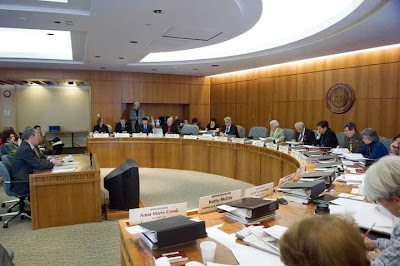
 The New Mexico House on Friday adopted two committee reports just hours after their Rules and Order of Business Committee, above, passed changes supposedly deigned to create more transparency.
However, though a step in the right direction, it does little in bringing the legislature any closer to allowing the citizens of the State of New Mexico to look into the faces of law makers as they go about the people's business.
 Republican Whip Rep. Keith Gardner, Chaves, Eddy, Lea, Roosevelt Counties introduced House Resolution 1, “Amending the House Rules to Expand the Live Streaming of House Proceedings to Include Video and Committee Meetings in the Chamber“;
The legislative council service is authorized to produce a live audio and video stream of the house floor proceedings that is accessible through the legislature's web site in a manner befitting the house of representatives, including an appropriate user interface. The stream shall begin as soon as practicable after the speaker has announced a quorum is present and shall terminate as soon as practicable after a motion to recess or adjourn has carried, or upon the order of the speaker. The live video stream shall be produced from cameras configured and operated in such a way that as much of the chamber is displayed as practicable but that no material on members' desks, computer monitors or similar devices can be read or viewed except as would otherwise be possible with an unaided eye. The live stream shall not be archived. The stream shall carry a notice to the effect that the stream is being produced for the benefit of the public and any political use is prohibited. The provisions of this rule shall apply when the house is meeting as the committee of the whole and when any standing substantive committee is meeting in the chamber.“The passing of HR3 and HR1 reflects years of hard work on behalf of greater transparency,” said Republican Whip Keith Gardner (Chaves, Eddy, Lea, Roosevelt). “This is a victory for New Mexicans and the democratic process.” The quote came from a New Mexico House GOP Caucus press release issued Friday under the headline, “Transparency Victories for New Mexico Citizens.“
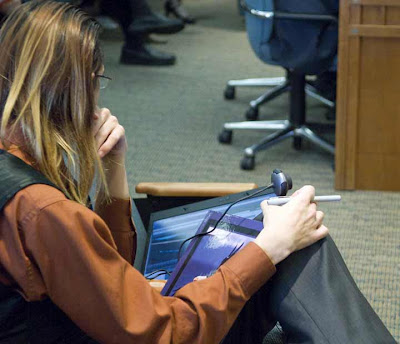 The staff of the New Mexico House GOP Caucus, above, has been using a small camera, held in the hand to webcast various House committees and floor activities.
 So what’s wrong with this picture?
The pictures of the Rules committee were taken during the Friday meeting where the issues of webacsting and transparency were taken up after they had been tabled on Wednesday.
The twenty-member House Rules and Order of Business Committee amended the resolution, 18 – 0 with two Reps., John Heaton, D, Eddy County and Debbie Rodella, D, Rio Arriba, Sandoval & Taos Counties, excused.
The amendment included two phrases: "and that the stream is not an official record of the house's proceedings," and the webcasting “shall not be archived”.
Rep. Zachary Cook, R, Lincoln and Otero Counties, introduced House Resolution 3, “Amending the House Rules to Provide for Posting Roll Call Votes on the Internet”.
The vote on the passage of a bill, resolution or memorial shall be taken by yeas and nays, which shall be entered in the journal and, within one day of taking the question, be publicly available on the legislature's internet web site.The amendment would have required the posting of all Representatives’ individual votes.
However, the Committee, by the same 18 - 0, with two excused, altered the meaning to apply only to “final” votes. The argument was that it was too much of a burden to “record” votes, which are preliminary or on amendments. Those votes are already recorded; it is only a matter of posting them on line.
The committee also amended the requirement to post the voting record on the internet within twenty-four hours.
 Albuquerque Tea Party Board members Patricia Morlen, left, and Gayle Bacon attended the Rules Committee’s Wednesday session and were using a hand held camcorder to video parts of the proceedings. On Friday they were back.
Seated upper right, is Governor Bill Richardson's Speech Writer Allan Oliver.
Rep. Gail Chasey, D, Bernalillo County, approached Speaker of the House Rep. Ben Lujan, D, Santa Fe County, pointing out the two women.
 Lujan, center, had challenged the two Tea Party member’s asking what party they represented and with what candidate they were associated, Morlen said in an interview.
Lujan demanded to know if the women had received permission to video the proceedings in accordance with House rules.
Photography, video or audio recording or transmission of committee proceedings may, upon request, be allowed with the permission of the chair.The rule was written in response to Rep. Janice Arnold-Jones, R, Bernalillo County, bringing a webcam into her assigned committee meetings of Taxation and Revenue, and Voters and Elections Committees during the 2009 regular session.
TEMPORARY PROVISION: During any session of the forty-ninth legislature, the legislative council service is authorized, in consultation with the speaker, majority floor leader, minority floor leader and appropriate committee chairs, to produce live audio streams of committee proceedings. Any such live audio stream shall be accessible through the legislature's web site in a manner befitting the house of representatives, including an appropriate user interface, and shall begin as soon as practicable after the chair has called the meeting to order and shall terminate as soon as practicable after the committee has recessed or adjourned or upon order of the chair. Any such live audio stream shall carry a notice to the effect that the stream is being produced for the benefit of the public and any political use is prohibited.
 Lujan left the committee room and Rep. Kathy McCoy, above, left, R, Bernalillo, Sandoval, and Santa Fe Counties, asked Chairman Rep. Nick Salazar, below, D, Mora, Rio Arriba, San Miguel, Santa Fe, and Taos Counties, for permission to allow video to continue. Salazar granted permission.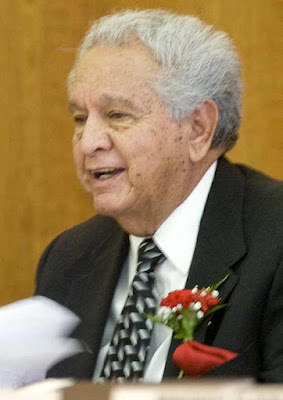
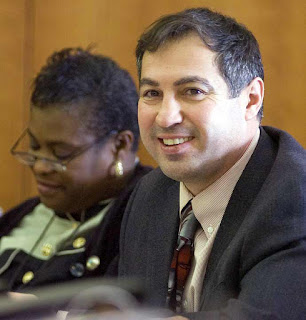 Rep. Elias Barela, right, D, Valencia County, last year said. "I understand the frustration with some members, that we don't have this (webcasting), but just look at the havoc, if one member, of one party, with one ax to grind. And I'm not in any way insinuating that this particular member has that (pointing to Arnold-Jones, standing in the back of the room)." "But, what you're opening up is something that could be used as a partisan tool."
After Wednesday’s meeting, Barela called for an apology for Lujan's comments to citizens visiting the legislature.
The comments by Representatives espousing a fear that video webcasting, and in particular, archiving, might be used as a device to damage them politically, is a recurring theme.
“Almost any words can parsed and used in ways that would seem to be unfair,” Chasey was quoted as saying in an article, “Webcam measure tabled in the House,”
by the New Mexico Independent’s Larry Behrens.
_______
 A third issue, sponsored by Rep. Jeff Steinborn, Left, D, Dona Ana County, House Joint Memorial 15, “Requesting The Legislative Council Service To Webcast and Archive Interim Committee Meetings,” was approved. The Legislative Council Service John Yeager, front, answered technical questions for the committee.
The memorial will work its way through the committee process with its next hearing before the House Appropriations and Finance Committee. If it passes the House floor it would go to the Senate for concurrence.
Rep. Arnold-Jones sponsored a resolution, “Amending the House Rules to Require Webcasting of Committee Meetings and to Authorize Video Webcasting of House Floor Proceedings.” The resolution expands coverage to committee meetings.The matter is scheduled for a hearing before the House Rules and Order of Business Committee, this morning.
 This is Arnold-Jones listening to Governor Bill Richardson’s state of the State address at the opening of the 30-day session. The camera, mounted on the wall, behind her was a remotely operated broadcast camera belonging to KNME TV which covered the speech live.
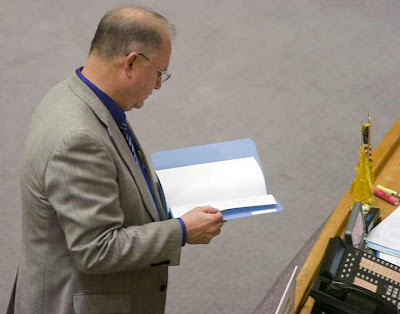 On the other side of the Capitol, Senate Floor Leader Sen. Michael Sanchez, above, D, Valencia County, has introduced Senate Resolution 1, “Amending The Senate Rules To Expand The Number Of Cameras Used To Webcast Senate Proceedings.”
The resolution, if passed, would add the use of additional cameras to cover Senate floor activities. The resolution removes the language limiting coverage to one stationary camera replacing it with:
…produced from cameras configured and operated in such a way that as much of the chamber is displayed as practicable but that no material on members' desks, computer monitors or similar devices can be read or viewed except as would otherwise be possible with an unaided eye;There is no proposed change to the prohibition of archiving webcasting.
My TakeThe citizens of the state are entitled to be intimately aware of how the business of spending their tax dollars is done. It starts with the legislature, but it also includes the executive branch.
The so-called move towards transparency is simply resulting in a less opaque view; it’s not clear yet.
Opening the legislative process to the prying eyes is only a scratch of the surface.
If one takes a look at the judicial system, it is obvious that every court proceeding takes place in public rooms; the result is such high public confidence that seldom do routine trials attract citizen’s attention. It is the knowledge that one can simply walk into a courtroom at any time and watch every aspect assuring that the system works.
There are rules requiring media access to the courts.
Such rules exist for access to all meetings of governmental bodies through the State Open Meetings Act.
Another aspect of public oversight comes from the State’s Inspection of Public Records Act. Of course when you have employees of the State refuse to comply with the requirements of the act and be either non-responsive or worse, deny access to the papers of the work of government, then transparency is replaced by corruption per-se.
 Transparency is more than the public spectacle of covering the Governor's state of the State address, above, with live coverage from local television stations, below, and all the attendant media frenzy.
 Currently, the Governor, through his Assistant Chief of Staff and Director of Communications has been stubborn in his refusal to identify 59 exempt employees that the Executive claims had their jobs eliminated to save millions of dollars during this depression by claiming it would be undignified to disclose who they are.
There are a number of exceptions to the IPRA, being "undignified" is not one of them.
I have not sought this information, as I leave it to others whose compulsion to find out the details is their desire, I know a couple of ways to seek the information to get around the stubbornness of Gov. Richardson and to establish those identities without having to resort to going to court.
One of the best way for the public to view the legislative process is through the governmentally staffed closed circuit remotely controlled triangulated camera webcasting.
Those who have expressed fear of being exposed for saying something foolish and don’t want to be held accountable and responsible for their actions and comments should not worry about a system of following the speakers during the legislative debate.
 Here, three-fifth 's of New Mexico's Congressional delegation, US Sens. Tom Udall, Jeff Bingaman and 2nd Congressional District Rep Harry Teague listen to Richardson's speech. Udall and Teague were reading along with the speech; Bingaman rested his eyes momentarily. The federal lawmakers are on camera all the time while in session and you don't hear them complaining. The two Congressmen not present have specifically availed themselves of C-Span to get their faces and message out to the public.
 The media may be battling for their continuation, but there are still those who will point their cameras, like the Santa Fe New Mexican's Director of photography Clyde Mueller, and ask questions like Albuquerque Journal's Sean Olson, center, speaking with Sen. Linda Lopez, left, D, Bernalillo County.
 As long as there is a press box full of journalists from TV, print and the internet, and because of the ever improving and simplifying of new technology and ease in getting information to the masses via the web, I have no fear that the Government controlled webcasting will become a propaganda tool. There are just too many eyes watching; more would only make the discussion better.
 Advocates for total transparency want to see everything and to have all the information archived, so that citizens who cannot watch government in person or because they work during sessions may stay informed. The archiving push is also for educational, research, and historic purposes. Legislators don’t want archiving for the very same reason; they don’t want to be held to public scrutiny, accountable for what they say.
 If the dumbest thing Rep. Chasey, above, ever said was that she was afraid that some political opponent might parse her words to gain a campaign advantage, she hardly needs to worry. The fact that she has a penchant for playing solitaire on her computer during the session hasn’t gone unnoticed; however, I doubt that it will diminish her viability as a candidate for reelection.
Transparency will not be totally achieved by just being able to look at legislators while on the floor of their respective Houses, because so much of government is still done in the shadows and back rooms or under the guise of attending a caucus outside of the average person’s view.


