Tuesday, January 15, 2008

A Restaurant Review

What’s Wrong With This Picture?

I haven’t done a restaurant review on this site; I haven’t had a meal well enough prepared upon which to comment.

On my way back from a business trip to Roswell late last week, I stopped in Capitan. It is a small town, best known for being the home of Smokey Bear.

On the corner of Smokey Bear Boulevard, which is Highway 48 at South Lincoln, I had dinner at the Greenhouse Café. The outside is a rustic looking building that gives no indication of the atmosphere inside.

It is a narrow dining room that seats about 30. It has warm low lighting and walls adorned with locally produced jewelry, pottery and leatherworks.

The meal started with a fresh salad, grown hydroponically in the chef’s own “Greenhouse Gardens.” It was a collection of mixed greens with numerous choices of dressings. I had a blue cheese in oil dressing. For the entrée, the special of the night was scallops in a white chocolate with Chardonnay and dill. It was complimented with mashed potato and a side of vegetables.

So what’s wrong with this picture?

You’ve probably heard the phrase running around the kitchen; this is Chef Tom Histen, literally running around his kitchen.

The clientele was clearly the Texan ski crowd that had come down from Sierra Blanca. The Texas accents were thick. The overheard conversation from our eastern neighbors was that the snow was manmade, yet the lift lines were non-existent.

The Greenhouse Café serves dinner Wed. through Sat. from 5 pm to 9 pm and Sun. brunch, from 10am to 2 pm. Lunch is served only during the summer. The Café is closed Mon. and Tue.

If traveling between Roswell and Interstate 25, this restaurant and its sauces are worth the trip.

Thursday, January 10, 2008

Time to Smell the Coffee

What’s Wrong With This Picture?

When Bill Richardson is tired, a cup of coffee is not always enough to keep him awake.

These are pictures of him, taken after he had flown nearly halfway around the world from Sudan to Albuquerque in January 2007. He was obviously tired; he had trouble keeping his eyes open and a third cup of coffee wasn’t helping.

The cliché, time to smell the coffee, seems to have caught up with Richardson. After finishing fourth in the first two forays of the Democratic presidential campaign, with two percent in the Iowa caucus and five percent in New Hampshire, the Associated Press is reporting that Richardson will withdraw from the race today.

So what’s wrong with this picture?

There is a fair amount of speculation of what’s next for Richardson. The commenter, LP, called me out for suggesting that Richardson might possibly run for the Senate. LP wrote that Richardson would not stab Rep. Tom Udall, current Democratic Senate candidate, in the back.

It is my considered opinion that Bill Richardson is not prepared to mark the beginning of the end of his political career. Yet, over the past week, he seems to have made a serious tactical error in Iowa where it was reported that he made a deal with Sen. Barack Obama. According to members of Richardson’s Iowa staff, if he did not meet the minimum 15 percent support in the complicated caucus rules, he asked that his supporters switch to Obama.

The Clinton camp was furious. After having appointed Richardson to two high level positions during Bill Clinton’s presidency: United Nations Ambassador and Secretary of Energy, the deal to have supporters switch to Obama was seen as back stabbing.

If the Clinton camp sees Richardson as a backstabber, there is little reason for anyone else to feel assured that it could again happen elsewhere.

The last time I saw Udall, far left, Clinton, center, and Richardson, far right, together, they were on stage at Patricia Madrid’s late night rally last year. Who could have imagined that “loyal Democrats” could have created such a political riff.

My Take

Richardson, in spite of any hard feelings he may have caused at the national level, is popular enough in New Mexico to be favored in the Senate primary and general election.

We’ll see what happens… Stay tuned.

Monday, January 07, 2008

My 2% worth

What’s Wrong With This Picture?


New Mexico Gov. Bill Richardson got 2.11 percent, with 53 votes in the Iowa Caucus. He remains fourth behind the new Democratic front-runner, Illinois Sen. Barack Obama, who received 37.58 percent, with 940 votes, followed by former North Carolina Sen. John Edwards with 29.75 percent, with 747 votes, and New York Sen. Hillary Clinton, with 29.47 percent, with 737 votes. For more details check the Iowa Democratic Party Caucus results and the New York Times.

Delaware Sen. Joseph Biden Jr., received 23 votes, for 0.93 percent, Connecticut Sen. Christopher Dodd received a single vote, for 0.02 percent. There were three uncommitted votes, for 0.14 percent. Two candidates, former Alaska Sen. Mike Gravel and Ohio Rep. Dennis Kucinich received no votes.

Biden and Dodd announced their withdrawal from the race after their poor showing in Iowa.

The Iowa Caucus results from its 1,781 precincts are used to determine delegates and alternates to their county Democratic conventions. At those conventions, held between April 26 and June 14, the Iowa Democratic Party will choose 46 delegates to the national convention.

The Republicans will choose their 37 national party convention delegates on June 14.

According to the Iowa Republican Party:
Former Arkansas Gov. Mike Huckabee got 34.4 percent, received 160 caucus votes with 40,841 total votes. The total votes translate into caucus votes that will be used to determine national convention delegates.
Former Massachusetts Gov. Mitt Romney got 25.2 percent, received 31 caucus votes with 29,949 total votes.
Former Tennessee Sen. Fred Thompson got 13.4 percent, received 24 caucus votes with 15,904 total votes.
Arizona Sen. John McCain got 13.1 percent, received 22 caucus votes with 15,559 total votes.
Texas Rep. Ron Paul got 10.0 percent, received 19 caucus votes with 11,817 total votes.
Former New York City Mayor Rudolph Giuliani got 3.5 percent, received one caucus vote with 4,097 total votes.
California Rep. Duncan Hunter got 0.4 percent, with 524 total votes.
Colorado Rep. Tom Tancredo got 0 percent, received one caucus vote with five total votes.

Those are the facts, but what do they mean? The Iowa Caucus, is at best, confusing.

The New Hampshire primary is tomorrow. New Hampshire, based on its own law, is the first primary in the nation and will directly select delegates to the major national party conventions. Registered independents may take a ballot from either the Republican or Democratic Parties. Up to 30 percent of the voters may be independents.

“Pretty crazy here in NH now, from my observation,” writes in Video Photojournalist Todd Ziemek. “I think the nation is going to be surprised (if their not already) on how many people want change...”

Ziemek, who used to be a KOAT TV videographer, has been covering the campaign trail, being in Iowa last week and his, new home state, of New Hampshire sends this stilled frame of Obama from his last assignment.

This is Moondog; he was a soothsayer who used to stand on New York City sidewalks carrying a spear, wearing homemade clothing, including a cape and a cap. Here he is in front of the CBS building in New York City in the fall of 1969. Later in life he wore a helmet with horns and was referred to as “the Viking.” At first glance, one might think he was no more than a stoic forecaster of the truth.

However, there was much more to Moondog. Born Louis Hardin, in Maryville, Kansas, he lost his eyesight in a railroad fuse accident when he was 17. He attended the Iowa School for the Blind where he studied music. Hardin would become a musical great; some called him an icon. His eccentricity seemed to get in the way of his talents. He was written about, he was sung about by singers of the caliber of Janis Joplin and Bob Dillon. Hardin was an accomplished classical musician. He also wrote poetry and music and performed in Carnegie Hall.

Soothsayers have been around since the dawn of time; the most famous, Shakespeare’s character whom, in Julius Caesar, warned “Beware the Ides of March.”

I am no soothsayer; not even a political prognosticator. However, the early events of Iowa and New Hampshire, as far as I can tell, are not accurate indicators of the will of the populace, but simply because they are first, they have a disproportionate effect on our election process. New Hampshire, by allowing independents to vote skews the party system. In a way that might be a good thing, as it expresses the will of the people, however because it is one of the few places that does not adhere to the strict party choices it changes the dynamics.

So what’s wrong with this picture?

This is Ohio Congressman Dennis Kucinich, seen here during the September 4, 2003, Democratic Party Presidential candidate debate at the University of New Mexico's Center for the Arts' Popejoy Hall. He did not take the stage in New Hampshire Saturday night and he is mad about it.

It seems that ABC, which broadcast the debate, created some rules that limited which candidates would be allowed into their televised debate. In order to be eligible to participate, ABC required that a declared candidate must have one of the three: finished in the top four positions in the Iowa Caucus; or place with more than five percent in one of four the most recent state polls; or place with more than five percent in one of the four most recent national polls.

Kucinich filed a complaint with the Federal Communications Commission. According to the Associated Press, as seen on the ABC site, but not part of their on-air reporting.

"ABC should not be the first primary," Kucinich complained, in his filing. He claimed, that ABC’s parent company, Disney, had made political contributions to the four Democratic candidates who took the stage, but not to him.

Kucinich asked the FCC to enforce the equal-time provision of their rules. Unfortunately, the equal-time provision of the Fairness Doctrine no longer applies as a rule, since deregulation of the communications industry under Ronald Reagan’s presidential administration.

Reagan, you may recall, started his professional life as a radio sportscaster calling baseball games. He went on to be: a movie actor, the President of the Screen Actor’s Guild, was host of the TV programs “General Electric Theater” and “Death Valley Days,” and then spokesman for General Electric; before running for governor of California.

Reagan might have had some insight when he ordered deregulation as the cable industry expanded and the concept of pay TV was taking hold.

One of the reasons for voiding the fairness doctrine’s equal-time provision was the argument that political candidates had access to putting forward their message based on economics, or the ability to buy advertising time.

My Take

Kucinich makes a valid point; why should a network determine whom the American people see as a valid candidate after a single political exercise?

Disney, along with General Electric, are two of the six large companies that control the majority of media outlets in this country.

So, the question of one-man, one-vote is in jeopardy as big corporations influence the public through their contributions and their exercise over who gets air time.

My crystal ball is hazy. I don’t know what Richardson might do. He has several options available to him should the presidential run fail. Being governor, starting just his second year of his second four-year term he can do several things and if they fail he’s still governor. He could enter the U.S. Senate race for the seat left open by Pete Domenici’s retirement. By all accounts, Richardson could walk away in that race. He is term limited, so if he won the Senate race he would extend his uninterrupted political life with the six-year term. It also would place him in another high profile political position that, should a Democrat not take the White House, he would be positioned to take another run at the presidency from the Senate in 2012. A lot of people think he has a good chance of being selected as the vice presidential running mate to whomever wins the Democratic party’s nomination, or he might be appointed to a cabinet post should a Democratic become president.

Though his resume looks good, and he has made some gaffs along the campaign trail so far, he has missed a couple of political opportunities, like announcing late, after Obama, that may indicate his failure to have a razor sharp political sense. He still can cut deep, but can he cut through the political din?

His campaign is not dead in the water today, as some pundits wish; yet it might be tomorrow night…

As for Richardson’s two percent, I believe he will try to stay in the race until Feb. 5, when the Super Tuesday primaries, including New Mexico’s Democratic Party’s caucus, takes place. New Mexico’s Primary is the last in the nation, held on June 3, along with South Dakota.

The bumper stickers should be fairly weathered by then. Or they might read Richardson for Senate… .

Friday, January 04, 2008

Kenyan History of Tough Politics

What’s Wrong With This Picture?

It is a wreck. This Mercedes Benz transport turned over along Kenya’s highway A109 from the capital, Nairobi to the country’s major Indian Ocean port city of Mombasa. These pictures were taken 10 years ago. It represents the political reality that country was and still is experiencing. I doubt much has changed in the rural parts of the country.

The Republic of Kenya acquired its independence from the United Kingdom’s Empire when it was British East Africa, in 1963. It is considered one of the most stable democracies on the African continent. It uses the British common law and its own statutes as its legal basis. Kenya has a population of about 37 million and is about the size of the state of Nevada.

I was on a cruise with my parents and Mombasa was the original destination for the Kenyan leg of our trip. However, the British government had posted a travel advisory about its former colony, based on political instability in Mombasa.

In 1997, the country was preparing for national elections and it seemed that the local political party around Mombasa was taking to the streets, protesting their allotment in the country’s National Assembly known as the Bunge. The British advisory, like those of the United States and the European Union, are usually considered very seriously by each other and followed. In this case, port activity dropped to a minimum, dockworkers had little work, the local economy suffered and the trade route traffic was reduced to a trickle. A short while later, the local political party, feeling economic pressure, announced that it had reevaluated its claim and agreed that the election commission’s apportionment was accurate. The local thinking at the time was that the economics of the boycott was hurting the political party’s chances in the upcoming elections.

About half the population lives in poverty. Seventy-five percent of those working do so in agricultural endeavors, yet only eight percent of the land is arable, according to the Central Intelligence Agency’s World Fact Book. Over the past five years, anti-corruption efforts and reform measures have waned.

President Mwai Kibaki, a member of the Kikuyu tribe, the largest in the nation, ran for reelection to a second five-year term. He was narrowly elected Dec. 27, 2007. Immediate disputes over the validity of the election process were raised. International and independent poll watchers have refused to verify the outcome. The United States and European Union will not recognize the election results. The African Union and the Commonwealth observer mission are attempting to mediate.

Chairman Samuel Kivuitu of Kenya's electoral commission has indicated that pressure from the ruling party to quickly declare Kibaki the winner was applied, while he acknowledged that there were inaccuracies in the results.

Kibaki has already been sworn in and violence has broken out across the country killing over 300 people. Over 100,000 people have been displaced.

The road to Mombasa, that was patrolled by traffic officers, like this stationary patrol, is now closed. The ruling government refuses to accept any outside efforts for assistance and has sent police to quell the violence.

Kibaki has agreed to talk to the opposition, but only if calm is restored. All governments that face internal violence must take that stance. However, if the violence persists, the chances of peaceful resolution are highly unlikely.

Now, the election might well have been fair, properly run and above board. Any perception otherwise would be put to rest by acceptance of the ruling party to a thorough audit of the votes. There may be problems as some ballots may have been prematurely destroyed.

The political divide initially appeared to be along economical lines -- poor versus rich. Ethnic and tribal clashes seem to have now escalated as the level of dissatisfaction grows.

The economics of Kenya may be influenced, as demonstrated by the placement, order and size of the flags that flew in front of the Nairobi Hilton Hotel. From left: the United Kingdom, the United States, Kenya and the European Union.

So what’s wrong with this picture?

This young man pointed at me as we drove slowly by the crash site. Our driver, James, a retired Kenyan army solider, warned me that some citizens did not like the presence of foreign tourists and might throw rocks at his tour van. Apparently, tourism didn’t impact the youth economically, as it did others.

“Power comes from the end of a gun,” Mao Tse Tung, chairman of the Chinese Communist party and Dictator of the People's Republic of China said. Mao was not the most democratic thinker in the world. However, his quote may have some real truth to it.

This past week, Kenya was not the only democracy where violent incidents may disrupt what is called the democratic process of “free elections.”

Former two-time Pakistani Prime Minister Mohtarma Benazir Bhutto was assassinated Dec. 27 at the end of a political rally, by a man who fired between three and five rounds before detonating a bomb, killing 35 people.

The event took place in Rawalpindi, eight miles south of the capital, Islamabad. Rawalpindi is the home of the military headquarters and the site where her father, the former Prime Minister Zulfikar Ali Bhutto, was hanged in 1979, after being deposed in a military coup.

Bhutto returned to Pakistan on Oct. 18, to run for office in the scheduled Jan. 8 elections. She was under death threats and while traveling from the Karach airport into the city, two bombs were exploded killing about 200 people.

Had Bhutto been elected and her Pakistan People's Party prevailed, it was almost certain that she would again become Prime Minister. Her two previous stints as prime minister ended with charges of alleged corruption and she went into self-imposed exile in Dubai.

President Pervez Musharraf had earlier declared a state of emergency and imposed martial law upon the country. It was just before the supreme court, whose justices he had appointed, were about to hand down an opinion that would have required Musharraf to give up his role as head of the military to run for president. Ironically, Musharraf gave up his general’s uniform shortly after restoring freedoms. He did not restore the supreme court justices to their positions.

Pakistan is a vital ally to the U.S. and holds an important role in fighting terrorism. It also poses potential threat as a nuclear power. It is one of the few democracies from the Middle East across the Asian continent, though it borders the largest democracy in the world, India. They are no friends as they have always had differences over land disputes and religion.

The democratic process in Kenya and Pakistan is clearly stressed.

So, what does this have to do with our democracy?

This week, the election process in our country takes its first formal steps with the Iowa caucus and then the New Hampshire primary. They will, in all likelihood, eliminate many if not most of the candidates in both parties.

As messy as our politics are, our history has had its share of violence.

In 1968, the assassination of Robert Kennedy during the primary season resulted in Hubert Humphery, left, becoming the Democratic Party’s candidate against Republican Richard Nixon, right.

In 1972, Democratic Party nomination hopeful, Alabama Gov. George Wallace was the victim of a would-be assassin in a Laurel, Md., shopping center. He is seen here, sitting in a wheelchair, at the top of the podium, behind President Richard Nixon, during his second inaguration, Jan. 20, 1973.

It is doubtful that our election process will not be an orderly affair. There is a fair amount of criticism about how the relatively small state populations of Iowa and New Hampshire are likely to determine the candidates for the general election. It is the nature of the process that allows for quick and almost certain lethal blows to be administered to candidates’ campaigns that do not charm the early primary voters. The political pollsters will argue that if you can’t energize the cold weather voters, you’re not going to do any better in the other, later primaries.

What is happening in the world is evidence of how fragile democracies also can be.

Wednesday, January 02, 2008

Tribune’s Days Numbered?

What’s wrong with this picture?

This is the University of New Mexico’s newly remodeled Communications and Journalism School. Being on the historical registry, the exterior retained all the architectural character of its 1949 era Spanish-Pueblo Revival design.

The refurbish job seems pretty good. There are state of the art classrooms with computer projectors, several large computer labs and a suite of administrative offices. The offices for instructors and professors are still small. After the first semester, the building seems to be functioning fine.

It was originally the Journalism building, printing plant and post office. I first visited it in Aug. 1967 during the week long New Mexico Interscholastic Press Association Workshop. At the time, I thought I was a well-seasoned student newspaper and yearbook photographer, having been published for all of three years.

The then UNM Journalism School's Chairman and Professor Tony Hillerman was the coordinator and master of ceremonies at all the evening convocations.

Now, 40 years later, I seem to be coming full circle. I attended a class in the same room this semester as I had back then. A new computer-driven console that runs a digital projector now replaces a simple wooden lectern. The picture of the Hindenburg disaster is gone; blank white walls give tribute to the meaning of today’s sense of journalism.

There currently is little art in the building. There are a handful of Photojournalism Professor Miguel Gandert’s local cultural portraits and little else in the public areas. However, there is this 1973 sculpture by J.D. Hammond, “Give light and the people will find their own way.” It is made with parts from the printing process of the day, specifically a linotype bed and two different kinds of printing plates. The saying is the motto of the Albuquerque Tribune, written by Carl Magee who sold his one-year old Magee's Independent paper to Scripps Howard publishing company as the Tribune in 1923. Magee remained as editor.

This is the current flag of the Albuquerque Tribune. A “flag” is the journalistic name for the graphic logo used on the front page of a newspaper.

The Tribune is owned by E.W. Scripps and is operating under a joint operating agreement since the 1930s. A JOA is an exception to the monopoly laws and anti-competition rules. It allows a morning and evening newspaper in a city to join forces and share certain aspects of the newspaper business, while still competing. The Albuquerque Publishing Company, owned by the Lang family, is headed by the eldest son of the former publisher, Thomas J. Lang.

The Tribune has a long history. Magee uncovered the Tea-Pot Dome scandal. Ernie Pyle was a Tribune writer who went on to be considered one of the great World War II correspondents. The Tribune’s Eileen Welsome received the national reporting Pulitzer Prize in 1994 for her coverage of secret radiation experiments conducted by the government almost 50 years earlier.

These students are part of the editorial staff at the UNM Daily Lobo: Design Director Colin Bridge, Editor in Chief Christopher Sanchez, Rhian Hibner, and Managing Editor Damian Garde. They also represent the leadership and core of the UNM campus chapter of the Society of Professional Journalists.
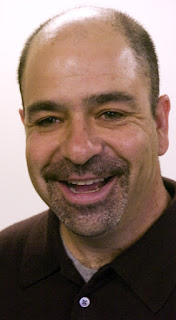
SPJ invited Phill Casaus, left, to speak before at SPJ's November meeting about the state of the newspaper business in Albuquerque. He has been with the Albuquerque Tribune for the past 11 years as editor, managing editor and assistant managing editor. Casaus doesn’t expect to make it to 12 years. The Tribune appears doomed.

“It’s the last job in America where you put your name on it,” Casaus said speaking of the importance of young journalists to get their reporting right; to be accurate. He spoke enthusiastically about the craft as his paper faces a crisis.

Scripps offered the Tribune for sale at the same time it announced its dissolution of the Joint Operating Agreement with the Albuquerque Journal.

The Tribune’s name will die unless a qualified buyer is found.

However, the 1933 agreement with the Tribune's parent organization, the Albuquerque Publishing Company, now the Journal Publishing Company, is over whether the Tribune’s name continues or not.

Casaus talked with student Margaret Ybarra, who may have been one of the last interns at the Trib. Ybarra is a photographer and has since the internship she has written for Albuquerque Arts and is the Assistant Cultural Editor at the Daily Lobo.

UNM’s Journalism Lecturer Dennis Herrick, left, is the SPJ faculty advisor. He has a great deal of experience with newspapers, having been a reporter, editor, owner/publisher and even a broker, selling newspaper companies. He teaches Media Management, and has written a textbook, Media Management In the age of Giants: Business Dynamics of Journalism. Last summer, a couple of weeks before Scripps announced the demise of the Tribune, Herrick predicted in his copy-editing class that the Tribune was not long for this world. He admits that he had no idea that his prognostication would come true so quickly.

Casaus clearly has his head down putting out a paper six-days a week and was not aware of the details of the management of the publishing agreement. He did not know what the split of the JOA profits were. According to Scripps quarterly report filing with the U.S. Securities and Exchange Commission, the answer is 40 percent of the profits. “[W]e will continue to own an approximate 40% residual interest in the Albuquerque Publishing Company,” until 2022 when the JOA expires.

There is speculation that the sales offer is simply a method of keeping the Department of Justice from seriously looking into the JOA’s profit schedule.

Tom Carroll, left, is president of D.W. Turner, a local public relations firm. Carroll and Doug Turner have made an offer on the Tribune; apparently the only one made by Scripps' deadline.

What does D.W. Turner get if they buy the Tribune? They get the name of a failing newspaper, one that, along with most afternoon papers in this country, has shrinking readerships. They also would get four aging automobiles, some old computers, office equipment and furniture. The potentially most valued asset is the web domain name. Employees appear to be negotiable, but not part of any up-front offer.

What they do not get are any of the benefits of the JOA: access to the presses, advertising or circulation staffs.

Anyone wanting to take over the afternoon newspaper niche might be better off starting from scratch.

There have been several people who are or were Tribune staffers in the news of late.

Dennis Domrzalski, left, was a Tribune staffer for 12 years starting in the mid-1980s.

He’s bounced around since: he was the news editor at the Alibi, a writer at New Mexico Business weekly, a radio newscaster at the now defunct, 106.3 KAGM FM, and currently is spokesman for the Middle Rio Grande Conservancy District. He also has written a book, “I Got Stinky Feet” and has blogged on occasion. He has a current offering, f-brilliant. He wrote a piece “The Tribune's Psychosis, A Few Reasons The Tribune Failed.” It’s worth the read. I hope Domrzalski continues blogging a little longer than his last effort, Spin Free, with its five postings.

He last wrote of Anna Politkovskaya,the murdered Russian journalist and critic of President Vladimir Putin: “Count your blessings for having been born in America. You've got it incredibly easy compared to everyone else in the world.”

Just because Domrzalski was called on the fact that Politkovskaya was born in America to Russian diplomats stationed in New York at the United Nations was no reason to go away for a year. Welcome back anyway.
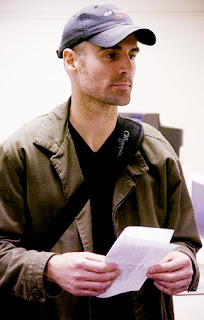
Michael Amedeo Tumolillo, left, works under his middle name Amedeo. You met him here, when he spoke to my advanced reporting/multimedia journalism class a year ago. He was the video producer at the Tribune, but has left. He secured work as Web producer at the International Herald Tribune – Asia-Pacific, in Hong Kong.

The International Herald Tribune is owned by the New York Times Company and Amedeo spent a week in New York obtaining some in-service training before heading to the Far East.

Alisa Valdes-Rodriguez, left, spoke at the University of New Mexico, in August of 2006 as father, UNM Sociology Professor Nelson Valdes, right, listened to her.

Albuquerque Tribune political reporter Kate Nash wrote, Tue. Nov. 27, 2007, that Valdes-Rodriguez wants to run for congress.

Valdes-Rodriguez had written Tues. Nov. 20, “Testing the Waters for Congress,” that she was raising money to examine the possibility of running for democratic nomination for the New Mexico Congressional District 1 on her blog, “The Latina (L)it Girl,” now under the title Multiplicative Identity and her MySpace page. She has at least a half dozen blogspots and web-pages.

I am amazed at the thinking, talent, and boundless energy Valdes-Rodriguez seems to display. She is a former journalist, a blogger who acts like a journalist, a best selling novelist, and a screenwriter who is bringing her first book, The Dirty Girls Social Club, to production as a Hollywood movie.

She is extremely sharp, tough, and all too human, at the same time. I won’t point out her flaws, because if one follows her writing, she does an excellent job of exposing them herself. I wouldn’t do it for another reason; though they seem like flaws, she uses them as strengths and I’m not going to dispute her. In politics, the public is unlikely to embrace her brutal honesty. It seems they wish to vote for people who lie to them.

There were some problems that would face Valdes-Rodriguez in a run for the House. The first problem is her house, her residence. She moved in the summer from Albuquerque’s North Valley to Scottsdale, Ariz., in what she described as a necessary move. Now she seems to hate Scottsdale, recently writing that her neighborhood association is dictating what flags residents may fly; the American flag is one of the few still approved. Her liberal sensibilities seem offended by "my adopted home state," Arizona’s conservative culture. The Constitution requires a candidate to be an inhabitant in the state at the time they are elected. So it’s time for her to come home.

It brings her to the other point, that, no matter how smart and clever she is, she has amassed a huge written history of blunt and even sometimes vulgar comments on almost every topic of concern to our society. Though it is oft-heard that voters want an honest person who speaks their mind, the reality is that as voters, citizens have an abysmal record of not paying attention to the issues or what is happening in the political arena.

Political consultants and handlers try to limit their candidates to a few simple points and then repeat them until Election Day. Unfortunately, those political operatives are usually right, because so many citizens are lucky to even be able to name the top tier of candidates and might only have a limited range of familiarity with the names of those running in the lower ballot position races.

To her credit, Valdes-Rodriguez is capable of being very conversant with the issues of the day. However, being so attuned to the issues will not serve her well on the campaign trail, as she will exceed the constituency’s desire and therefore their ability to keep up. I wish it weren’t so, but it is.

She has so many irons in the fire that she comes off as flighty.

I am not supporting her or suggesting that she shouldn’t run or that she might not be able to mount a competitive campaign. She’s the first to admit she is “no politician,” though that is exactly what she is; just not in the political party kind of way. She is, “of the people.” Poli being the root Latin word in politic, political, politician and even police.

"Nope. 
Not gonna do it,” she wrote on Dec. 8, in announcing her "Decision" not to run.

What I will suggest is that she continue to write and speak out for she is an issue identifier and helps set the agenda.

I don’t know the Tribune's State Political Reporter Kate Nash, left, very well. The longest conversation we had was after last year’s State Legislative session, when the Senate was still wrangling about coming back into special session. She had previously announced in the press box that she was going on a well-deserved vacation to some Caribbean island. On her return, I had asked her why she didn’t look so well tanned. She made some comment about strong sunscreen and her effort to avoid the harmful rays.

Other than that, we simply nod to each other at political events that we both cover. I picked on her a few times on this blog about being geographically challenged when she had misidentified a federal courthouse. I also picked on her friend, Journal Photographer Roberto Rosales, for pushing my camera out of his way when it got into his shot. I’ve also said nice things about her reporting, especially the interview that she and Kate Nelson scored with Gov. Bill Richardson in Feb. 2007.

Nash is an honors graduate of the UNM Journalism school and was the editor of the Daily Lobo. She currently sits on the University’s Publication Board as the professional community member.

Valdes-Rodriguez wrote a glowing recounting, "The Irrepressible Kate Nash," of her days as feature editor at the Tribune, watching and marveling at Nash’s work ethic and writing.

Nash is seen here in the middle of a press row, representing the Tribune at Democratic NM Congressional District 1 nominee Patrica Madrid's concession speech last November.

Santa Fe New Mexican’s political reporter and blogger, Steve Terrell announced that Nash will join his paper in January.

So what’s wrong with this picture?
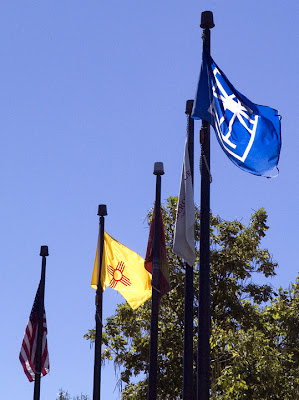
This is the Tribune flag, with the Scripp’s lighthouse icon, at the end of the line in front of the Albuquerque Publishing Company. It seems that the light may soon be gone.

Monday, December 31, 2007

2007’s Top Stories

What’s Wrong With This Picture?

As the year ends, it is a tradition for the media to look back at the past year and pick its top news stories.

The Associated Press put out their list choosing:
1. Senator Pete Domenici’s retirement announcement.
2. Gov. Bill Richardson’s presidential run.
3. Federal Indictments handed down alleging former State Senator Manny Aragón in a kickback scheme on Bernalillo County Metropolitan Courthouse construction.
4. U.S. Attorney David Iglesias fights firing.
5. Statewide smoking ban legislation.
6. Statewide Cock fighting ban legislation.
7. Medical Marijuana legislation.
8. Los Alamos and Sandia National laboratories layoffs.
9. Clovis Tornado.
10. Higher minimum wage.

So what’s wrong with this picture?

AP’s choices make a fair amount of sense; they probably reflect the amount of resources devoted to stories, as a measure of importance, as anything else.

However, my take differs in a couple of places. Probably for the amount of resources I devoted on these stories. Though present at the legislature, I didn’t actually cover the smoking ban, medical marijuana or minimum wage legislation. Nor did I cover the laboratories layoffs or the Clovis Tornado.

I published, contributed or worked on the top four and because of my local concentration, have my own top five.
Here’s my take:

1. Sen. Domenici announced his intentions to run for a seventh U.S. Senate term on March 4.
Domenici announced his retirement on Oct. 4, due to the uncertainties of being diagnosed with Frontotemporal Lobar Degeneration, an incurable disease that causes dysfunction of the brain.Capitol Report New Mexico will be distributed Jan. 9.

Domenici was under a Senate Ethics Committee investigation for having called then U.S. Attorney David Iglesias about whether pending indictments of the Bernalillo County Metropolitan Courthouse investigation would be unsealed before the November 2006 election. The progress of the ethics investigation was suspended when he announced his retirement.

Domenici’s retirement at the end of 36 years opens the political floodgates. Three congressional seats were vacated by Representatives: Republicans Heather Wilson, District 1 and Steve Pearce, District 2 and Democrat Tom Udall, District 3 to run for Senate. Like a tsunami, it’s not just one wave but a series and backwash.

Even those who are politically attuned are having trouble keeping up with the names of and the number of people: considering runs for office, selecting races, announcing candidacies, dropping out of races, switching races and even switching districts.

2. On the first day of the year, Gov. Bill Richardson was sworn in, beginning his second four-year term in office. He announced his bid for the Democratic Party’s presidential nomination on ABC’s Jan. 21 Sunday morning news program, “This Week” with Chief Washington Correspondent George Stephanopoulos. Stephanopoulos was a former associate when both were in President Bill Clinton’s administration.

Richardson’s announcement came just a week after he opened the State Legislature’s 60-day session, declaring it the “Year of Water.”

International concerns of genocide prompted Richardson to travel to the civil war-torn Dufar region of Sudan, where he helped obtain a 60-day cease-fire.

He spent more time on the campaign trail than he has in the state tending to his office.

Richardson has lagged in the polls behind Democratic front-running Senators: Hillary Clinton of New York, Barack Obama of Illinois and former North Carolina Senator John Edwards.

The state of Iowa holds its caucus on Jan. 3, followed by the New Hampshire primary, Jan. 8. Richardson feels he must move upwards in those two states’ selection processes in order to remain a viable candidate. Iowa and New Hampshire voters have a history of bucking poll leaders. The Iowa caucuses are not a straight one-man one-vote proposition, but a consensus affair. Sometimes, the second or third ranked candidate may emerge. This was true for Jimmy Carter and Bill Clinton, both governors. Richardson is hoping for similar results.

3. Federal indictments were handed down against former State Senate Pro-Tem Manny Aragón, left, Contractor Raul Parra, center, former Metropolitan Court Administrator Toby Martinez and his wife Sandra Mata Martinez, right, alleging a kickback scheme of $4.2 million in construction of the new Bernalillo County Metropolitan Courthouse.

Former Albuquerque Mayor Ken Schultz, architect Marc Schiff and electronics subcontractor Manuel Guara, agreed to enter guilty pleas to two counts each of conspiracy and mail fraud, and to testify against the other four. In August, a related indictment was filed against Michael Murphy.

4. U.S. Attorney David Iglesias, right, along with seven other U.S. Attorneys were asked to resign on Dec.7, 2006, from their presidential appointed positions. They claim the firings were for illegal political reasons. Iglesias testified before two congressional hearings that Sen. Domenici and Rep. Wilson made improper phone calls during the 2006 election campaign.

Attorney General Alberto Gonzales, who denied to congress that there was any political component to the firings, came under increased pressure and resigned Aug. 27.

Prominent New Mexico Republicans complained about Iglesias to the Justice Department and White Hous , including: Attorney Patrick J. Rogers of the Modrall Sperling law firm; Albuquerque attorney, Mickey Barnett, who at one time was a Washington based Domenici aide, and later sat on the Republican National Committee representing New Mexico, and currently is a presidential appointed Postal Service Governor; and current Bernalillo County Sheriff Darren White and Republican candidate for N.M. Congressional District 1, who has been involved the State Republican Party, serving as chairman for President Bush's 2004 re-election campaign in Bernalillo County.

White House Deputy Chief of Staff Karl Rove, who was also in charge of: the Office of Political Affairs, the Office of Public Liaison, and the White House Office of Strategic Initiatives, was suspected of orchestrating the politics of the firings. He resigned, leaving the White House Aug. 31.

5. Albuquerque’s Mayor Martin Chávez had multiple failures:

In July, Chávez traveled to China and while there, attempted to secure a Panda for the Rio Grande Zoo.

Chávez openly supported political newcomer Kathryn Martinez, left, to run against Council President Debbie O’Malley. Though he denied publicly supporting another candidate, Paulette de Pascal, in the City Council District 4 race held by Brad Winter, several of Chávez’ mayoral staff members were involved in her campaign. A five Councillor majority coalition had formed blocking several of Chávez’ initiatives. Martinez was soundly defeated and de Pascal lost by the largest margin in the city’s current form of elections.

Chávez vetoed a proposed charter amendment that would make recalling elected city officials nearly impossible. The Council overrode the veto and the electorate passed the amendment.

Voters approved an amendment that took away the sole prerogative of the mayor to make all appointments to city boards and commissions. The Council can now make some appointments where authorized by ordinance.

Chávez solicited contributions for “Chávez for New Mexico” without announcing any solid intentions to run for a particular office.

Chávez expressed an interest in the office of governor, especially after Lt. Gov. Diane Denish, above, was reelected and announced that she was putting her residual funds from last year’s election into a run for governor in 2010. Statewide polling numbers showed Denish would soundly defeat Chávez in a primary. So, he quietly went away.

Chávez said that he was also interested in being a Senator, but would not run against Domenici, offering his support for him instead. When Domenici retired, Chávez announced for the office. Then, when Rep. Udall, above, entered the race, statewide polling numbers showed Udall would soundly defeat Chávez in a primary, especially in Hispanic areas that Chávez thought would support him. He again withdrew quietly.

Chávez threatened the University of New Mexico at a protest rally before a public meeting over a proposed development on the North Campus Golf Course by suggesting he would not approve required construction permits.

Chávez added to the list of offenders who he feels compelled to publicly vilify. His weapon of choice after conviction and sentence is to use a high tech form of the scarlet letter, newspaper advertising, showing the jailhouse mugshots of selected offenders. He has previously gone after sex offenders, drunk drivers and this year, street gangsters.

Chávez’ penchant for the Red Light/Speed cameras caused him no end of political problems. Legislators made moves on forcing the abandonment of the program or having fines go through the state that would take a portion of the proceeds. Eventually, legislation required the city to provide a method of warning for drivers approaching camera-monitored intersections, including the use of flashing lights or rumble strips. After publicly complaining about the state imposed action, the city cut rumble strips into the roadways, rather than installing more expensive flashing warning lights.

The Governor vetoed another bill that had passed by huge margins in both houses of the state legislature. It would have required that fines collected by the city’s “civil” process and administrative hearing officer’s procedures, go through the courts fee system to help pay down the bonds for the Metropolitan Court building. Sen. Timothy Z. Jennings, D - Chaves, Eddy, Lincoln and Otero counties, complained that by allowing Albuquerque to retain the proceeds of the Safe Traffic Operations Program, also known as the STOP ordinance, the rest of the state was having to unfairly fund a greater portion of the Metropolitan Court.

Chávez defended the extra millions of dollars the program generated, but refused to call them profits.

The City Council had been assured each time the City’s STOP ordinance, was reviewed, that it was self funded and any excess would be used to maintain and expand the program and to fund support of prosecutors in the District Attorneys office, especially for methamphetamine enforcement. A one-time contribution was made and now the “excess funds” were used to balance the budget rather than for the maintenance of the ordinance.

Chávez, feeling political pressure, appointed a task force, including members of the federal government to review the issue of automated enforcement. Observers doubt that there will be any serious look at the underlying issues and believe the task force will rubber stamp the mayor’s support.

The City Council voted to suspend the STOP ordinance until the task force renders its report due Jan. 15. Chávez vetoed the suspension and the council overrode the veto.

Just a couple of thoughts on the other stories on AP’s list.

State Senator James Taylor, above, District 14, D, Bernalillo and Valencia Counties, grabbed a smoke after the opening session. The Capitol building was previously designated as a no smoking facility in a bill named after it’s strong supporter, former First Lady Dee Johnson. The legislature outlawed smoking in all public buildings.

During the same session, Medical Marijuana legislation was passed. There seems to be a disconnect; smoking one kind of plant is deemed hazardous to someone else’s health while the smoking of another kind of plant is deemed to be of medicinal value. I know all the arguments; it just doesn’t make sense when the two issues appear in the same paragraph.

As for the Statewide Cockfighting ban; most New Mexico counties and cities and many towns had already outlawed the blood sport.

The strongest argument for not banning the grisly venture was a reliance on provisions of the Treaty of Guadalupe Hidalgo having to do with respect for religion and culture.

At a North Valley City Council candidate forum, sponsored by New Mexico Vecinos Unidos, Carlos Cansino, wearing his cockfighting cap, called for the City Council to reinstate cockfighting in Albuquerque using the Treaty of Guadalupe Hidalgo.

ARTICLE IX
The Mexicans who, in the territories aforesaid, shall not preserve the character of citizens of the Mexican Republic, conformably with what is stipulated in the preceding article, shall be incorporated into the Union of the United States. and be admitted at the proper time (to be judged of by the Congress of the United States) to the enjoyment of all the rights of citizens of the United States, according to the principles of the Constitution; and in the mean time, shall be maintained and protected in the free enjoyment of their liberty and property, and secured in the free exercise of their religion without; restriction.

The 1848 treaty applied to all the land that changed hands after the Mexican-American war. The area became U.S. territories that are now the states of California, Nevada, Utah, and parts of Arizona, Colorado, Wyoming and New Mexico. All of them have successfully banned cockfighting. The State’s ban has withstood its first challenge when a state District Court refused to issue an injunction to ban enforcement of the law earlier this month.

It further would seem that only those parts of New Mexico, west of the Rio Grande, were covered by the treaty, because when Texas gained its independence from Mexico in 1836, the western border was the river.

It seems to me that in 1848, people had the right to smoke in public buildings; they even had the right to smoke marijuana in public buildings. However, as a society we have seen fit to curtail those rights and what was “maintained and protected in the free enjoyment of their liberty and property,” is no longer. Killing chickens with razorblades attached to their legs, as sport, just isn’t acceptable social behavior anymore.

So, the year 2007 is in the bag.

2008 looks promising, Happy New Year!