Tuesday, December 06, 2011

Almost Live Television, all smoke and mirrors?

What’s Wrong With this Picture?

Some events are more ironic than others.

I was invited to attend the taping of a segment of KNME’s “In Focus” program, to be aired April 22, 2011.

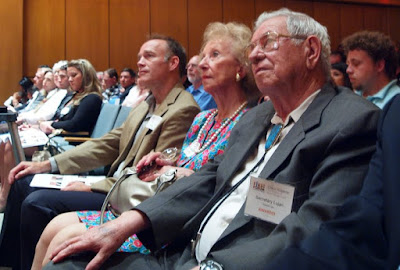
They needed bodies to help fill out a studio audience. The actual audience was made up of students from UNM Journalism Professor Ilia Rodriguez’ Media History class.

The segment was a conversation via satellite from San Francisco, with Dr. Daniel Ellsberg, of his release in 1971 of a classified history of the Vietnam War known as the Pentagon Papers, the release on PBS of a movie, “The Most Dangerous Man in America,” and the relevance of events of the day with WikiLeaks, and its founder Julian Assange.


The New York Times published three segments starting Sunday, June 13, 1971, before Richard Nixon’s Attorney General John Mitchell’s Justice Department filed for and was granted an injunction keeping the Times from continuing publishing. At the same time the Washington Post began publishing details of the papers. The Post was asked to voluntary refrain from continuing publishing. The Post refused and Justice sought an injunction in Federal District Court, which refused to order the paper to stop. Two days later, the Boston Globe began publishing aspects of the leaked documents.

Fifteen other papers printed stories about the Pentagon Papers.

The U.S. Supreme Court took up the two injunctions on direct appeal under the caption, New York Times Co. v. United States.

The court, with each justice writing separate opinions, ruled 6-3 that the government had not satisfied the high burden necessary in proving the compelling national security interest, outweighing the public’s right to know what their country was doing in their name, before allowing the government to exercise prior restraint against publishing the Pentagon Papers.

The revelation of the papers’ content, though marked Top Secret “Sensitive”, never threatened national security, but proved embarrassing to the former administrations of Presidents John Kennedy and Lyndon Johnson, who had lied to the American public and Congress.

Ellsberg, admitted he had leaked the Pentagon Papers, turning himself in to federal authorities in Boston. A federal grand jury in Los Angeles, indicted Ellsberg for a violation of the espionage act of 1917.

Daniel Ellsberg was viewed as the critic of the Vietnam War. Nixon, Mitchell, and US National Security Advisor Henry Kissenger were recorded on Nixon’s secret tapes plotting to “get Ellsberg.”

“The most dangerous man in America,” Kissinger called Ellsberg, In an effort to “get” Ellsberg the “White House Plumbers,” were formed and their first assignment was to break into the office of Dr. Lewis J. Fielding, Ellsberg’s Los Angeles based, psychiatrist, looking for incriminating evidence to help stop leaks of classified documents to news media.

The Plumbers reported to their White House superiors, that their mission was a failure; Dr. Fielding said Ellsberg’s rifled records were on the floor of his office.
(Personal conjecture – the plumbers succeeded in photographing the records and left the file as a message that they had been there.)
The Plumbers would be later used to break into the office of the Chairman of the Democratic National Committee Lawrence O'Brien, at Democratic national headquarters in the Watergate complex a couple of times. On their second sortie they were caught by plain clothed Washington Metropolitan Police officers.

During the Watergate investigation information about the Plumbers burglary of Ellsberg’s psychiatrist’s office was made public. The federal district judge in California dismissed the case against Ellsberg for the governmental misconduct.


So, What’s Wrong With this Picture?

Stand By We are experiencing technical difficulties.

The KNME studio was set up so host Gene Grant could look at a large monitor in front of him with Ellsberg shown via satellite.

Ellsberg could be seen and heard in Albuquerque, but he could not hear Grant.

Grant using a mobile phone, to talk to Ellsberg, overcame this technical difficulty. However that was not going to work because Ellsberg couldn’t be seen on camera, talking or listening to a phone.

Solution, Grant talked to the studio floor manager in San Francisco who repeated the question Ellsberg would then answer.

KNME videotaped a specific student question from Aubrey Hovey of how Ellsberg felt about the demise of newspaper print journalism, and a consensus class question asked by Professor Rodriguez, of how to deal with the tension of how to protect national security interests with the public’s right to know?  The questions were passed on to Ellsberg in the same telephoning way.

The rented satellite time expired and Ellsberg disappeared from the screen.

Grant thanked Ellsberg by phone and signed off.

Producer Kevin McDonald, entered the studio from the control booth, announcing to the students from the ethics class that the session would air:

Friday night seven o’clock, “New Mexico in Focus” you’ll see this, we’ll make it look like all that technical stuff never happened; that was really cool that you came up and asked those questions.

The studio audience left and Grant remained to ask his question into the camera without the cellular phone.

Then in the editing process the jigsaw puzzle of video parts were arranged in an appropriate sequence.

The process was more like movie making, one shot at a time, even though there were three cameras acquiring video that could be selected by the director.

McDonald was correct, watching the end result, you couldn’t tell that there had been any technical issues or that it hadn’t been live or the some of Ellsberg’s longwinded comments had been edited down.


The irony I mentioned came in several forms: the piercing of the veil of television magic through accepted editing techniques, and that on the fortieth anniversary of Ellsberg’s leaking the Pentagon Papers, the National Archives released the entire declassified non-redacted documents, including one chapter that Ellsberg seemed to have missed.

Their release reinforced the earlier findings that they never contained any national security secrets, only repeated proof of presidents lying to the people and Congress of the United States.

Ellsberg is still a name that raises passions, some call him a hero, others call him a traitor, even though he had served as a Marine officer, a top level analysts, and could not allow his country to be continually lied to. He was willing to serve the rest of his life in prison to let his fellow citizens know a hidden truth.

Thursday, November 10, 2011

Never Let Them See You Sweat!

What’s Wrong With This Picture?
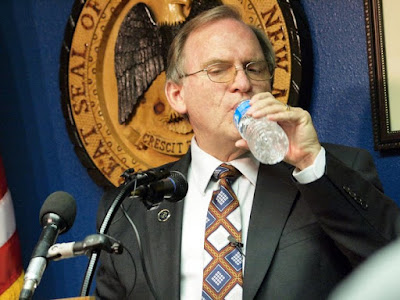
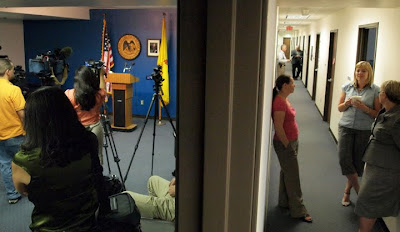
New Mexico Attorney General Gary King stepped before the bright lights and more than a dozen members of the media in his Albuquerque office, Friday June 24, to comment on what many have been saying about him.
In a Santa Fe New Mexican editorial, "Odoriferous doings at the AG's office," Saturday June 18 the paper wrote:
…Gary King lately has been dragging his public trust to political depths previously unplumbed — and certainly beneath his once-praiseworthy self.

“I wanted to hold a little press conference today, partly because there have been, it seems like, a significant amount of comments and discussions from a lot of different people, from lawyers, from prognosticators, from bloggers, all those other kinds of things, about what it is the Attorney General office is doing in regard to a number of cases,” King said.
King’s position was to educate the public through the news media on what he promised to be a boring and dry press conference.

The meeting lasted an hour and 25 minutes.
King mentioned cases involving lawyers representing clients who have been indicted, who were criticizing the Attorney General, especially with claims of conflict of interest.

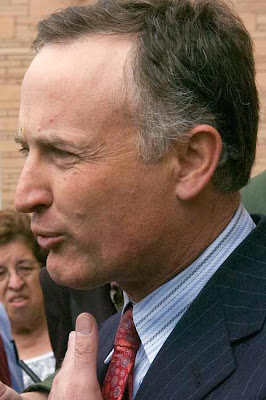
Robert Gorence has claimed there is a lack of a speedy trial for his client, former Secretary of State Rebecca Vigil-Giron. New Mexico Second judicial District Court Judge Albert S. "Pat" Murdoch barred King's office from prosecuting the case based in "perceptions of a conflict of interest", though the judge found no actual conflict.

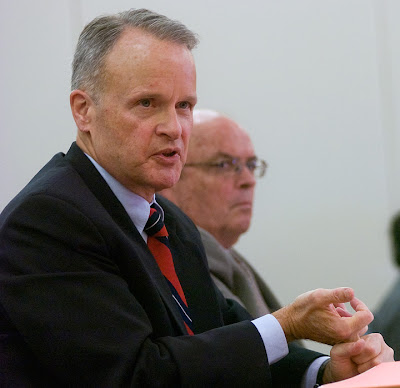
Attorney Victor Marshall, left, who is representing former Education Retirement Board Executive Frank Foy,right, as complaining about the AG's office getting involved in their case. Foy also contends King has a conflict of interest because Bruce Malott, below, had been King's campaign treasurer during a 2004 run for Congress. King denies the conflict because Malott is not under indictment, but is named by Foy as a defendant in his case.
So what’s wrong with this picture?

As with every story, there are two sides; how the media reports it and how the AG's office perceives it. The citizen is left not knowing the complete story.
If you don't read the newspaper, you are uninformed. If you do read the newspaper, you are misinformed. Author unknown, commonly attributed to Mark Twain or Thomas Jefferson.
There is no way the media could provide citizens with the AG's educational attempt; they just don't have the time, or space, or inclination to present it.

The Albuquerque Journal's front page headline read:

Attorney General Lashes Back at Critics
For the soft-spoken King, this is about as harsh as he looked, if that was even "lashing back."


Since the media event former Secretary of State Rebecca Vigil-Giron's case has become more active as a Federal grand jury indicted her three codefendants in the State case, but not her.

King brought to a conclusion charges in an indictment against Public Regulation Commissioner Jerome Block Jr.


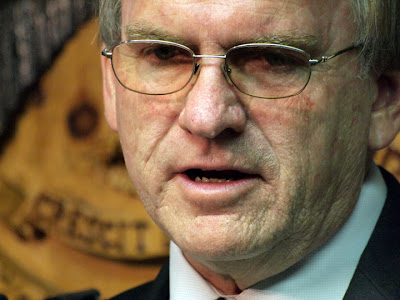
Defending oneself seems to be hard work, as King worked up a bead of sweat that collected at the end of his nose.

I guess you just can't use an antiperspirant on your forehead,

Sunday, September 04, 2011

Ladies from Washington

NOTE: I got behind on my blogging, while writing a series of case studies from the last election cycle, but I have continued to cover events. So, here are some.

What’s Wrong With This Picture?

During the month of May a couple of powerful women from Washington, D.C. visited New Mexico.
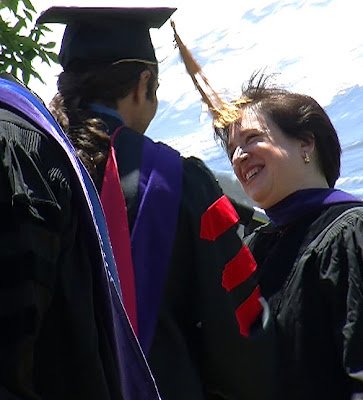
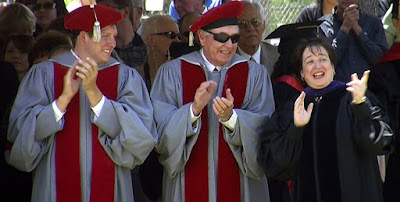
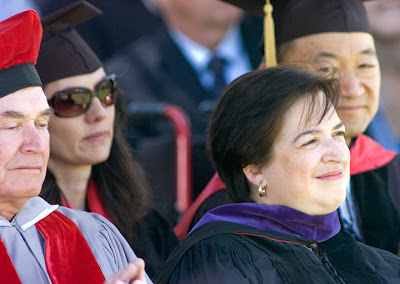
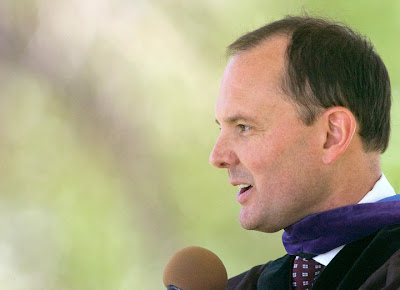
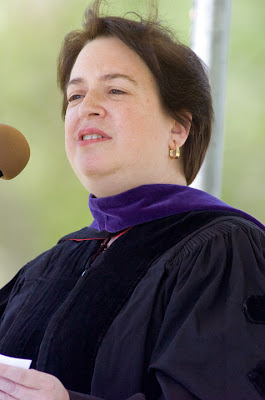
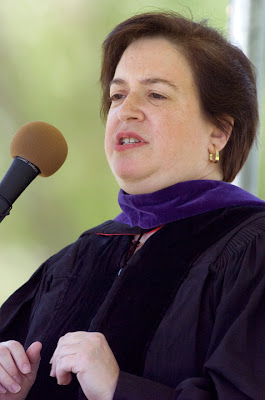
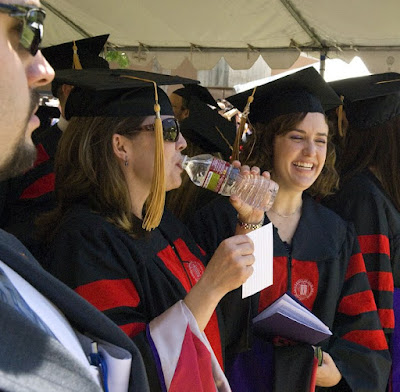
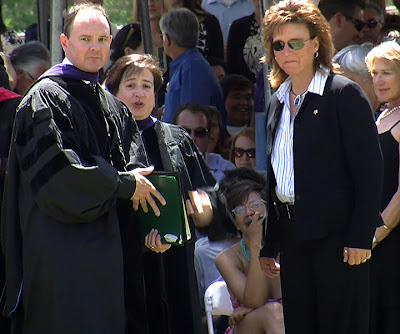
The newest appointed member of the United States Supreme Court, Associate Justice Elena Kagan, gave the commencement address to the 60th graduating class of the University of New Mexico Law School. She is seated with Board of Regent J.E. (Gene) Gallegos, left.
Professor of Law, and the Dean of the School of Law Kevin Washburn, introduced Justice Kagan by reading her biography, as posted on the Supreme Court’s webpage.
Elena Kagan, Associate Justice, was born in New York, New York, on April 28, 1960.
She received an A.B., summa cum laude, in 1981 from Princeton University.
She attended Worcester College, Oxford University, as Princeton’s Daniel M. Sachs Graduating Fellow, and received an M. Phil. in 1983.
In 1986, she earned a J.D. from Harvard Law School, graduating magna cum laude, where she was supervising editor of the Harvard Law Review.
She served as a law clerk to Judge Abner Mikva of the U.S. Court of Appeals for the District of Columbia Circuit from 1986-1987.
She served as a law clerk to Justice Thurgood Marshall of the Supreme Court of the United States during the 1987 Term.
And she worked as an associate in the Washington, D.C. law firm of Williams and Connolly, from 1989-1991.
She became an assistant professor at the University of Chicago Law School in 1991 and a tenured professor of law there in 1995.
And about that time she left the University of Chicago to join the White House where she was associate counsel to President Clinton and then served as deputy assistant to the President for Domestic Policy and Deputy Director of the Domestic Policy Council.
She joined Harvard Law School as a visiting professor in 1999 and became professor of law in 2001.
She was the Charles Hamilton Houston Professor of Law and was appointed the 11th dean of Harvard Law School in 2003.
She was the first female dean of Harvard Law School.
While there, she earned a reputation, deserved, as the most transformative academic leader of our time.
President Obama nominated her to serve as the 45th Solicitor General of the United States and the first woman in that role of the United States, and she was confirmed on March 19, 2009.
President Barack Obama then nominated her as an Associate Justice of the Supreme Court on May 10, 2010, to take the place of retiring Justice John Paul Stevens and she assumed this role on August 7, 2010.
“We’ve had other justices visit UNM School of Law,” Dean Washburn said. “But, the last justice to actually give the commencement address was William O. Douglas. And I know that you now hold his seat,” Washburn said.
"You know from that introduction that Dean Washburn gave me, the secret to my career, or ah, the secret is, I can’t keep a job,” Kagan said, “But, I think I’ve solved that now,” referring to the lifetime appointment to the federal bench.
“I understand Albuquerque is sometimes called the city at the end of the world,” Kagan said, “because it’s the city in America located furthest away from any other city; and perhaps that is why you treat your guest so well.”

“You know how far we travel, and let me tell you, it took a little bit of time yesterday on Southwest Airlines,” She said to knowing groans and laughter.
In fact, this address is something of a momentous occasion for me as well, because this is my very first commencement address as a Supreme Court Justice.
And in fact, it’s my first public address as a Justice of any kind whatsoever.
So, you know, we’ll see how I do, you know.
Kagan told the crowd the reason she accepted the invitation to UNM was because Dean Washburn had taught at Harvard during her tenure as Dean.
There was nothing political about her speech; only encouragement and advice.

When it came time to present graduates with their hood, Kagan insisted on greeting each student, shaking their hand, and having their picture taken together.
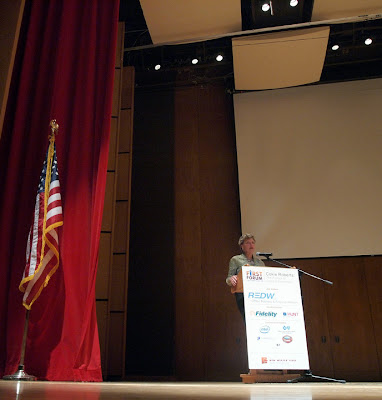
Mary Martha Corinne Morrison Claiborn Boggs – Roberts. You would know her as, Cokie Roberts was the featured speaker at New Mexico First’s First Forum Lecture Series, and the awarding of the “Spirit of Bipartisanship Awards," May 25, 2011 at UNM's Keller Hall.
The topic, Cokie Roberts: The Politics of Good Government.

Roberts comes from a unique place, her parents served in Congress for some combined total of 50 years according to her.

Her father, Thomas Hale Boggs Sr., a Democrat, served 14 terms as a member of the U.S. House of Representatives from Louisiana’s 2nd district, New Orleans. He was first elected to one term, January 3, 1941 – January 3, 1943, when he was defeated in his reelection bid. He joined the Navy and served out the remainder of World War II. He was reelected and served from January 3, 1947 – January 3, 1973.

Boggs was the 16th Majority Whip of the United States House of Representatives from January 10, 1962 – January 3, 1971. He became the 17th Majority Leader of the United States House of Representatives from January 3, 1971 – January 3, 1973. He presumably died in a twin-engine airplane crash over a remote area of Alaska on October 16, 1972, the wreckage has never been found, and he was not declared dead until January 3, 1973,

Boggs' widow, Marie Corinne Morrison Claiborne Boggs, known as Lindy, also a Democrat, was elected in a special election and served from March 20, 1973 – January 3, 1991, six terms, just under 18 years. She served as ambassador to the Vatican, appointed by President Bill Clinton in 1997–2001.

Roberts says her role is to try to explain politics on radio and television.

The moderator for the evening was New Mexican Sam Donaldson. He has served 37 years as an ABC NEWS reporter and commentator.
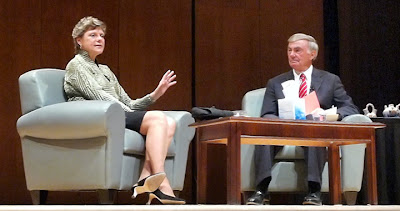
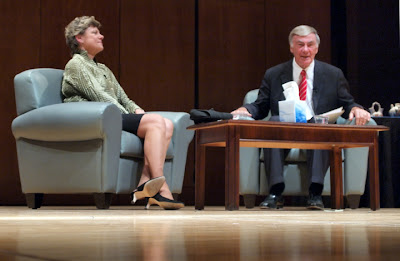
Roberts and Donaldson appear to enjoy each other’s company and during the question and answer session, it felt like you were watching a couple of pretty smart and well-informed people having a living-room conversation, and you were a silent guest, taking it all in.

Donaldson asked several questions and read some from the audience:
Roberts was talking about the polarization in the legislative process, “… it’s destructive, but it’s not new.”

"But it didn’t again use to be that way,” Donaldson said. “When I came to Washington 50 years ago, to think of your father, people assumed that people in Congress were trying to serve their constituents, assumed they were honest, which is not always true, and assumed they were good people….”
I’m from Louisiana,” Roberts said. “It wasn’t always true at all. Our most recent jailed governor just got out. But, there was a much more strong assumption of that period,
But again I’ve come to believe again that that period of from about 1946 to 1974 was really the aberrant period of…. But, was aberrant in a lot of ways and a lot of it was because of World War II and in fact if you look at the graphs, of when the Congress was most, was least polarized, it was in that period of our history.
You know, the men that were in, and it was men in Congress at that point, had literally been in the trenches together.
And they, and the whole country lived through it, you know we, the whole country had been on rationing, sacrifice and America understood the enemy was the dictator across the ocean not the guy across the aisle. And so that carried over for a very long period time.
And then it ended.
“Do you see any way, or ways, to lessen the influence of big – big money, and lobbyists, and PACs on our elections,” Donaldson asked?
“Uh No,” Roberts said. “In a word,…
“What are the prospects of a Constitutional change for term limits,” Donaldson read an audience question?
None. And that’s a good thing. I speak as a daughter of people, with combined terms of about 50 years.
Term limits don’t get you anywhere. The problem in Washington is not that people stay forever, and are set in their ways. Those people who are actually the ones who are willing to do some compromising and try to get things done. It’s people who arrive fresh and new who have never, you know spend the first few years looking for the men’s room. They’re worrying about their voters at home and don’t have the security to do the right thing beyond that.
And it’s not as if they served for six years and go home, they serve six years and have plenty of experience in state legislature. They serve and then run for something else. It’s not like they’re not running for something, and therefore not paying attention to what the electorate has to say.
And, by the way, why shouldn’t they pay attention to what the electorate has to say?
We are their bosses, they should pay attention to what we have to say…
And the truth is, if you have members of Congress who don’t know the system and don’t have institutional memory, and don’t know, and frankly lots of piece of legislation, Secretary Lujan can tell you, can take 10, 12 years to get passed; because, it takes a long time for some of these changes.
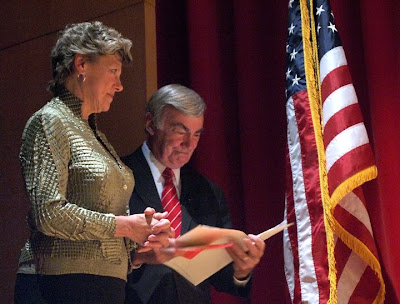
Former New Mexico 10-term U.S. Congressman and Secretary of the Department of Interior Manuel Lujan, below, with his wife, Jean, was awarded a life time achievement for bipartisanship.
And so, if you don’t have people there who can do those kinds of things. The power devolves on to staff, the bureaucracy in Washington, and us, the press.
…Having weakened elected officials has, in fact, strengthened bureaucracies.
So what’s Wrong With This Picture?


Where was C-SPAN for Kagan's first speech as a Supreme Court Associate Justice. How could such an opportunity be lost. Getting a Justice to a college campus is neither a small nor insignificant feat.
Justice Kagan and Cokie Roberts don’t make the pictures wrong.


The outstanding things instantly apparent are that Kagan and Roberts are both smart and have wry senses of humor.
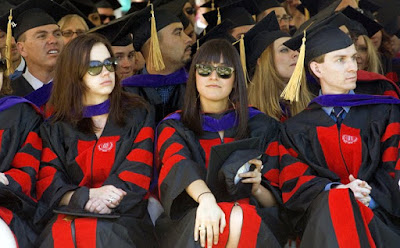
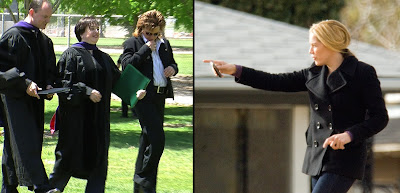
Justice Kagan was under the protection of the United States Marshal with local assistance of the United States Secret Service, above left, the Albuquerque and University of New Mexico Police Departments.
I display the above picture more as art imitating reality, or the fact stranger than fiction impressions. The woman to the right, in the mirrored sunglasses is the Deputy U.S. Marshal accompanying Justice Kagan.
Right here in the Duke City, we are host to a TV production, "In Plain Sight," starring Actress Mary McCormack, above, as U.S. Marshal Mary Shannon of the Witness Protection Program, with Actor Steven Weber, who played FBI Special Agent Mike Faber.

You met McCormack, below right, who lives in Albuquerque, in a post a couple of years ago, while filming in the neighborhood.
Someone has the look of a U.S. Marshal down pat, I'm just not sure which one pulls it off better.

From a media standpoint there was a problem with the delivery of sound from the podium microphone to what is known as a mult-box.
A mult-box, seen above the knee of the television, cameraman, seated in the center of the photo above, is an electronic device with multiple outlets that delivers an audio signal form the master control board of an event, especially for audio dependent press of television and radio, but also used by journalists who more often use recorders as auxiliary note taking devices.

You may note that there are no plugs attached to the box, as the media present were unable to obtain any signal through the box. So, the reason for using a mult-box, to avoid cluttering the podium with several wireless microphone units and recorders failed.

However, the apprehension of the media, was completely averted when Kagan placed the binder with her speech in it, at the side of the podium, letting the left side, of turned pages, hang over the edge, and not covering any of the microphones.

Friday, August 05, 2011

Sharing Light on a Real Hero

What’s Wrong With This Picture?

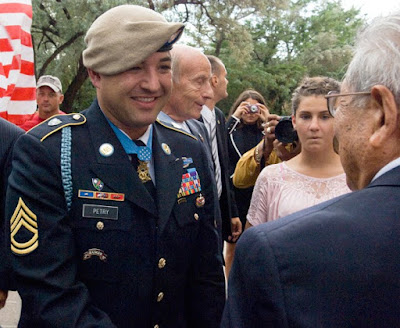
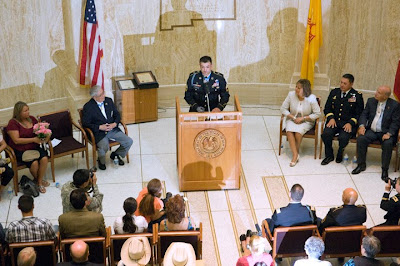
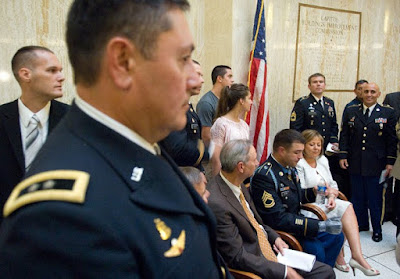
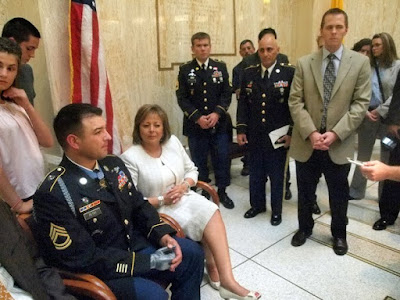
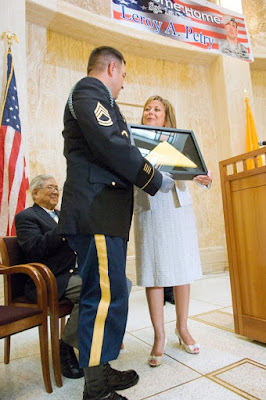
Santa Fe – The latest recipient of the Congressional Medal of Honor, Army Sergeant First Class Leroy Petry, a native of Santa Fe, was welcomed to the Capitol by Governor Susana Martinez, July 29, 2011.

Petry is the second living recipient of the highest military honor awarded since the Vietnam War.

As a Weapons Squad Leader with D Company, 2nd Battalion, 75th Ranger Regiment, Petry was severely wounded on May 26, 2008 protecting his fellow Rangers in combat with the enemy in Paktya Province, Afghanistan. During the firefight, he was shot in both legs, but continued to press the fight. When confronted by a grenade, he picked it up and tried to throw it back toward the enemy. The grenade exploded as he let it go spontaneously amputating his right hand and riddling his body with shrapnel. Though badly wounded, Petry treated himself, applying his own tourniquet, and remained calm while directing the fight until the enemy fighters were eliminated.

Petry was serving his seventh deployment to the southwestern Asia, region with five tours to Afghanistan, and two tours in Iraq. He has since been to Afghanistan for a total of eighth tours.

Hiroshi H. "Hershey" Miyamura, above right, of Gallup, who was awarded the Medal of Honor for his action during the Korean War greeted Petry at the Roundhouse entrance.

Miyamura, for whom a main north-south road in Gallup is named in his honor, gave a crisp salute to Petry and the gathered group when he was introduced.

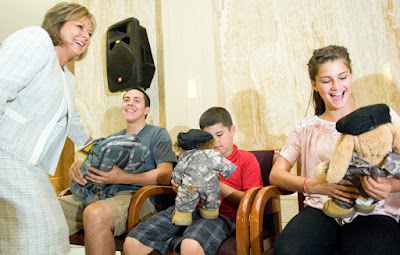
Martinez presented Petry’s children, Austin, Landon, and Reagan with gifts from the New Mexico National Guard.

Landon, 7, gives his GI bear a big hug.

The Governor presented a bouquet of flowers to Petry’s wife Ashley. Petry presented Ashley with his own reward, a public display of affection.

Governor Susana Martinez presented him with the New Mexico flag that flew over the Capitol on July 12, the day he received the medal from President Barak Obama during a White House ceremony.

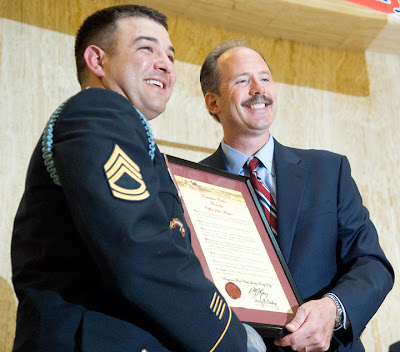
Santa Fe Mayor David Coss and Albuquerque Mayor R.J. Berry, above right, presented Petry with proclamations from both cities.

Petry spoke to the crowd of about 200 gathered in the Capitol Rotunda.

The New Mexico military affairs set up an impromptu press conference in the rotunda.

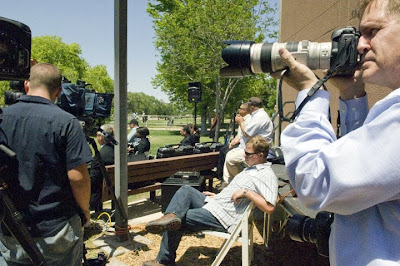
Governor Martinez’s staff has yet to grasp the finer points of handling a press conference. The Capitol has so any committee rooms and conference rooms available to them, but instead the PR machine set up a row of chairs in the cavernous rotunda with the crowd still milling around and sounds echoing off the walls.

Standing only feet away from other journalists asking questions, one could not hear over the din in the room.

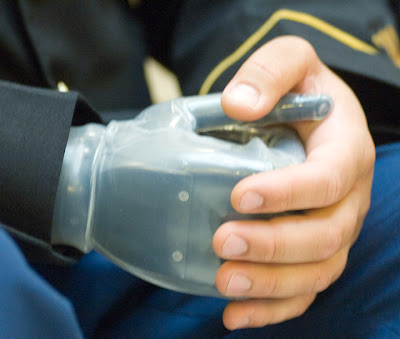
Fitted with robotic prosthetic hand, he has the names of fellow Rangers from his unit who died in action etched on a plaque attached to the forearm of his artificial limb.

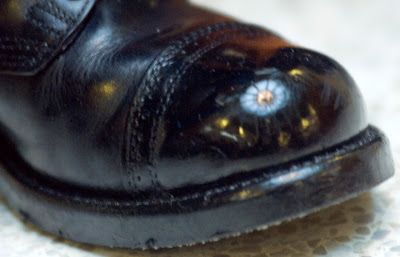
His military bearing is not at all hampered, as evidenced by the mirrored spit-polished shine on his combat boots, which reflect the glass ceiling in the rotunda.

Petry has reenlisted and will now finish his career assisting other wounded and recovering soldiers where he is now stationed, Joint Base Lewis-McChord near Tacom, Washington.

So what’s wrong with this picture?

The events of the day were well covered, with many people wanting to document Petry's arrival. There were so many people using flashes to capture the event that I chose to edit this post as much as I could using the shared light of other photographers.

The shared light emphasizes the significance of the moment and the light coming from a different angle helps create another dimension to the image.

It was a day full of shared light; on the way back to Albuquerque, I captured the image above, of a storm south of Santa Fe, with a double rainbow and a lightening strike.