Sunday, March 22, 2009

Manny’s Arrogance

What’s Wrong With This Picture?

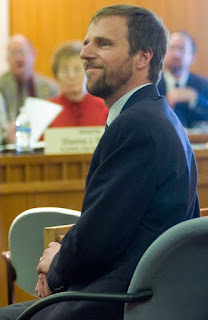
Former State Senator Manny Aragón, D, of Valencia and Bernalillo Counties’ District 14, South Valley was sentenced to five years and seven months in federal prison for his part in skimming $4.3 million from the Bernalillo County Metropolitan Courthouse construction.

Seen here before the Metropolitan Courthouse with one of his attorneys, Ray Twohig, leaving the Federal Courthouse, Aragón was ordered to pay $750,000 in fines and to additionally pay restitution on $1.5 million to be shared with his co conspirators.

The sentencing hearing lasted three and a half hours before Federal District Judge William P. Johnson.

Aragón refused to make a comment or answer any questions posed by members of the assembled media.

Two years ago, I wrote about the arraignments of four of the eventual seven people charged and all plead guilty in the conspiracy.

So what’s wrong with this picture?

United States Attorney Greg Fouratt, center, speaking before the Pete V. Domenici Federal courthouse across the street for the edifice of the corruption, said the "the era of picking the taxpayers' pockets is over."

The amount of money illegally diverted was more than $4 million, according to Fouratt’s statement on the courthouse steps.

Listen to Fouratt talk with the press.


So why is restitution for the conspirators limited to $1.9 million? Where did the other $2 million go?

There are some lingering questions. Several other large public construction projects with cost overruns were allegedly under investigation three years ago, including the Bernalillo County District Courthouse, the Bernalillo County Metropolitan Detention Center, and the Anderson-Abruzzo International Balloon Museum that have now evaporated into the ether. We don’t know that there was wrongdoing in those projects. There were rumblings that there were active investigations and possibly grand juries looking into the matter. Several people who have pleaded guilty in the Metropolitan Courthouse case were involved in those construction projects as well. There has not been a public accounting of them.

Grand juries are supposed to be secret. There were leaks and implications about who might be under investigation. Once information leaks there should be an announcement saying what, if anything came of the investigation. It does not require a lot of detail. However, if the grand jury presented a "no bill," meaning they did not find probable cause to believe, either there was a crime committed, or the person investigated had probably committed the crime, it would be good to clear the rumor generated by leaks.

My Take

I had three distinct encounters with Aragón over the years:

Aragón represented a woman whom I arrested for a 1983, Driving While Intoxicated and related charges. His cross-examination of me was probably the second harshest attack I had from an attorney.

The toughest cross-examination was from ACLU Chief Trial Attorney, William Kunstler, right.

I understood the difference between Kunstler’s tough and Aragón’s bullying. Due to the lessons learned in preparation for Kunstler, Aragón was easy. His tactic was to try to confuse me with rapid fire hypothetical questions which changed slightly and then ask if the differences changed my answers as they applied to his client, who when she took the stand agreed with every charge I made against heard including the breath alcohol read out of .126 percent.

Aragón did not irritate me as much as he irritated Metropolitan Court Judge Burton C. Cosgrove. The judge got to a point where he suspended the hearing momentarily to get a tape recorder threatening Aragón with a disciplinary complaint before the State Bar. Ultimately the client was convicted. The case was appealed in District Court before Judge Richard Traub. Aragón did not handle the appeal. I testified and was cross-examination with little fan fare. The woman under her own direct examination admitted to having taken the breath test and observing the machines indication as .12%. She said she felt that she should not be found guilty because, “the officer had been rude to her.”

Traub dismissed the case. I won’t say the fix was in, but there was no evidence presented, even from her testimony, which would have lead to anything but a conviction.

Then Albuquerque Mayor Ken Schultz, appointed Aragón's law partner, Jim Foley as City Attorney. The office required approval of the City Council. Aragón was made Chief Trial Attorney. Foley seemed to be a figurehead and Aragón appeared to run the office. The title “Chief Trial Attorney” meant little, as Aragón never made it into a courtroom representing the city.

In 1986, as President of the Albuquerque Police Officers Association, I attended a couple of meetings held with Aragón, about the settlement of a lawsuit which alleged an officer, represented by the APOA, had used excessive force. The topic of discussion centered on how the settlement figure had been leaked to the Albuquerque Journal. Concerns expressed at these meetings were the impetus to the department's Internal Self Evaluation Task Force. The task force led to the creation of an Independent Review Officer and years later was expanded to become the Police Oversight Commission. Aragón told me to warn the APOA attorney that City deals with the union were a thing of the past, that there, “was a new Sheriff in town.” My response was that I was handling the case for the union’s interest, not our lawyer.

The APOA membership voted that I not have any dealing with Aragón, for they adamantly disliked and distrusted him. I explained that the APOA did not get to decide for the city as to whom they sent to the table. I defied my membership’s will with the promises that I would never give Aragón anything that the city would not have gotten on their own without him and he would not enjoy dealing with me. He met one more time and I never saw him in that capacity again.

I organized and moderated a Police Labor Seminar in 1992 for the New Mexico State Lodge of the Fraternal Order of Police. I invited State Senate President Pro Tem Aragón as a speaker because he had sponsored a Senate Bill on statewide collective bargaining for state, county and municipal workers that session. He’d been quoted in the Sunday February 26, 1989, Albuquerque Journal, that, during debate on the bill, he found the City of Albuquerque's Labor-Management Relations Ordinance was, "one of the most poorly written documents I've ever seen."

After lunch, the prosecution team led by Fouratt and accompanied by Assistant U.S. Attorneys including Paula Burnett, returned to court to sentence one of Aragón’s co-defendants.
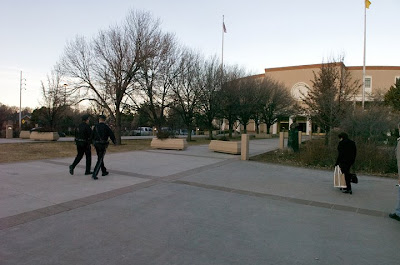
This is co-defendant Raul Parra, above right with his attorney Robert Gorence on their way to court with the Bernalillo County Metropolitan Courthouse behind them.

Parra, left, an audio-visual contractor, filed false and inflated invoices where much of the illegally diverted funds were generated, and he was sentenced to 45 months and ordered to pay $611,000 in restitution.

The other co-defendants: former Albuquerque Mayor Schultz, architect Marc Schiff, then construction manager, Michael Murphy, electronics subcontractor Manuel Guara, former Metropolitan Court Administrator Toby Martinez and his wife Sandra Mata Martinez, all pleaded guilty and are awaiting sentence.

Tuesday, March 10, 2009

Parody. No Seriously, It’s a Parody.

What’s Wrong With This Picture?

This is rookie State Senator John Sapien, D, Sandoval County.

He led a parliamentary procedural charge using Senate rules Saturday night that has put a speed bump in the road to public access in allowing the public to watch the State Senate activities on the Internet.

Sen. Mark Boitano’s bill, SB 401 and resolution, SR 3 addresses webcasting. The issue has been addressed since passage of a different sponsored Boitano action back in 2005. Boitano is a Republican from Bernalillo County.

On Saturday evening when Senate Resolution 3, “Senate Live Audio and Video Web Streaming,” came to the floor, Sapien was prepared to introduce three amendments.

Sapien first complaint was about the use of legislative council generated video for political purposes. Sapien may not have realized what was in the resolution and bill. Boitano made reference to his Italian heritage and referenced the old Prego spagetti sauce commercial, by telling Sapien, “it’s in there.”

Sapien proposed his first amendment; it created a "senate streaming oversight committee." The amendment failed.

Sapien’s second amendment read:
(b) the live video stream shall be from a single camera installed at the rear of the chamber, positioned and focused so as to capture an image of the chamber that as nearly as possible replicates the view of a member of the public seated in the gallery in such a way that no material on members' desks, computer monitors or similar devices can be read or viewed;
The amendment passed. Sapien withdrew his third amendment saying, that with the passage of the second, the last one was unnecessary.

There was a “call of the house,” a parliamentary procedure to compel the attendance of all Senators before the motion on the amended bill be taken. Under this procedure, the doors are locked and the sergeant-at-arms were issued warrants to arrest all unexcused Senators and bring them before the bar. They are permitted to make their excuse. If their excuse is not accepted, the President of the Senate Lt. Gov. Diane Denish would impose a fine that has to be paid in cash before the Senator is allowed to take their seat and act under their charge of office.

This is serious stuff. If a Senator can not be located, or they can not pay their fine, their inability to act is a further violation of their rules requiring them to vote on every issue, unless they have a conflict of interest.

The group of Senators who made the “call of the house,” withdrew their request when it became clear that the sergeants-at-arms were apparently unable to locate the missing members. The floor leader agreed to put off the final vote until the entire Senate was in session.

Santa Fe Reporter Weekly Newspaper writer Dave Maass described Sapien’s amendments as “poison pills.” Amendments to a resolution alter the voting requirements from a simply majority to a two-thirds majority. Apparently legislative watchers, political handicappers and even Senators counting votes indicated that the measure did not have the two-thirds support.

Maass was not the first to indicate that there was poison in the ethics reform well. Democracy for New Mexico’s Barbara Wold’s take on slow moving ethics bills in the Senate Rules Committee.

Executive Director for the Center for Civic Policy Eli Il Yong Lee, left, who is also the registered lobbyist for the companion Center for Civic Action, wrote that House and Senate Majority Floor Leaders: Rep. Ken Martinez and Sen. Michael Sanchez, who were proposing legislation that would require organizations engaged in voter registration to be registered.

Lee sees it as another attack on nonprofits, which many see as being involved in political activity in conflict with the IRS’ tax-exempt status.

The two centers: for Civic Policy, and Action, are registered with the Secretary of State’s office as charitable, educational and social welfare domestic nonprofits.

The nonprofits attempt to make a distinction between permissible educational activities and engaging in what is already defined in the law as:
"political purpose" means influencing or attempting to influence an election or pre-primary convention, including a constitutional amendment or other question submitted to the voters;
Statutory Chapters in New Mexico Statutes Annotated 1978, Chapter 1, Elections, Article 4, Registration of Electors
1-4-49 Third-party registration agents; registration required; procedures; reports; penalty. Section 1. Section 1-4-49 NMSA 1978

Yet, Lee does not offer a bright line test upon which his nonprofits may rely to determine what is done in the name of education. Others see it more likely a guise for attempting to poison the election pool. There is no bright line; at best, a diffused one. 

Lee, and his nonprofit associates have filed a lawsuit to prevent the Secretary of State and the Attorney General from moving to threaten the tax-exempt status of the organizations.

Sen. John Ryan, right, R, Bernalillo County, introduced SB 247, Election Agent Registration Requirements.

It would add to the requirements already in law and possibly already covered, but not adhered to, so as to clarify:
“C. Organizations employing registration agents or using volunteer registration agents are required to register pursuant to the Campaign Reporting Act.”

Section 2. Section 1-19-26 NMSA 1978 (being Laws 1979, Chapter 360, Section 2, as amended). Ryan’s bill proposes amending it further to read:
1-19-26. DEFINITIONS. As used in the Campaign Reporting Act:
L. "political committee"….
(1) political action committees or similar organizations composed of employees or members of any corporation, labor organization, trade or professional association or any other similar group that raises, collects, expends or contributes money or any other thing of value for a political purpose;
The additional relevant language Ryan wants added is:
(4) an organization defined by the internal revenue service as a 501(c)(4) organization or another organization that has unlimited ability to lobby for legislation and participate in political campaigns, whose net earnings are devoted exclusively to charitable, educational or recreational purposes and that also promotes social welfare;
and
(5) an organization employing registration agents or using volunteer registration agents to register voters pursuant to Chapter 1, Article 4 NMSA 1978.
The act, on the books already defines:

M. "political purpose" means influencing or attempting to influence an election or pre-primary convention, including a constitutional amendment or other question submitted to the voters;

When the audience was asked who opposed the bill, a number of nonprofits rose in adamant opposition, including Policy Director for the Center for Civic Policy Matt Brix, left, Director, American Civil Liberties – New Mexico, Northern Regional Office Diane Wood, center, and Political Director for the Association of Federal State County and Municipal Employees in New Mexico Carter Bundy, right.

They defended the rights of 501(c)(3) organizations, even though the bill specifically does not mention them.

So what’s wrong with this picture?

Has the place gone to the birds?

This is the Wildlife Center’s Executive Director Katherine Eagleson with a Red tail hawk in the rotunda on Friday.

My Take

This is rookie State Senator John Sapien, D, Sandoval County. Is there an echo in here?

Sapien, center, is being photographed by Albuquerque Journal Photographer Roberto Rosales with Sen. Michael Sanchez and the new University of New Mexico Head Football Coach Mike Locksley, in red.

The Senate invited Locksley to coach their team in the Legislators Basketball game, that evening. The Senate lost to the House 61-51.

What was the Senate thinking, inviting the head FOOTBALL coach to lead the basketball team?

Every once in a while, a bill will comes along that is described as "a full employment act for lawyers." because it will surely be litigated at every turn.

If Boitano’s bill, SB 401 "Legislative Audio and Video Streaming Webcasts," is not passed and the resolution, not made workable, webcasting will stall again. Boitano is a Republican from Bernalillo County.

I am a great believer in open coverage of governments.

I wordsmithed the protocols used by Rep. Janice Arnold Jones in her House effort. They were based on the U.S. House rules as seen on C-SPAN.

However, Boitano’s bill and resolution were severely flawed in my opinion.

The problem was that Senators were trying to dictate professional standards and techniques that should have been made through regulation, not law. The legislation should have required the director of the legislative council service and the chief clerk of the senate who would control the production, to develop protocols and technical standards for the video camera operators to follow. The mission statement being, to webcast the events of the Senate in a way that accurately informs the citizenry of the proceedings of their government. A secondary consideration is to maintain the dignity of the body.

I wrote Boitano early in the process through one of his consultants:
When you speak to Sen. Mark Boitano about his SB401 I suggest that he remove the do's and don'ts and write that the council services shall establish protocols and guidelines for the video/audio coverage of the Senate in keeping with the decorum of the body.
For every rule that can be written, an exception can be found.
For example:
"(5) at no time shall the live video image be of the gallery; and"
What happens when a Senator wishes to acknowledge some person or group for some outstanding feat or achievement, like driving to Santa Fe, and the Senator points out Ms. Smith's eighth grade civics class?
Let the professionals determine what are the professional standards; then hold them to the standards.
Employees who are properly trained will behave; if they don't can them.
Boitano responded, but it seemed the language was locked down.

The Senate has purchased high quality, state of the art equipment, but is refusing to implement its use.

The use of small stationary cameras, like this one used by New Mexico Independent's Gwyneth Doland, don't add to the debate. When the camera can not zoom in on a speaker, it perpetuates the thinking that Sapien relied upon in his sucessfull, one-camera amendment.

Someone’s going to have to keep an eye on things. This is a Screech Owl from the Wildlife Center in Espanola.

Sapien, and those who do not want video webcasting, are going to get it anyway.

The defeat of a reasonable bill will become a full employment act for video webcasting. Next year, instead of attending college classes, I will be lugging my video equipment to the Senate press box and provide webcast coverage of the floor. One of the things that the Senators won’t want is that I will make my own editorial decisions. All the things they fear are fair game, as my work is protected under the First Amendment. Though I am unlikely to go out of my way to make anyone look bad; it could happen.

Just by way of example, on Friday, as we waited hopefully for the webcasting issue to come up, I chose to make a little experimental video. My parameters were: to tape the individual Senators on the floor. I would run tape for 10 to 15 seconds, of each legislator, accepting whatever they did. I would also violate the sections on looking over their shoulders at phones and such.

This is the Blackberry of a bored government official during the Senate Rules committee.

The floor came to a stand still when Sen. Lopez asked for some time to have an amendment that was being drawn up. In the interim Majority Floor Leader Sanchez volunteered to tell a joke. It became the underling audio track for this two minute video.


Sen. Nancy Rodriguez owes me a debt of thanks for not using the 11 seconds of her activity. I’m a hard bitten old crime scene photographer, but I couldn’t bring myself to show her. I invoked the Queens rule; No photographs of the Queen after she picks up the first eating utensil, at a meal, until the clinking of a glass to summon the attention before proposing a toast.

Sen. Michael Sanchez has commented to reliable roundhouse sources, about how much he dislikes the continued presence of video cameras during our Senate Rules coverage. If he doesn’t want the Senate to be made to look bad, then maybe he shouldn’t lead the pack.

According to Santa Fe New Mexican's Steve Terrell, who in past years has written about knowing the session is over when Sen. John Pinto, D, McKinley and San Juan Counties will sing “The Potato Song.”


He sang Friday night. It was the second time this session. Pinto, along with President Pro Tempore Timothy Jennings, D, Chaves, Eddy, Lincoln and Otero Counties, are the longest serving members of the Senate, since 1977. Pinto’s probably right; in New Mexico he may well serve as the fat lady. It’s over.

Thursday, March 05, 2009

In Defense of the Canada Goose

What’s Wrong With This Picture?

US Airways Flight 1549 had a mishap Jan. 15, 2009, shortly after take off from New York’s LaGuardia airport. At an altitude of about 2,800 feet, the airplane encountered a flock of birds. The Airbus 320 ingested birds through both CFM56-5B4/P turbo fan engines.

First Officer Jeffrey B. Skiles, on his first A 320 flight assignment after training, was at the controls when the birds were hit.

“I’ve got the aircraft,” Captain Chesley Burnett "Sully" Sullenberger III was recorded saying, as he took over control of the aircraft while the engines lost all thrust.

The Internet is a wonderful communications device. Every once in a while, someone will make an observation that must have made sense in their head when their fingers stroked their thoughts to the world.

I read a comment that went something like this, “Man has been flying for a hundred years. You’d think they would have found a way to avoid hitting birds.”

Aviation is a high tech world. There are a lot of advanced technological pieces of equipment incorporated into aircraft and used by the Federal Aviation Administration’s Air Traffic Control facilities.

Radar can be attuned to detect small flying objects. A flock of large birds can be seen on a radarscope. As a normal procedure, the radar screen’s brightness and contrast are not set to pick up birds.

Aircraft under radar control use a transponder, an electronic signature assigned to a particular aircraft to identify it. Every time a radar beacon sweeps a transponder, the aircraft is shown as a bright readout with corresponding information including its: type, altitude, heading, and speed.

When I took this picture, years ago, the air traffic controller demonstrated the radar’s ability to track migratory flocks flying up and down the Rio Grande valley where they spend winters. The birds were flying between 1,300 and 1,800 feet above the river, directly in, but well above the approach path of landing aircraft.

The FAA reported, that upon review of its New York area radar data for Jan. 15, they determined after takeoff, the flock of birds was detectable. It doesn’t mean that the radar controller was able to see what was likely visible.

So what’s wrong with this picture?

The prime suspect is the Canada goose (Branta Canadensis), which is a good-sized bird.


The Canada has been flying the skies much longer than man. It doesn’t know or understand human ways. And it certainly doesn’t know what to do in front of airplanes taking off.

The airplane lifted off at 155 knots and as it climbed, it accelerated to 210 knots when the flaps were retracted; the maximum speed allowed was 250 knots; that’s 155 mph or 227 feet per second.

Skiles said he saw the birds just before he heard them hit the plane.

A friend of mine asked if Sullenberger was a hero?

The answer is an unqualified yes. He did everything correctly. He was faced with a nearly impossible situation, yet he made it work.

There used to be a joke about, you only think that pilots are taller than they are because they are sitting on their wallet. The rest of the story is that pilots aren’t paid for the routine; they’re paid for being able to handle the emergencies. It would have been easy to imagine the January 16 headlines, “155 Killed in N.J. Air Crash.”

The powered landing speed with gear down is 145 knots or 90 mph. The airplane probably has to be flown a little faster without the extra lift from the flaps; but at the same time both flaps and landing gear create drag.

Aviation experts on cable television said the A320 has a sink rate of 20:1. That’s 20 feet forward for every foot of altitude lost. This is a high glide ratio in the range of medium performance sailplanes.

From 3,000 feet, LaGuardia, Teterbro, and Newark airports were perceived to be beyond the range of the quickly descending aircraft.

Sullenberger also holds a glider rating as part of his impressive list of aviation accomplishments. That rating may have served him well. Though it wasn’t his normal sailplane, the same laws of physics apply. He had to shift mental gears, but he understood how the aircraft should act.

Pilots who have saved aircraft after major damage or fuel exhaustion have carried glider licenses in such incidents as: United Airlines flight 811 out of Honolulu, Hawaii in 1989 and the Canadian Air Gimli Glider.

Sullenberger’s choice of landing site was made for him by virtue of practical elimination. The only logical place to land was the Hudson River. His landing was a textbook glider landing, minus the glider, solid surface and landing gear.

Here is the BBC’s reporting.


Result, 155 lives got off that airplane. Worst injuries were a few broken bones.

Aviation News at AVweb.com’s Glen Pew has a good look.


My Take

Sullenberger and his crew are indeed heroes.

Glider experience has proven helpful and the Canada Goose will fly where it might.

Little Miss Sunshine

What’s Wrong With This Picture?

With no money available this legislative session because of diminishing oil and gas tax revenues and a sense of an ethical crisis, a number of pieces of legislation calling for reform have been introduced.
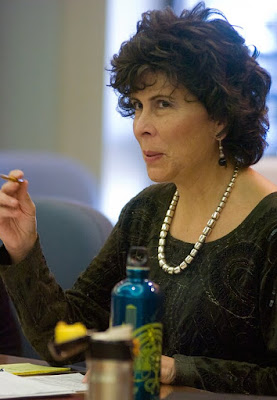
This is Senator Linda Lopez, D, Bernalillo County.

Her district 11 runs from the Rio Grande on the east, to the Rio Puerco on the west, and from Central Avenue and Interstate Highway 40 on the north to the Isleta Pueblo boundary, on the south; with a few cut out here and there. Senate district 11 abuts with districts: 12, Sen. Gerald Ortiz y Pino, 14, Sen. , 22, Sen. Lynda Lovejoy, 23, Sen. Sander Rue, and 26, Sen. Bernadette Sanchez. All the districts are wholly or partially within Bernalillo County, except 22, which contains parts of Cibola, McKinley, Rio Arriba, and Sandoval Counties, 23, which contains part of Sandoval County and 14, which contains parts of Valencia County. All of the Senators from abutting districts are Democrats, except Rue, who is a Republican.

Lopez Chair’s the Senate Rules committee. The committee is considered to be rather powerful and if one looks at its make up, you can understand why.

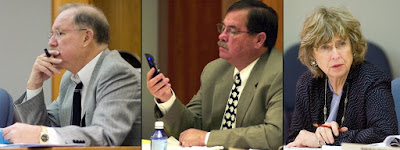
There are five Democrats; Lopez, Vice Chair Peter Wirth, Santa Fe County, Majority Floor Leader Michael Sanchez, Valencia County, President Pro Tem Timothy Jennings, Chaves, Eddy, Lincoln and Otero Counties, and Dede Feldman, Bernalillo County.
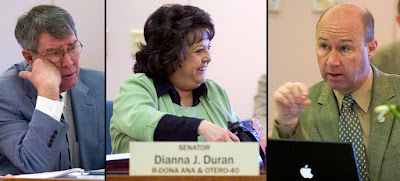
On the Republican side: Minority Leader Stuart Ingle, Chaves, Curry, De Baca and Roosevelt Counties, and Dianna Duran, Dona Ana and Otero Counties, and Ranking Member Kent Cravens, Bernalillo and Sandoval Counties.

So what’s wrong with this picture?

All Senate Ethics bills started in the Rules committee. To the casual observer, the bills are bottlenecked. It is true that the Rules committee did not meet until early February, but the committee has a preexisting policy of not reporting out multiple bills on the same topic.
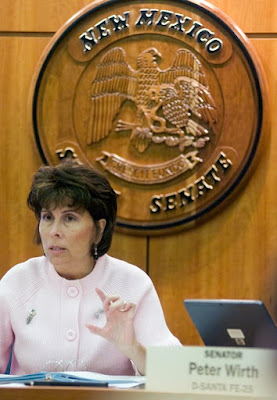
Lopez explained in a quiet, logical manner, the reasons why the Rules committee has adopted such a policy. She said multiple bills confuse legislators who tend to vote against them. The policy requires the sponsors of competing bills to work together to create a committee substitute.
Several activists, lobbyists and bill watchers are openly complaining that Lopez is obstructing the committee process while the bills are being reworked into substitutes.

Common Cause’s Executive Director Steven Robert Allen’s, right, position is that because New Mexico is one of a very few states that does not have campaign contribution limits; the legislature should not have to reinvent the wheel. There are plenty of models, some court tested, which can be readily adopted.

Democracy for New Mexico’s Barbara Wold, and Heath Haussamen on New Mexico Politics, based their comments, in part, after watching the video provided by the New Mexico Independent's Gwyneth Doland.

Doland has joined the glacier chorus.

One of the complaints was based on an extended debate Feb 25, on an “advice and consent of the Senate,” in the confirmation process of a reappointment to the Fish and Game Board. Ethics activists awaiting their bills became more than slightly irritated over the half-hour discussion of antelope hunting enforcement practices.

"I hope it becomes clear to many how much purposeful time wasting goes on in the committee," Wold wrote on the NMI transcript. "Who knew that antelope management was on the front burner(?)"

One may remember that antelope were a hot topic earlier in the year. Each piece of legislation is due its own proper hearing before the committees.

Analysis

Review
New Mexico’s legislature was designed by our State’s Constitution to follow the Federal Constitution’s model of a House and Senate.

The House is meant to be closest to the people and is therefore very reactive. The House is the larger body, with fewer constituents and each Representative is elected every two years.

The Senate is considered the deliberative body. In the Federal system, two Senators represent each State. The thinking within the Federalist system was to allow each state an equal voice. Senators were appointed by the states, but a Constitutional amendment changed that to allowing the people to directly elect them. They serve a six-year term on staggered cycles. A third of the Senate is elected each Congressional election.

17th Amendment, Senators Elected by Popular Vote.
The Senate of the United States shall be composed of two Senators from each State, elected by the people thereof, for six years; and each Senator shall have one vote. The electors in each State shall have the qualifications requisite for electors of the most numerous branch of the State legislatures.

When vacancies happen in the representation of any State in the Senate, the executive authority of such State shall issue writs of election to fill such vacancies: Provided, That the legislature of any State may empower the executive thereof to make temporary appointments until the people fill the vacancies by election as the legislature may direct.

This amendment shall not be so construed as to affect the election or term of any Senator chosen before it becomes valid as part of the Constitution.
It was ratified April 8, 1913.

Thomas Jefferson was in France when the Constitution was drafted. Upon his return, he asked fellow Virginian, George Washington, why a Senate? “We pour legislation into the senatorial saucer to cool it," Washington supposedly said.

In New Mexico’s legislature, Senators are elected every four years. At one point, half the Senate was elected every two years, but that was altered so they now are elected at the same time as the Presidential election.

My Take

I’ve been pointing video and still cameras at the legislature this session. The first interest was to get the House to seriously consider webcasting. Rep. Janice Arnold Jones, R, Bernalillo County, has been covering the House Taxation and Revenue and the House Voters and Elections committee meetings.
The House took steps to move towards webcasting their own meetings. The effort is limited and vigilance must be maintained to assure that the leadership, in spite of their rhetorical support, follows through.

Rep. Dennis Kintigh, Left, R, Chaves, Lincoln and Otero Counties, has this week, joined Arnold Jones in covering his assignments on the House Health and Government Affairs and House Judiciary committees.

My attention has turned to the Senate, which voted to reinstall the cameras in their chamber, but nothing has been streamed from there yet.

The Senate Rules Committee is our focus since they took up the ethics bills. With the assistance of Ched MacQuigg, of Diogenes' six, we have provided a live video feed to the New Mexico Independent several times.
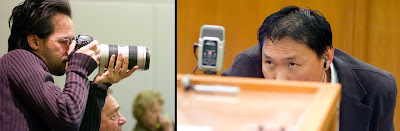
The ethics legislation has attracted a fair amount of media attention. The Santa Fe New Mexican's Photographer Luis Sanchez-Saturno, above left, and KUNM FM's Reporter Scott Ki covered the meetings. KUNM FM's News Director and Reporter Jim Williams, below left, records witness testimony, while Albuquerque Journal Staff Writer Jeff Jones reports on the proceedings.
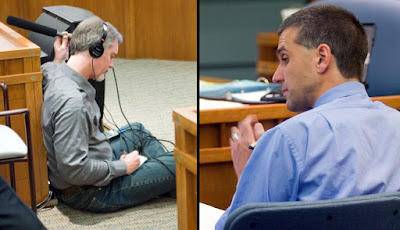
Wold wrote on her DFNM site, Feb. 25, in, NM Senate Rules Committee Continues Glacial Pace on Ethics Bills:
I have to admit I find it all a bit embarrassing to witness. What I'm seeing -- live and shamelessly presented -- appears to be a circus act organized to placate big donors and the status quo power bloc. And the people be damned. It can't just be me, can it?
Yes Barbara, it can be just you; and Stephen and Heath, and those others, who think that their particular interests, in their particular issue, is of vital importance to the exclusion of others. Maybe it’s why you shouldn’t watch sausage being made either. The political/legislative process is an ugly mess. It takes time, between being required to be on the floor, at other committee meetings, attending joint sessions to hear federal congressional delegation members speak, it’s hard to find the time to coordinate schedules and work out details. The negotiations are not always amicable. The issue differences are not always easily surrendered. It may take time and it may seem “glacial,” but it also may be moving at an appropriate pace.

Wold has been very hard on Sen. Lopez, as she carried a Tax Increment Development District bill that directly affects her district and future constituents.

To Wold, political demonizing has become standard fare. Lopez is not viewed as a Progressive, by Progressives and is not always regarded highly by other Democrats. Lopez has a long history of being very independent.

In last Friday’s, Feb. 27, posting, Sen. Linda Lopez Continues Delays on Ethics Bills in NM Senate Rules Committee, Wold blamed Lopez for not bringing forward the ethics bills until four were raised late in the hearing.

Wold hasn’t always been so hard on Lopez. In a May 04, 2005, posting, she wrote: Senator Lopez Sheds Light on Repub Distortions.

Every piece of legislation, every appointee, every memorial, has its supporters and oft times, its detractors. Not every detractor is some “evil” special interest. There may only be a different viewpoint, opposite of a supporter’s or detractor’s own special interest.

Government workers lobby for their respective departments' or add information to the committee’s debate. They include Bureau of Elections Administrator Kelli Fulgenzi who spoke about the effect of campaign reporting requirements on the Secretary of State’s office.
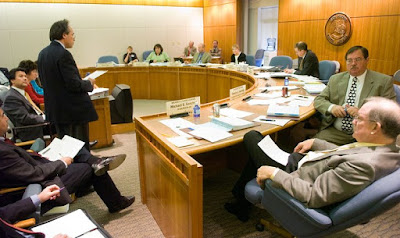
Chief Deputy Attorney General Stuart Bluestone, above left, addresses the committee about legal issues associated with the formation of an ethic commission.

Several ethics bills have cleared the Rules Committee:
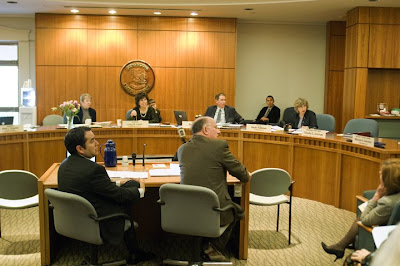
SB 94 and 163 sponsored by Mark Boitano, right, and Eric Griego, left, Prohibit Former Legislators as Lobbyists. At the initial hearing Griego indicated Boitano had stronger language and they would later prepare a substitute bill, which was passed out of Rules and is now awaiting a hearing at the Senate Judiciary Committee
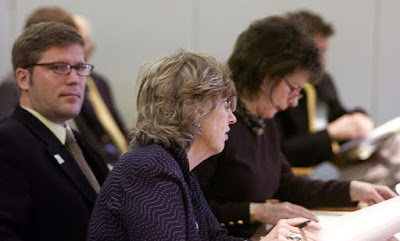
Sens. Timothy Keller, D, Bernalillo County, Feldman and Berffort Wilson presented bills that would prohibit contractors from making political contributions for up to two years prior to accepting any State work.

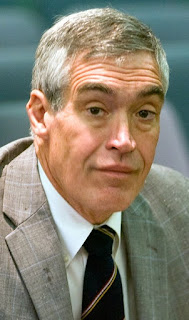
Former Sen. H. Diane Snyder, R, Bernalillo County, is now, and has been Executive Director of the American Council of Engineering Companies-New Mexico. Snyder said that part of her duties is governmental relations and that as a citizen legislator, she had to make a living. Her presence was not something that came from her having served, but her service had come from her professional work.

She took offense with the bills tone that contractors, contributors, and lobbyists were somehow bad people.

Snyder said that members of her association were being continually strong armed to make campaign contributions, sponsor public or charitable events; such as hosting seminars, workshops and retreats. They just want to know the rules, that they are written down, so they don't break the law.

SB 261 Retirement Benefit Forfeiture for some Crimes, sponsored by Sen. Sue Wilson Beffort, left, R, Bernalillo, Sandoval, Santa Fe and Torrance Counties, was passed out of Rules and is awaiting hearing at the Senate Judiciary Committee.

SB 128 to Require Biannual Campaign Reports, sponsored by Sen. Peter Wirth passed the full Senate, 37-3, with two Senators excused; Cynthia Nava and Mary Jane Garcia, both Democrats from Dona Ana County. Senators Carroll Leavell, R, Eddy and Lea Counties, Richard Martinez, D. Los Alamos, Rio Arriba and Santa Fe Counties, and Michael Sanchez voted against the bill. It is now before the House Consumer and Public Affairs Committee.

Four bills, individually sponsored by Senators: Feldman, Wilson Beffort, Bernadette Sanchez and Wirth, addressing the issues of limiting the amounts of political contributions from individuals or groups to candidates, campaigns, and political action committees. Each specifically requires the donor to be named, even if the money goes through a third party. The bills were consolidated into committee substitute 116 and reported out of Rules, today with a do-pass recommendation.

Most, if not all the other pending ethics bills had a first hearing. Those bills, that either have the same name or address the same issues, have been relegated to the committee substitute process and some apparently are coming back for additional debate.
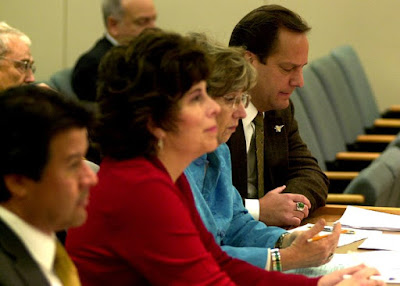
There are four Senators sponsoring individual bills that all address a State Ethics Commission. They are: Sens. Lopez, Feldman, Pete Campos, D, Guadalupe, Mora, San Miguel, Santa Fe, and Torrance Counties, and John Ryan, R, Bernalillo and Sandoval Counties.

There are some major differences amongst these proposals, especially in the number and manner of selection for commissioners. There is also wide latitude in just how broad an ethics commission’s reach should be. Some argue it should be limited to the elected members of the three branches of government: the executive, legislative and judicial. Others propose that it apply down to County Commissioners, while others believe it should be all encompassing; including all public employees and any contractors who are working on government projects. There was a discussion that might lead to the term of art, “and all political sub-divisions.”
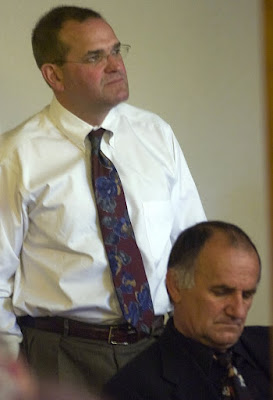
Executive Director and General Counsel for the New Mexico Judicial Standards Commission Jim Noel, above, pointed out that the legislature is barred form creating an ethics commission for judges. The State Constitution’s Article VI, Judicial Department, Section 32, Judicial standards commission, was adopted by a voter approved amendment November 7, 1967, and updated several times. If the legislature wants to include judges in a new process, they must do so by amending the Constitution.

SB 693 Prohibiting Certain Contributions and Solicitations of Contributions by Business Entities and Lobbyists and the Principals of State Contractors sponsored by Sen. Eric Griego, above left, with Common Causes' Allen is still pending.
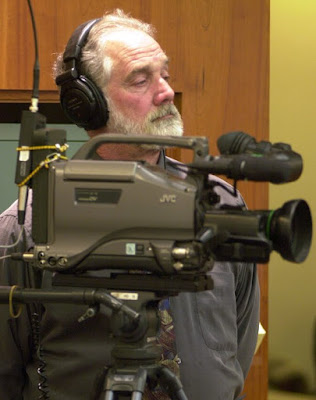
MacQuigg has taken his own view of the back and forth of the bureaucratic political gamesmanship over the problem of a window with its overpowering sunlight streaming through it into the Rules Committee room.
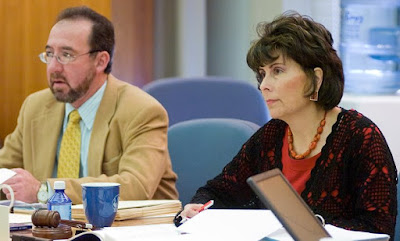
It wasn't until about mid way through the third day of our webcasting efforts that Rules Committee Analyst Matt Baca, left, inquired about the window blinds' adjustment. He fixed the the window.
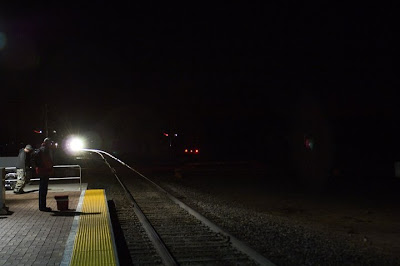
MacQuigg also has a comment about how hard it is to get up at 4:30 am to catch the 5:30 RailRunner train to be set up for the scheduled 8:00 committee meeting.

Though he may have closed his eyes momentarily, I sat on the floor, at the back of the room, during a non-ethics related debate and took a quick nap. I opened my eyes and saw Daniel Ivey-Soto, above, who is lobbying for County Clerks on election issues, pointing his cellular phone’s camera in my direction. He has been kind enough not to put it on the internet.

As I see it, casting light on the legislative process is a good thing, but competing with the bright sunlight can cause problems photographically. This is Sen. Cravens, left, talks on his cellular phone silhouetted before the committee room's window.

Lopez has the power to move these bills forward, but my sense is she rather get good legislation rather than hurried junk. There is adequate time to accomplish the passing of meaningful ethics reform.