What’s Wrong With This Picture?
I think I have been invited to join a blogging discussion by Mario Burgos, http://www.marioburgos.com/, and comment on the police recruiting issue that has been making the rounds the past couple weeks.
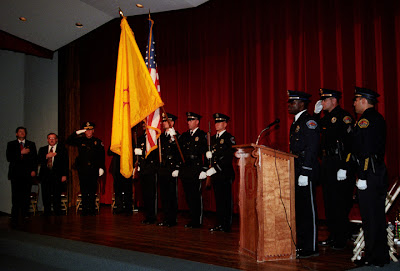
It seems that the news media has been picking up on a trend that police departments around the country are relaxing standards in their recruiting practices to get enough applicants into their academies. Burgos decries the relaxation of a couple of things. In particular, experimental use of, what some call, recreational drugs, i.e.: marijuana, powdered cocaine and Ecstasy. He also finds it disturbing that applicants who have had scrapes with the law are not automatically disqualified. http://www.marioburgos.com/2007/06/some-standards-shouldnt-be-relaxed.html. He linked to me because I had commented about recruiting and staffing numbers.
So what’s wrong with this picture?
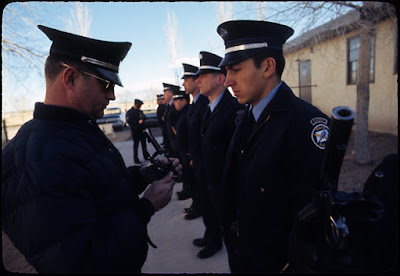
Relaxing the standards is nothing new. In the early ’70s, I attempted to become a police officer and ran into a series of high standards that disqualified me at several levels. Back in the days, I called the Dinosaur era, it was not uncommon to find state and large city departments requiring applicants to be at least six feet tall and weigh over 200 pounds. I was nearly six-foot tall, but weighed a mere 127 pounds. Eyesight had to be 20-20 uncorrected; mine was correctable.
One of President Richard Nixon’s domestic programs was his “war on crime and drugs.”
There was a large federal infusion of money to state and local governments to hire lots of new law enforcement officers. Long-standing physical standards that restricted the consideration of many applicants were relaxed.
The biggest change came with the widespread admittance of women into the profession. There was a fair amount of grumbling among males, citing that women were not physically capable. Thirty-five years later, women in police work are no longer unique or unusual.
There were attempts to raise standards, specifically that college education was considered to be helpful. Some believed that educated people would bring with them skills that would make them better cops.
The FBI agents of the late ’60s had to either be lawyers or accountants. Then Director J. Edgar Hoover, a lawyer himself, thought education made for the best agents.
The myth of the FBI would be shattered by the anti Vietnam War, Civil Rights and Black Power movement surveillances. The use of illegal wiretaps and infiltration into organizations engaged in lawful protest and the problems surrounding the Watergate cover-up investigation all added to the demise of credibility that Hoover had maintained for years.
In the early ’70s the FBI started accepting candidates with a full four-year college education. Soon, they would accept non-college-educated recruits who were allowed to trade one year of other law enforcement experience for each year of college.

Federal money was available, in grant form, for cops to go to college. It’s how I got my undergraduate degree.
Departments tried to hire either degreed applicants or with some lesser amount of college, usually around a two year minimum.
There was a big problem; a degreed applicant could make two-to-three times as much money in the corporate world doing a non-risk-taking job. Initially, no extra money was offered for education.
The arguments that drug use and having a police record are not disqualifiers for police employment are not adequately examined in the recent press accounts.
Felonies are normally absolute disqualifiers. Misdemeanors and traffic offenses were and still are viewed on an individual basis.
Since the mid ’60s, when the use of recreational drugs blasted into the American culture, experimentation became a rite of passage for many youth. The mere experimental use of drugs like marijuana, several years before, was not viewed as a disqualifier. The thing that departments found more important was honesty. One of the highest eliminators of applicants, was and still is, lying about having used drugs. The admittance of drug use would not, by itself, remove an applicant from the process; but lying about it would.
The American people are actually very tolerant of substance use and even abuse from their leaders. President George Bush admitted that he had a period in his life where he was drinking so much that his wife told him he had to make a choice between her and Johnny Walker. When asked about allegations of cocaine use, made by his former sister-in-law, that they had used together, Bush said, “When I was young and foolish, I was young and foolish.”
A review of the disqualifiers used by APD can be found at, http://www.apdonline.com/requirements/disqualification.html. One will note that a number of years are attached to certain behaviors, such as not having had a misdemeanor DWI conviction within the past three years or what would have amounted to a felony drug possession, in the past five years. These time frames are most likely based on statutes of limitations for prosecution.
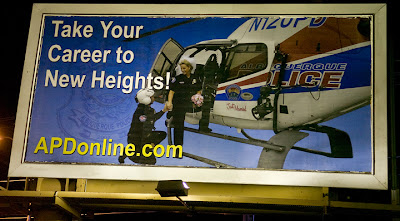
The qualifications for APD can be found at http://www.apdonline.com/requirements/cadet.html.
Age is an issue for some departments; not Albuquerque though. There is no upper age limit. Physical testing will weed out those not capable of working at older ages. I believe that police work is a young man’s game, but won’t argue for a limitation to those who otherwise qualify. There is an age window of criminals; it ranges from about age 15 to around 27. It is within this demographic that one finds most criminal activity. There is a police saying that criminals stay the same age and cops grow older.
Some older applicants bring life experiences with them that they have obtained from other careers. I recall a 57-year-old retired military officer who joined the force and was even declared the most-fit cadet in his academy class.
I was fully qualified to be a police officer in Taos, yet the job went to an equally qualified man who additionally spoke Spanish. There is no doubt in my mind that for the town of Taos, that was a proper decision.
Greenbelt, Md. disqualified me based on my IQ. It seems that Greenbelt had determined that having a high IQ over some arbitrarily established number, was problematic in their experience. They may have been correct. Later in my career, I had more than one supervisor contend that my intelligence was, at least causing them some problems.
There is a certain pomposity for those who might believe that some youthful misbehavior means that an individual is incapable of performing satisfactorily as a police officer.
Not all prospective applicants are Boy Scouts, nor, have I learned, should they be.
Author Norman Mailer put forth a theory that if police officers had not gone into law enforcement, they would have gone into crime. Mailer, of course, was full of it. However, at some narrower levels, he may have been correct. Many officers with whom I served and those who still serve bring diverse backgrounds with them to the job.
I worked with many officers whose upbringing was quite different from my middle class experience. This was a good thing. As one example: I was never very good at reading a burglary scene. I followed the procedures by rote, investigating diligently, collecting forensic evidence and writing an accurate report, but with little success in identifying an offender. On occasion, there was that officer who had a lot of street experiences growing up, who could walk into a burglary scene, look at it and state that he knew whom the perpetrator was. He disappeared, returning a short while later with the stolen property and an offender, handcuffed in the back seat. I couldn’t see the signature, but my colleague may as well have seen a neon sign.
I knew officers who had experimented with drugs before joining the force and later became very effective narcotics detectives. As for education, some of the smartest officers I worked with only had GEDs.
Polygraphs are simply voodoo! I have taken them apart in administrative hearings. Their only value is as a threat; a hollow one at that.
What I have learned over the years is that a standard has been relaxed, but it is not the standard alluded to in the press and on blogsites.
The standard is the failure of governments to pay an adequate wage to attract higher caliber applicants.
Recruiting in the real world is difficult enough because of the competition for qualified people that goes well beyond police. The economic realities and low unemployment rate not withstanding, many seek public employment that has good benefits. If the citizenry wants a higher class of law enforcer, then they must respect the profession; they have to demand more for and from it.
Law enforcement is not the only profession that falls into this same category; teaching and nursing are two examples where vital work is not sufficiently rewarded or honored and their recruiting efforts have trouble as well.
Santa Fe County’s Sheriff Greg Solano recently wrote about the travails of recruiting qualified applicants and retaining older officers who are eligible to retire. http://sheriffgregsolano.blogspot.com/2007/06/chief-johnson-recieves-vote-of-support.html
Solano also has responded to Bourgos’ comment; check him out. He holds similar views and as an elected Sheriff, he gets to set standards; he explains why.
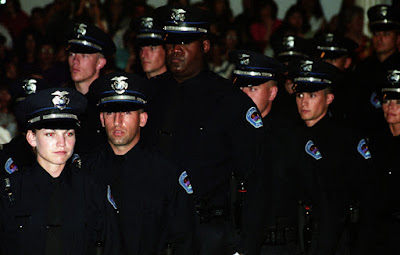
A police force should mirror the community’s makeup. Numbers of men and women, race and ethnicity and even the wide range of experiences should be represented.
The problems of recruiting are fairly well documented, http://www.abqjournal.com/news/metro/400243metro10-20-05.htm. I, among others, have been critical of the politics and spin that tries to bring the accurate numbers of APD officers to light.
However, that debate over real numbers underscores the problem that raises two questions; if and should strict standards be relaxed.
In a copyrighted Journal article by Carolyn Carlson and T.J. Wilham, http://www.abqjournal.com/news/metro/566278metro05-27-07.htm, exposure of the criminal histories of several lateral transfer officers who recently joined APD was outlined.
The privacy of personnel records makes it difficult to track whether officers disciplined or terminated were those who would have been disqualified had they not benefited from some relaxed standard. My guess is that it wouldn’t have a significant statistical showing. In common language, those who had used drugs recreationally or had a traffic or misdemeanor record years earlier, who became officers, didn’t get into trouble at a greater rate than their peers.
Our society has changed. Post World War II baby-boomers changed what were acceptable norms of the generation before them. The civil rights movement brought a new thinking of what a fair process meant. The anti-Vietnam War movement opened a realization of how angry citizens could interact with their government. The hippy-generation spawned a different view of how morals and standards should be treated. The values of earlier generations don’t hold the same meaning for many. I’m not suggesting that there has been a wholesale rejection of our society’s values. However, it is clear that the values I, as a man in my late 50s, grew up with as a child, with a very different view of the world than what this next generation has.
The United States has more of its citizens incarcerated, per-capita than any other nation on earth. When every little thing is a crime, then it is not surprising that the common citizen will occasionally run afoul of it.
There is an old anonymous quote, “In the kingdom of the blind, the one eyed man is king.” Maybe in our draconian era it should be modified; “In the land of criminals, the misdemeanant is cop.”
 This is Portland, during Rose Festival opening night’s fireworks display visible from blocks away. Every vacant lot seems to have a paid parking lot on it.
 Portland is a densely populated area that has two rivers running through it that converge, the Columbia and the Willamette.
 A cleaning crew working on a Friday night in the Federal building.
 The downtown is a mixture of late 1800s warehouses and modern skyscrapers.
 Many old warehouses are now converted into condominiums and loft apartments.

 Though there are streetlights, Portland is a dark city.

 The older buildings have classic designs and facings made of ironwork or concrete.
 There is a fair amount of building of condominiums going on.
 The streets are a mess; dominated by one-ways with only an occasional two-way street. On the weekend there were lots of people riding bicycles. Speed limits are not so dependant on drivers’ compliance as it is hardly possible to exceed the limit based on traffic volume.
 There are lots of bridges crossing the rivers.
 Portland has a number of downtown parks. There is a river’s edge park on the Willamette River and two separate parks that run multiple blocks along Park Ave., north and south in the downtown area that displays large pieces of public art.
 This sculpture, a tribute to money sits at the entry to a large shopping mall, the Lloyd Center.
 Portland public transportation is provided by Tri-Met, an independent governmental subdivision. Busses run frequently and seem to be on all the streets all the time.
 There is a light rail system that runs to four destinations, including the airport. A third line is about a year into its two-year construction project.


 Albuquerque has looked to Portland to solve many of its problems. Light rail is just one of those issues; anti-cruising is another.
 Portland also seems to have a large number of homeless and street people.


