Thursday, May 10, 2007

Open Meetings?

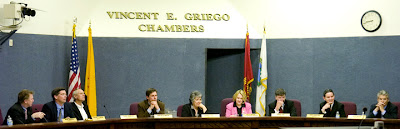
What's wrong with this picture?
At this week’s City Council meeting, Monday, Albuquerque Police Officer Paul Pacheco approached me to warn me that I could not stand where I normally shot pictures of city meetings because of an incident several weeks ago.

Pacheco removed Geraldine Amato from where I stood after she got into an altercation with Council President Debbie O’Malley.

Amato, left, is a regular participant in the governmental process. Her attendance is as prompt as any councilor, county commissioner or member of other meetings. She prefers meetings that are televised by the GOV TV – Government Television Cable Channel 16, http://www.cabq.gov/govtv/, and the Teach and Learn Network educational access cable channel 96, http://www.knmetv.org/education/talnet. She has her own talk show, “Amato's Debates,” on the public access channel 27, http://www.quote-unquote.org/, which airs on Thurs. at 5:00 pm. She does all she can to get her political views to the public without spending any money. She has run for political office, including, District Attorney and Bernalillo County Sheriff. She is a social security pensioner who had been a reader for the blind. She shepherded two law students through UNM’s law school.

According to Pacheco, left, who is regularly assigned as security at city council meetings, Amato was standing in the stairwell and blocked a council staffer who was trying to get to the dais.

O’Malley approached and physically confronted Amato. Pacheco observed them from the press booth and started to cross the chamber. He had to go into the hall to get to the other side and when he reentered the room, he saw papers flying. Apparently, Amato had grabbed some papers O’Malley was holding. When Pacheco got close enough, he asked O’Malley if she wanted him to remove Amato. She did and he escorted her out of the chambers.

Amato filed a 20-page complaint with the independent review officer against Pacheco.

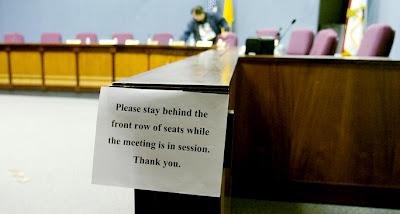
City council staff posted the warning, “Please stay behind the front row of seats while the meeting is in session. Thank you,” pictured above.

As the meeting started, Director of Council Services Laura Mason, right, approached me and told me I would have to move about 10 feet away from where I have stood photographing for the better part of 20 years.

Amato, below right, is seen complaining to Pacheco that the TV videographer from KOB Eyewitness news was not behind the front row. Mason also asked him to move and he did.

So what’s wrong with this picture?

Amato has a long history of irritating a number of public bodies and has driven several of them to take steps to minimize her appearance and stifle her speech. She complains about the current structure of governments and the interdependency of local government on federal influences and mandates. She sees a narrowing between the states from the federal government. Her theories of the federalist republic harkens back to the days of the Articles of Confederation that separated the states from each other and the central government. It was deemed unworkable and the Constitution was written and ratified. She doesn’t much like where 200 plus years of governmental evolution has brought us and she’s not afraid to say so.

Amato sat strategically behind the podium, so that when the government access cable station’s coverage of meetings focused on presentations and citizens making public comments, she would appear on camera.

Several current and former city employees, who have asked to remain off the record, have expressed a degree of contempt for Amato. She has aggravated many, wears what is seen by some as garish clothing and is viewed as trying to upstage the proceedings. The biggest complaint is the repetitive nature of her comments.

Amato claims she has a bad back and brings a supportive pillow on occasion. She will get out of her seat and walk around the chamber. She often times will laugh or blurt out a comment reacting to a statement she seems to finds hypocritical. Some of her critics claim she may have a pathological need to be noticed.

The Bernalillo County Commission began roping off the section of the audience that was the backdrop of the GOV TV’s wall-mounted camera. It is much like the area in center field at some major league baseball parks that have no spectators and are painted black or a dark color to create a contrast, so the batter has a chance of seeing the ball as it leaves the pitcher’s hand. GOV TV’s coverage o the City Council and Police Oversight Commission also maintained the same roped off area. By blocking off up to 15 seats, it keeps any movement behind the podium from distracting the viewing audience.


A couple of years ago, the County Commission moved its public comments section to before the beginning of their regular televised agenda. Earlier this year, the Albuquerque Public Schools also took steps to move public comments out of the public eye.

Councillor Don Harris, currently has a rules amendment proposal to eliminate general public comments from regular meetings. Instead, he would have a separate special meeting, once a month for public comment limited to a “City Government related matter.” The meetings would take place prior to the start of an already scheduled city council committee meeting. His proposal was postponed. He had previously suggested moving public comments to the last item on the agenda.


The New Mexico Open Meetings Act is pretty clear.

§10-15-1. Formation of public policy; procedures for open meetings;
exceptions and procedures for closed meetings

A. In recognition of the fact that a representative government is dependent upon an informed electorate, it is declared to be public policy of this state that all persons are entitled to the greatest possible information regarding the affairs of government and the official acts of those officers and employees who represent them. The formation of public policy or the conduct of business by vote shall not be conducted in closed meeting. All meetings of any public body except the legislature and the courts shall be public meetings, and all persons so desiring shall be permitted to attend and listen to the deliberations and proceedings. Reasonable efforts shall be made to accommodate the use of audio and video recording devices.


In trying to deal with what the council and its staff see as a problem with Amato, their solution steps squarely into the requirements of the open meetings act.

“The current design and arrangement of furniture in the City County Council Chambers restricts the ability of the public and press to see the proceedings clearly” I wrote in a March 30, 1995, letter to then Director of Council Services Mark Sanchez, left. “The presence of oversized tables with an excessive staff on the City Council side and the established presence of the Mayor/CAO (Chief Administrative Officer) on the other side of the podium effectively creates a physical barrier that excludes and blocks the free participation and exchange with the public.” This was after he had insisted I move from the same vantage point where I had been working on a video documentary. I moved and “Local television news cameramen then took up virtually the same position you ordered me from,” I wrote.

After the dust settled from the letter, I returned to the same location and until now, managed to get along just fine with the rest of the still, video photographers, council, staff and administrators.


The problem is not the news media, rather it's Amato. I have on more than one occasion, including Monday night, had to get her attention because she was blocking the aisle and was so engrossed in shuffling her papers that she was oblivious to wheelchair bound citizens who were making their way to the podium as part of a presentation on the issue of public access restrictions for persons with disabilities.

The television news photographers all dutifully acquiesced removing themselves to the back of the chambers. The result of following the legally questionable order is that the visual press is no longer able to adequately provide for the public, whom are, “entitled to the greatest possible information regarding the affairs of government.” Instead, the television cameras are only able to shoot the backs of balding heads of city administrative leaders.

It is neither compelling TV nor the access called for in the open meetings act.

If Amato is causing problems, then bring the right laws into play for the right solution.

Over the years, I have become experienced with dealing with disruptions at public meetings. Seldom are they handled well or legally. The first problem is that the ego of elected officials become involved. Their perceived authority is challenged and they don’t react well. Officers, present at meetings to maintain the peace, defer to the presiding officer and tend to use the wrong law. There is a state statute:


§30-20-13. Interference with members of staff, public officials or the general public; trespass; damage to property; misdemeanors; penalties. (1981)

C. No person shall willfully refuse or fail to leave the property of or any building or other facility owned, operated or controlled by the state or any of its political subdivisions when requested to do so by a lawful custodian of the building, facility or property if the person is committing, threatens to commit or incites others to commit any act which would disrupt, impair, interfere with or obstruct the lawful mission, processes, procedures or functions of the property, building or facility.

E. Nothing in this section shall be construed to prevent lawful assembly and peaceful and orderly petition for the redress of grievances, including any labor dispute.


The tricky part of the language is that the “a lawful custodian of the building,” must make the request. In this case that should not have been a big problem because the lawful custodian of the building is the Chief Administrative Officer Bruce Perlman, who would have been sitting closest to Amato. The law does not allow for delegation of who is a lawful custodian. Though O’Malley, as president of the council, has control of the meeting, she has to use the proper channels to enforce what is ostensibly a sergeant at arms role for the officer. However, Pacheco, had good criminal law available to him, in the form of disorderly conduct for what he witnessed.


As for the still and video photographers, it’s hard enough getting anything more than a profile shot of citizen participation in government, but a profile shot from behind the ear is simply unacceptable. I will be returning to the front of the chambers and am sure that the other photographers will follow.

As for Amato, she invoked my name in telling Pacheco that she could stand in the same place I do. However, I remain aware of my surrounding situation and am constantly making room for those who travel the room, as I also do for the television cameras.

If Amato were a visual journalist, then maybe she could invoke such standing, but she is not.

As for the council and its staff, follow the law and allow the working press to do their jobs under the open meetings act. Don’t punish the media for the council’s inability to appropriately deal with Amato’s behavior.

Tuesday, May 08, 2007

Better Numbers

What's wrong with this picture?

This is Albuquerque Police Chief Ray Schultz, on the left. Last week, when Mayor Martin Chávez said there were close to 1,000 officers, Schultz didn’t layout the real numbers of how many officers are on the police department.

At this week’s City Council meeting, Monday, Schultz was asked by Councillor Brad Winter, right, how many officers were on the police department’s payroll.

Schultz’ answer was 1,028, including cadets. He included cadets because he says they will eventually fill slots that are already authorized by the budget.

Schultz promised to deliver a complete list of every officer on the department to Winter.

What’s Wrong With This Picture?

Schultz’ answer hedged a little bit. In an interview, after testifying before the council, he identified that the number of cadets was 49. He said that he currently has multiple classes in session. Of the three classes, he anticipates graduating: 17 officers on May 25, another 15, June 29 and 18 on Sept. 28.

The number of sworn officers is 979.

Schultz told the council that the runaway bride recruiting campaign was successful, with about 500 people contacting the department. He said recruiting received 351 interest cards in the month of April.

The chief said that there had been a shift in the number of cadets necessary to start a class. Now he will start one with as few as 12 cadets. There are some advantages. Interested applicants do not have to wait months for a class to begin and the smaller numbers allows for more one on one teaching. Problems with trainees can be identified, isolated and corrected sooner. He hopes to start more classes on the way to reaching the goal of 1,100 officers by the end of the year.

Scoop Your Poop

What's wrong with this picture?

This is the City Council meeting Monday.

The best quote that exemplifies the entire meeting has to be the admonition by Councillor Sally Mayer, “scoop your poop.”

It was an announcement from the city staff through the Councillor as a reminder of the health risk associated with animal feces left to the elements. So, scoop your poop!

What’s Wrong With This Picture?

If only the council had taken this advice. The meeting was one of those interminable affairs. Over 20 action items were on the agenda, of them only a handful came to a voted resolution. All the rest were deferred; some after extended discussion and debate.


I was not going to mention the comment posted on the anonymous Eye on Albuquerque blogspot that accused me of being its author. I am not! However, several people, including a couple of councilors inquired if I wrote the Eye.

It seems there is some confusion. I will speculate as to how that confusion came about.

I used the Eye on Albuquerque as a reference on a couple of postings in the past few weeks. I have communicated with the editor of the Eye by e-mail several times. I have made no effort to ascertain who or whom the Eye is. Knowing that the Eye wishes to remain anonymous, simply means I take what is said with a great deal of skepticism, as I would any anonymous source. No matter how many times the Eye’s information might prove accurate, the anonymity maintains the skepticism. Credibility is an entirely different issue.

When I was researching the Million Dollar Recruiting post, May 1, I asked APD for permission to use the city-produced picture of the runaway bride. The request went up the chain of command. Before I got an answer, I learned that the police department had produced a press release and provided hard copy handouts of the picture for the news media. I lifted the picture from the APD website for inclusion on this site.

A couple of hours before I went on line, the Eye on Albuquerque posted, what I consider a relatively harsh entry that also used the same picture.

At this point, I believe there was an error made. Because the Eye posted and I had requested the picture, someone made the assumption that because of my request, I must be the Eye. Whoever has been reading the Eye, was not aware of this blogspot, but had heard that I was blogging.

Unlike the Eye, though I have been critical of some of the same things the Eye has, I have attempted to take a more journalistic approach to my reporting and analysis.

On May 2, in the Eye's comment section, “anonymous said... LIE on Albuquerque, AKA Mark Bralley (SP), enough with your (expletive deleted) rhetoric already…..”

I don’t expect an apology from the commenter, for the personal attack, but if somebody accused someone other than me of writing my material, I would at least disabuse anyone of that notion.

When I’ve gotten a fact wrong, I’ve corrected it and I don’t write anonymously!

I don’t have time to write two blogs and it’s not my style to write as the Eye does. It would be nice if the Eye were to set the record straight. Scoop your poop.

Thursday, May 03, 2007

Bald-Faced Hypocrisy!

What’s Wrong With This Picture?

I can’t even seem to get a good night’s rest without Mayor Martin Chávez making a mockery of what he says he stands for.

Tuesday, I watched his slight-of-hand, fast-talking, bamboozling of the old folks at the Bear Canyon Senior Center during his community gathering to explain his proposed budget to city council.

The Albuquerque Journal’s city hall reporter, Jim Ludwick, writes today that Chávez wants to open up city government.

New Mexico Foundation for Open Government’s Bob Johnson praised the “initiatives” saying the city is doing a better job with “sunshine” laws than the state.

Johnson told Ludwick that openness increases the public's faith in government.

So what’s wrong with this picture?

I learned as a child the east coast phrase that “Gimbles doesn’t tell Macy,” about sales prices. I am going to skirt the details of my on-going efforts to report a couple of particular stories in the hopes that I can be the one to disclose the facts of these events.

I have been working on one story for over two years and have made repeated informal requests for information from various city employees, but have met total resistance.

Ludwick is also working on the same story. He has an advantage; he has access.

At least one television station has aired videotape of some of the documents I seek to view.

On March 14, I filed with the city clerk two formal written e-mail requests to view documents under the state’s Inspection of Public Records Act.

The act requires governments to respond, in writing, within three days as to where the records may be viewed. If the government cannot immediately provide the documents, they may inform the requestor that they need more time. The law allows the government up to 15 days to respond.

Over the years, I have seen a number of tactics used by the city to avoid complying with the law. Though I have obtained information after making e-mail requests, I thought they might argue that they did not have to respond to an unwritten request. So I took it to a more formal level.

When I received no response from anyone at the city, I hand delivered copies of the requests to City Attorney Bob White on April 12. White is the direct supervisor of the city clerk, who is responsible for handling the requests.

Fifteen days have come and gone, a second time, without a response. Even if my requests are being denied, the custodian of the records is required to respond in writing.

By law, this should be an open and shut case. Next step, court?

I couldn’t agree more with Johnson’s comment that openness increases the public's faith in government.

Yet, Chávez’ assertion of opening city government is hollow. If he really wants to prove his openness we could sit down over a cup of coffee and he could grant me an interview.

Wednesday, May 02, 2007

News Flash! Budgetary Update!

What’s Wrong With This Picture?

Mayor Martin Chávez held one of his “town hall” community gatherings held Tues. at the Bear Canyon Senior Center in Council District 8.

It actually was more a “dog and pony show.” Chávez started the session introducing a dog, up for adoption, from the animal services department. Then he did the pony stuff.

Before a group of about 50, mostly seniors, Chávez introduced his staff. Conspicuously absent was the new Director of Aviation, Nick Bakas.

So what’s wrong with this picture?

Chávez pointed out that the police department was close to having 1,000 officers and with the help of Chief Ray Schultz, would have 1,100 officers on the force by the end of the year. “That is almost double the number of officers we had 10 years ago,” Chávez said.

Schultz did not contradict his boss. However, ten years ago there were 830 officers on the department; the authorized strength rose from 900 to 928. The next year the authorized strength was to rise again to 1,003. In the past 10 years, the department has not been able to sustain that number.

Nor did Schultz correct Chávez' mathematics. Almost double of 830 is 1,600 or the other way around if 1,100 is almost double what the number was 10 years ago, then that number would have been less than 500.

Tuesday, May 01, 2007

Million Dollar Recruiting

What's wrong with this picture?

This is Max Sklower. He was the general manager of KOAT TV for a number of years in the mid to late ’70s and into the ’80s. He was a great supporter of law enforcement and the Albuquerque Police Department, in particular. Sklower is holding a CrimeStopper’s award given to him for KOAT TV’s efforts supporting and televising the “CrimeStopper’s crime of the week” campaign.

In 1977, I was transferred to the Police Athletic League. My assignment was to get me within the operational chain of command with the community relations unit. I had proven myself useful in public relations and the powers that be thought I could serve a dual role. The arrangement ultimately proved disastrous. However, upon arriving at PAL, I was asked to develop a name recognition campaign. Within a half-hour, I had talked to Sklower and worked out a symbiotic plan to aid APD and KOAT. At the time, KOAT was airing re-runs of the old Jack Webb production of “Adam-12,” at 6:30, immediately after the evening news. I proposed a ten-second spot leading into the program, touting PAL. Sklower agreed and a taping session was set up. By the end of the week the promotional spot was airing. “Serving the youth of the community; the Albuquerque Police Athletic League, brings you Adam-12, next on KOAT TV,” I said, as seen below.

KOAT ran the series for another six years and before every show, the promo ran. It didn’t cost a penny. Years later, I had more than one rookie approach me and say, “you were the Adam-12 guy, you got me interested in police work, now I am one.”

I later designed other recruiting campaigns that were deemed successful, including one directed at minorities and females. It featured newly promoted Sgt. Karen Wilson, Meliton “Dickey” Otero and Bill Middleton.

Recently, the department embarked on a campaign based on the “runaway bride” incident of a couple of years ago. Public Information Officer Trish Hoffman had become the face of APD during the press coverage of the Atlanta, Ga. woman who abruptly left home days before her scheduled wedding and several days later emerged in Albuquerque.

Hoffman, along with other male officers, escorted the woman, who was covered with a multi-colored blanket, through a gauntlet of still and video photographers at the Sunport, where she caught a plane home. The story took on a tabloid crazed feeding frenzy and circus atmosphere. Hoffman became a media star in her own right, including a comedy sketch featuring a caricature of Hoffman on NBC’s Saturday Night Live.

The electronic billboard recruiting campaign gained national attention after Albuquerque Journal’s cop-beat reporter, T.J. Wilham, broke the story. CNN and hundreds of other news outlets picked up the story. However, the project was not without its detractors and it has drawn some criticism.

A marketing and advertising lecturer, at the University of New Mexico’s Anderson School of Management, John Benavidez, praised and criticized the billboard in a follow-up story by Wilham.

"Whoever came up with this, (billboard idea) it is the best decision they ever made, and they should get a pay raise," said Benavidez. He then suggested that APD was wasting taxpayer money in buying space on 10 billboards.

Benavidez complained that there were problems with the billboards claiming they were not well presented and confusing. He pointed out the absence of the area code with the phone number. “The department is leaving itself open to criticism from the mental health community,” he told the Journal.

The City Council is being presented a budgetary proposal requesting more than $1 million to provide for increased recruiting bonuses, and extra money for officers eligible to retire who are willing to work longer.

So what's wrong with this picture?

I’ve used this picture before. It was taken 10 years ago, during Mayor Martin Chávez’ first term. He was trying to get a quarter cent “Public Safety Tax” approved by voters. The union had objected to having the tax associated with police, fire and corrections. Our feeling was, public safety is such a fundamental governmental activity, that it didn’t need a special tax designation. If a budgetary adjustment was needed for public safety, then other parts of the City should suffer first. The sequestering of a quarter cent for public safety was perceived as a scam to lock down money. Then, where there was excess, it could be used for pet projects of the mayor and council. Our argument was the public safety, along with water and sewage, were first, last and always budgetary priorities.

When the union’s public relations campaign got some traction and the press started giving us ink, the mayor and then Chief Joe Polisar and his Deputy Chief, Tim Bourgoine, ordered all uniformed police officers to attend a “City-wide briefing.” Such briefings were held periodically, but this one had a political theme. Chávez was trying to convince officers to support and encourage those they know to vote for the tax.

What is important are the numbers written on the board by Polisar. They show the fiscal year, the authorized strength and the actual number of officers on the payroll for the preceding years and the numbers projected into the future.

Let’s take it one more step. The discrepancies between the authorized strength and actual number:
89 – 771 – 756 - down 15

90 – 821 – 804 - down 17

91 – 827 – 768 - down 59

92 – 800 – 767 - down 33

93 – 784 – 779 - down 5

94 – 825 – 796 - down 29

95 – 900 – 830 – down 70

96 – 928 – when the picture was taken.

97 – 1003 – projected

98 – 1078 – projected


02 – 905 – 930 – down 25

07 – 1000 – 998 – down 2, but it includes 18 part timers.

At the time, 1996, Polisar said that according to FBI standards based on population ratio, Albuquerque should have had about 1,200 to 1,300 officers.

The department managed to get above the 1,000 officers level only once and then only briefly. A recruit class graduated, pushing the number above 1,000 and then a number of senior officers retired dropping the count below the “magic number.”

Now Chávez and Chief of Police Ray Schultz propose a scheme to spend over $1 million to retain senior officers.

They may not legally do so! The city has entered into an exclusive collective bargaining contract with the police officers’ union covering wages, hours and working conditions.

What that means is, that the city must bargain with the union over paying any member of the union more than the existing contract allows.

Recruiting has always been a problem at APD. At one time it was, by far, the highest paid agency in the state and was the place to work. Not so anymore; other agencies are offering more pay to join their departments and are touting a better package than APD can.

The ‘Run Away Bride” campaign is one of the better recruiting efforts that APD has come up with in years.

As for the complaints lodged by the marketing guru from UNM’s Anderson school, he’s simply out of touch. The fact that the campaign got worldwide press coverage because of the association with the ‘Run Away Bride” story, did not result in large numbers of interested applicants. He, better than anyone, should know that if advertising works at all, it is the result of a concentrated repetition of the message over a sustained period of time. The percentage of interested applicants who actually make it through the rigorous screening and testing process is usually less than a handful per hundred. Anyone who is offended by the humor displayed in the ad would never make it as a police officer. Though police must be sensitive to the plight of those they serve, they are going to see a lot of things that make the skittish bride pale in comparison.

The point Benavidez makes about the mental health community possibly complaining is, in the street vernacular of cops, “10-40,” the police code for: a mental case, or “crazy.” It also presupposes that the run away bride suffered from some form of mental instability when she decided to abandon her plans to get married without telling anyone. Based on her actions, her fiancé panicked, called police and whipped up a media frenzy. The press disregarded the hundreds of other adult missing persons reports filed that week to seize upon a young, white, attractive woman who exercised her free will to take a walk and deemed her crazy. It wasn’t bad enough that she chose not to go through with a wedding her story exploded in all the nooks and crannies of tabloid and mainstream media. She likely wasn’t nuts, but was driven to act out as surely as she arrived in Albuquerque by Greyhound bus.

Officer Hoffman exemplified the care and compassion of APD. There were no local charges pressed against the woman, even though she told a story of kidnapping and rape that she backed off of almost immediately.

There is a back-story; Hoffman came to Albuquerque and joined APD after leaving another state to avoid a former boyfriend turned stalker.

The simplicity of the billboards speak for themselves. The widespread press reaction was unexpected. The lack of an area code was not anticipated and because the billboards are local, unnecessary.

Monday, April 30, 2007

Blowing in the Wind!

What’s Wrong With This Picture?

It’s a windsock at the Sunport. The wind is blowing out of the southwest. Aircraft were taking off on runway 21. The most predominant wind direction in Albuquerque during the day is a west to east flow. During the night, a stable air mass will cool down and the settling air seeks the lowest point; the riverbed and then it flows down stream, to the south.

This story is only tangentially about the Sunport. The City’s Director of Aviation, Mike Rice recently retired. April 24, Mayor Martin Chávez announced that Chief Public Safety Officer Nicholas "Nick" Bakas would be taking over the position of Aviation Director.

It seems a strange move. Bakas was a deputy chief administrative officer, one of three under Chief Administrative Officer Bruce Perlman and the mayor. Now he is assigned to be director of aviation, a department head; a step below his current position.

Bakas is a seasoned administrator. He is a graduate of the UNM law school, though he doesn’t practice, not having passed the bar exam. However, his experiences have always been in the law enforcement field. Though management skills should easily transfer from one job to another, aviation skills bring additional challenges. The Federal Aviation Administration’s rules and regulations on operating airports fill volumes. His law degree will come in handy. He will get to enjoy the view from the multi-million dollar cost overrun, “Marty Chávez Memorial Observation Deck.”

Bakas joined the Albuquerque Police Department in 1973 and rose through the ranks to become a captain. He was one of three finalists for the chief of police job when Jim Baca became mayor and fired Chief Joe Polisar in 1997. Baca selected Gerald Galvin from Toledo, Ohio as chief and Bakas was nudged into retirement shortly afterwards.

In 1999, Gov. Gary Johnson, left, announced he wanted to have a public debate over drug reforms, including decriminalization of certain drugs, legalizing, especially marijuana and heroin. Johnson wanted drug treatment included in addition to prison time in an effort to tackle drug addiction as a public health issue as well as a criminal matter.

Much of the law enforcement community lashed out at Johnson. The drug war is a cash cow for the law enforcement/corrections industry. The mere suggestion of trying to address the underlying issues of drug enforcement caused a wave of hysteria. About 25 representatives of the New Mexico Sheriffs and Police Association held a press conference on Oct. 14, 1999, denouncing Johnson’s idea.

Then Bernalillo County Sheriff and senior law enforcement leader in the state, former Albuquerque deputy chief Joe Bowdich, above, spoke for the group.

A quarter of the NMS&PA representatives, seen below, including Bowdich, were associated with the Albuquerque police department. From the left: in uniform, former APD Sgt., Corrales Chief Mike Tarter, former APD deputy chief, Sandoval County Sheriff Ray Rivera, holding yellow legal pad, former APD Lt., former Torrance County Sheriff and Executive Director of NMS&PA, Richard Ness, in the green shirt, former APD deputy chief, Roswell Chief Richard Campbell, red tie and on the far right, is the dark uniform, APD Chief Galvin.

Johnson’s then Director of Public Safety, Darren White, who is now serving his second term as Bernalillo County Sheriff, resigned, condemning his boss’s proposal. Bakas reemerged on the public scene taking over the DPS job.

“We can't keep doing what we have been doing and expect to get a different result can we,” Bakas said? In an interview five years ago, Bakas said, no police officer who had a career behind them could admit that the current incarceration only answer to combating drug crimes was succeeding.

Johnson left office at the end of 2001; Chávez tapped Bakas to be deputy chief administrative office in charge of police, fire, corrections departments and the office of emergency preparedness. The city separated from joint management of the Metropolitan Detention Center last year.

Bakas, left with Sheriff White at the fifth anniversary of 9-11 ceremony in 2006.

There have been several scandals under Bakas’ watch including:

The APD evidence room incident embroiled in theft and embezzlement allegations that ended with Chief Gilbert Gallegos’ retirement.

Former deputy chief and Bernalillo County Sheriff Joe Bowdich was named interim chief until former Deputy Chief Ray Schultz, who was a Deputy Chief in Scotsdale, Ariz., was hired chief.

An off-duty police officer/friend removed a driving while under the influence suspect, Jason Daskalos from a DWI roadblock. It was further determined that Daskalos, a developer and large campaign contributor to Chávez’ mayoral campaign, had dozens of traffic charges vacated before getting to court.

Bakas threatened disciplinary action against police officers and firefighters who signed on to box at an annual charity event. He said it was because the year before, it had been held at a casino where there was drunken rowdiness and skimpily clad girls carrying cardboard signs around the ring announcing what round it was. It took the ACLU‘s intervention in defense of the off-duty employees right to association and free expression to clear the way for them to box.

There are continued problems of providing appropriate due process for red light and speed cameras and the use of mobile photo radar vans in a controversial automated enforcement program.

Since his appointment, five years ago, there were 905 police officers; the goal of 1,000 officers continues to elude the Chávez administration.

Two calls of domestic violence to the 911 emergency call center were not immediately dispatched and three people were killed in a murder and a murder-suicide, resulting in lawsuits claiming huge demands.

Most recently, the newly appointed manger of the 911 emergency call center resigned after receiving a 30-day suspension amidst allegations of sexual harassment and creating a hostile work environment.

Chávez said Bakas would remain involved in the City’s emergency preparedness planning in coordinating with homeland security, but police and fire departments would report directly to CAO Perlman.

Bakas spoke of his working relationship with the aviation police. That relationship takes the form of his long time association with former APD Sgt. Marshal Katz, left. After Katz’ retirement he made an unsuccessful run against Darren White for the Republican primary position as Bernalillo County Sheriff. He was appointed chief of the aviation police in 2003.

So what’s wrong with this picture?

Something is in the breeze if Chávez has reorganized the 911 emergency call center, removing the two long time civilian managers and replacing them with Assistant City Attorney Pete Dinelli. Deputy Chief Michael Castro, who had been in charge of the communication center, had it removed from his command and Civilian Executive Deputy Chief Bowdich assumed control.

Bakas has clearly been demoted, not withstanding any effort to put some positive spin on the move.