Saturday, April 21, 2007

Cleaning Up Little Nit-noyeds!

What's wrong with this picture?

This is the entry to the Vista Del Norte development on Osuna Road.

A few weeks back there was an uproar at city council over the 22-acre undeveloped lot between the homes and Osuna.

The owners of the property negotiated with Wal-Mart to build a super store on the property. A lot of “not in my backyard” and anti Wal-Mart protesting surfaced.

It seemed like there was no way to stop the development because the land that Wal-Mart and the landowner propose using is appropriately zoned. However, out of the blue, as in out of the blue sky, comes a balloon or a thousand balloons to land in one of the last large, vacant tracts in the north valley.

The lot is south of Albuquerque Balloon Fiesta Park where for nine or ten days a year, hundreds of hot air balloons launch.

The city council, in an extraordinary procedural move, introduced the matter for immediate action and voted on legislation without the benefit of committee deliberation or extended public debate.

The bill, introduced by Councillor Deborah O'Malley, will also provide for recreational fields under the control of the Parks and Recreation Department. The action passed 8-0 with Councillor Sally Mayer excused.

In the spirit of open disclosure, I have been a licensed commercial balloon pilot for 27 years and have watched the Balloon Fiesta change it’s launch sites in a steady northward march, leapfrogging across the city.

The first balloon event was not officially known as Fiesta. It was in 1972; the 50th anniversary of KOB radio held on what is now the west parking lot of Coronado shopping center. The next year’s event was a world hot air balloon championship. It was held on the infield of the racetrack at the New Mexico State Fairgrounds and the following year the designation of Balloon Fiesta came into existence and was held at the same venue.

The Fiesta then moved to Singer field, seen left, in 1976 during my first balloon ride, just northwest of Jefferson St. and I-25. Several years later it moved about a mile or so north to an unused gravel pit called Cutter field in honor of one of the founders of Albuquerque ballooning, Sid Cutter. It moved again to a former landfill that was designated as a city park just south of Alameda Blvd. The launch site moved one last time to its permanent location at the northern edge of the city, abutting against Sandia Pueblo. The land was designated as Balloon Fiesta Park and developed and grassed over. It doubles as a golf driving range when the balloons don’t fly. The south end of the park is the home to the Anderson-Abruzzo Albuquerque International Balloon Museum.

I indicated to my readers that if I ever used some extraordinary or manipulative photographic technique I would disclose it. This picture is a composite of several exposures brought together in the computer with the PhotoShop program using a technique call high dynamic range. It allows for the darkest portions to show detail and the brightest portions to not blow out. The camera’s normal exposure latitude would not allow for such a wide range. The picture however, is consistent with what the human eye can see.

In all my years of flying I never landed in that location. The closest I came once was about a half mile to the northwest, when I had taken off from the West Mesa. Balloons have no steering device and can, at best, only be coaxed to alter directions by finding differing winds at different altitudes.

I stopped launching from the Fiesta field in 2000 because I was not satisfied that it was still safe to fly over congested areas. Homes and business buildings continued filling in vacant land in the northern part of town.

Without supporting Wal-Mart or bashing Balloon Fiesta, there is a section of the Constitution, also applying to the city that is troubling. Article I, Section 9. 3. “No bill of attainder or ex post facto law shall be passed.” A bill of attainder is a piece of legislation designed to benefit a particular person or entity, while an ex post facto law is a piece of legislation written to take effect to encompass a time before the law was written.

The City Council’s action raises questions about using the right of eminent domain, the ability of a government to take property for a needed public purpose. This is generally accepted as necessary for building roads, bridges and schools. The Supreme Court upheld a town’s right to condemn property and turn it over to developers because the development would bring in higher tax revenues. There was a loud backlash and several states have outlawed the practice.

New Mexico is not one of those states and Rio Rancho, in particular, is using the right of eminent domain to take land purchased years ago. people were not allowed to develop their land. The City of Rio Rancho then, instead of exercising the power themselves’, farmed it out to the developer who stood to gain. The developer, with a vested interest, manipulated the assessed value of the properties virtually under paying the owners for the land. These property owners stood to gain substantially more had they been allowed to develop their land or if it had sold on the open market.

Expect a protracted legal battle and for those unfamiliar with the dynamics of balloon flight, a pilot is very limited in the ability to direct the movement against the wind’s direction.

The Journal editorial supported the action, calling for places for the balloons to come down. However ironic it might be, the Journal does not allow balloons to land on their property.

The City had not considered the site as a park prior to the Wal-Mart deal coming to light.

Rumble-strips

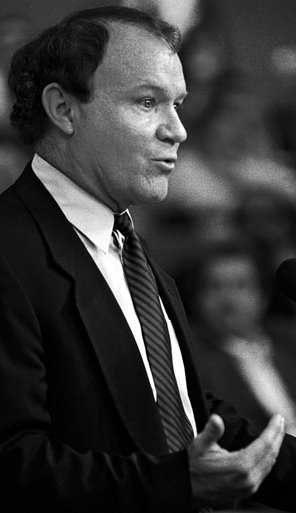
Mayor Martin Chávez and Chief of Police Ray Schultz are bemoaning the fact that Gov. Bill Richardson signed a bill sponsored by Sen. William H. Payne R- Bernalillo County, left, requiring notification to approaching drivers just before red light and speed camera controlled intersections.

The governor vetoed another bill that had passed by huge margins in both houses of the state legislature. It would have required that fines collected by the city’s “civil” process and administrative hearing officer’s procedures, go through the courts fee system to help pay down the bonds for the Metropolitan Court building. Sen. Timothy Z. Jennings, D - Chaves, Eddy, Lincoln and Otero counties, below, complained that by allowing Albuquerque to retain the proceeds of the Safe Traffic Operations Program, the rest of the state was having to unfairly fund a greater portion of the Metropolitan Court.

The mayor reportedly says that installing warning lights would cost $250,000 per intersection for the 20 camera systems now in place. That is a number that some critics say might be inflated by a factor of, as high as 10. According to Albuquerque Police Department Public Information Officer John Walsh, the cost of installing the cameras themselves is $35,000 per intersection. Installing flashing lights would require similar engineering and construction costs. The ballpark figure should not exceed $40,000 per location.

The state law offered an alternative, the use of rumble-strips. Chief Schultz claims that the use of rumble-strips poses dangers of their own to motorcyclists and vehicles that use anti-skid braking systems. Both claims are untrue.

Having been a motorcyclist and knowing a number of riders, no self respecting experienced rider would admit that a set of rumble strips would adversely affect them. Having been an anti-skid braking systems instructor at the police academy, a 20-30 foot patch of rumble strips would pose no major problem for a vehicle, even under a panic stop. The pulsating feature of ABS simply kicks out and normal braking takes over. It is no worse than for a vehicle that is not ABS equipped.

Within the recently renovated Big-I interchange complex, maintained by the New Mexico Department of Transportation, the roads have both rumble-strips and flashing warning lights. They were after thoughts installed because of accidents.

There are two sets of rumble strips on the westbound I-40 exit to University Blvd. and on the north frontage road west of University. There is a flashing warning light on the west frontage just north of Mountain Road because there is a hill that obstructs the view of the traffic control signal light. There were two fatal crashes within months of it’s opening where the southbound drivers who ran the red light claimed, that upon cresting the hill, were surprised by the existence of the red light, and could not stop or avoid the collision.

There are federal standards regarding virtually every aspect of road design and traffic controls that the states and city must follow.

Though Chávez claims that the only reason for the existence of the automated enforcement is safety, he is not willing to do reasonable things that might also reduce violations.

Chávez and Schultz held a press conference Monday, where Chávez announced traffic engineering was ordered to extend the yellow light timing by a half second at camera controlled intersections. I did not attend the press conference only because both the mayor and chief’s public information officers refuse to honor my repeated requests to be notified of such events,


Imus – Free Speech

Don Imus got sacked from his highly rated CBS radio and simulcast MSNBC television show, for his racist and misogynist rant of a couple of weeks ago.

Many felt his firing was proper while some have called it a violation of his free speech.

One needs to ask a couple of questions about assessing the free speech issue.

Imus, like everybody else in this country, is protected from government censorship. Imus lost his job because his employers, not the government, took back their microphone.

The Constitution only prohibits congress from writing laws that abridge the freedom of speech. The Constitution does a couple of things; it sets up and restricts government, and it outlines a capitalist theory.

Imus ran afoul of the capitalist theory. His language offended people who told his sponsors that they would no longer purchase their products and the businesses chose to distance themselves from him. It was a profit motive based decision and CBS/MSNBC also chose to follow such a business model in releasing Imus.

His free speech right hasn’t been affected. He can scream at the top of his lungs and rant any outrageous thing he wants; you’re just not going to hear him from the same place you used to on your radio dial.


Speaking of free speech…

A fellow local blogger, Eye on Albuquerque, http://eyeonalbuquerque.blogspot.com/, has been tracking several issues within the City of Albuquerque’s government. Recently, the anonymous blog has raised ethical questions and factual discrepancies surrounding the city’s 311 - information center’s manager Michael Padilla, who was recently assigned to additionally take over the management of the 911 emergency center.

Padilla, 28, has no law enforcement background, training or experience and made some bold assertions about how he was going to change the 911 - center and make it as efficient as the 311 - operation. He simply had no idea of why 911 works differently.

Sources, whom I will not identify, because they fear retaliation, have for years indicated the problems inherent in the 911 operations. Chávez removed Deputy Chief of Police Joe Silva, right, from operational control over the 911, even though Silva had forwarded upwards of 45 memorandums delineating deficiencies and seeking approval to make corrections, but was specifically denied permission and funding to make change. Silva retired.

Padilla’s ignorant and arrogant attitude aggravated and alienated some working at the 911 communications center. Questions of Padilla’s status arose. Was he certified by the State’s Department of Public Safety as having been trained and received a 911 and dispatcher certification and had he completed the FBI’s National Crime Information Center training? There was some speculation, because he was not a police employee, as to whether he was subjected to the rigorous background check that all other APD employees go through.

Padilla faced allegations of sexual harassment and creating a hostile work environment, and after an internal investigation, he was suspended for 30 days.

The Eye also revealed, according the City Clerks website, a Michael Padilla had made a $4,000 contribution to Chávez’ 2005 mayoral campaign, just weeks before he got the 311 manager’s job. The Eye speculated that when Padilla got the job, it was based on their assessment it would have taken a month or two to set up the unit. However, a long time employee familiar with telephone communications services with the public had done the lion’s share of preparation in the previous months for the call center. She was never publicly recognized for her efforts.

With Monday’s resignation of Padilla, the Eye raised another point: that Padilla was setting up a consulting firm and was angling to get a future city contract to continue working on the 911 management issues.

Chávez reorganized the chain of command structure of the 911 center. He removed Deputy Chief Michael Castro, left, and replaced him with Civilian Executive Deputy Chief Joe Bowdich, right. A Michael Castro is listed as making a $3,000 contribution to Chávez in 2005, on the City Clerks website.

The mayor also assigned Assistant City Attorney Pete Dinelli and Chief Administrative Officer Bruce Perlman to implement all of Padilla’s recommendations for the 911 center.

Dinelli has a long history with city policy making. I first met him as a rookie City Councillor when he took office Dec. 1, 1985 and I was the newly elected police officers association president. We spent many an hour discussing the role of public oversight of police.

He wanted civilian control over the internal affairs and disciplinary process.

We sat on an internal committee together, looking into whether there should be more civilian police oversight. The Albuquerque Journal ran a weeklong series called, “Policing the Police.” The committee decided to invite the Journal’s editor to come to express their concerns based on their series. Instead, an investigative reporter, Art Geiselman came to observe and report on the committee. Police administrators refused to continue the meeting as a public meeting. Dinelli and I wrangled with Chief Sammy Baca over the requirements of the Open Meetings Act. The meeting was cancelled when Baca chose to ignore our warnings.

Dinelli pushed very hard and the police union pushed back. Dinelli eventually compromised and twenty years later, much of what he originally proposed, has come to fruition, though many of the points that police officers objected to have never been implemented. The internal affairs and disciplinary procedures are still under the ultimate control of the chief of police, but there is also an independent review officer and a police oversight commission.

This is Dinelli, seen right, celebrating Jeff Romero’s election as Bernalillo County District Attorney in 1996. The greatest political foible I ever made was answering directly a question from my former personal lawyer, Romero, left, without adding my own take. Romero was considering hiring Dinelli as his Chief Deputy District Attorney. He asked me how the police would feel about Dinelli, knowing there had been some animosity. My answer was that those officers who would remember Dinelli from more than 10 years earlier were probably retired or had not been involved with him. My mistake was not saying that Dinelli probably had not changed and could strain relationships with police again. I regret not having spoken my mind. Romero appointed Dinelli. Not only did Dinelli strain relationships with the cops, he became a hatchet man within the DA’s office destroying morale, running off career prosecutors, and alienating the defense attorney’s community to the point that he publicly ruined any hope of Romero being reelected.

Dinelli has worked for the Chávez administration and is currently Deputy City Attorney heading the Safe City Strike Force, leading the closing down of old motels and pursuing vandals and taggers through civil suits in District Court. He is one of the architects of the public nuisance abatement theory. Unlike the motel and vandals who are pursued in court, he favors a “so-called civil process,” bypassing the courts using an administrative hearing process. He uses this “so called civil process” for actions that the city has no administrative authority over, rather than using criminal law to enforce city ordinances.

Perlman, a professor of public administration, has a long history with the police department starting in the late ’70s, working with the planning unit. The current Chief Public Safety Officer Nick Bakas, seen here below, on the left with police chaplain Jack Price in 1977, was an officer assigned to planning with Perlman. Perlman, lower right, was interested in police work, attended the police academy as a volunteer reserve officer and worked the streets.

The communications section of APD has had systemic problems and has developed its own cultural values that do not always serve the public, the department and ultimately the officers on the street, as well as they should. There are wonderful professional people in communications, but not all that they do is the best that they could do.

A radical change might be in order, however, how the mayor’s upper management staff attempts to deal with these problems could just as easily cause more problems than they solve.

The Eye reports that Deputy Chief Castro ordered Capt. David Depies the task of unmasking the identity of the Eye.

If true, the Eye is rightfully pissed.

Friday, April 20, 2007

Proof of Fraud?

What's wrong with this picture?

Blogger Mario Burgos, http://www.marioburgos.com/, continues to hammer away at former U.S. Attorney David Iglesias for not having prosecuted cases of voter fraud.

I posted “Wing Nuts,” a couple of weeks ago questioning Burgos, his fellow blogger Whitney Cheshire, The Wednesday Morning Quarterback, http://www.wednesdaymorningqb.com, and Albuquerque attorney Pat Rogers, asking for evidence sufficient to prove all the elements of the crimes.

A former fellow journalism student, Benson Hendrix, http://netnews54.com/, picked up and challenged them: “They claim to have a “mountain” of evidence regarding voter fraud, the point that the Wednesday Morning QB keeps trying to hammer David Iglesias and failing like a Miami Hurricane football player taking a trig test. I’d like to see this evidence. They do have it, don’t they? The vast mountains and bag fulls.”

Rogers, left, called me, April 6, asking for a copy of his picture from this blog. He contended that he didn’t agree with everything I wrote and offered me an interview with one of his clients, an Albuquerque police officer, whose 13-year old son received a voter registration card, though he had not signed anything. When I asked if they had identified who had signed the boy up, the answer was that the registrant had been a paid ACORN worker. The Association of Community Organizations for Reform Now has run several voter-registration and petition drives where critics, including Rogers, have contended that because workers get paid per signature, there is an incentive to manufacture names. Rogers correctly pointed out that the one case of signature fraud, in this county, where there is an outstanding warrant, was a petition drive in support of a minimum wage campaign, not a voter registration drive.

Rogers was unable to identify the name of any other person who committed the crimes for which there is some evidence. I accepted his offer to meet the innocent victims of these frauds, but I have not heard back from him.

On April 10, Hendrix blogged, “Just an update, it’s been a six whole days since I threw down the gauntlet for Mr. Burgos and Ms. Cheshire (Cat?) to pick up or shut up.”

Cheshire has been unusually quiet of late, much like the feline in Lewis Carroll’s Alice in Wonderland which was not noticeable until that wry smile appears. Satire, sarcasm and cynicism abound throughout her blog postings; her television performances are tame by comparison. Then she evaporates.

On April 17, Burgos posted, “How Much More Proof Do You Want?” He recounts a story told by the state’s newly appointed elections director, Daniel Ivey-Soto, left, that voters admitted to him that they had voted more than once at elections.

“Ok, am I the only one who finds it unnerving that the state's election director believes a certain amount of fraud is ok,” Burgos asks?

So what's wrong with this picture?

Burgos, Cheshire and Rogers, all continue to make a critical error; it is not enough to simply be able to prove that a crime occurred, it is also necessary to identify the perpetrator.

It doesn’t seem like anyone is endorsing voter fraud. Without the second evidentiary prong, cases are deficient.

The answer to Burgos’ question is that it is not OK, nor is a certain amount of fraud condoned. Instead, it is recognized as inevitable.

Until victims, law enforcement and political pundits put names to the offenders, the ability of a prosecutor to do their job is non-existent. The first prosecutor who has an obligation to pursue voter fraud is not the U.S Attorney, but the State’s District Attorney. Voting is controlled at the state level and managed by the county clerks, even in federal races. The U.S. Attorney has parallel jurisdiction. Therefore, it is the primary responsibility of the Sheriff to conduct the investigation and present the necessary evidence to the prosecutor.

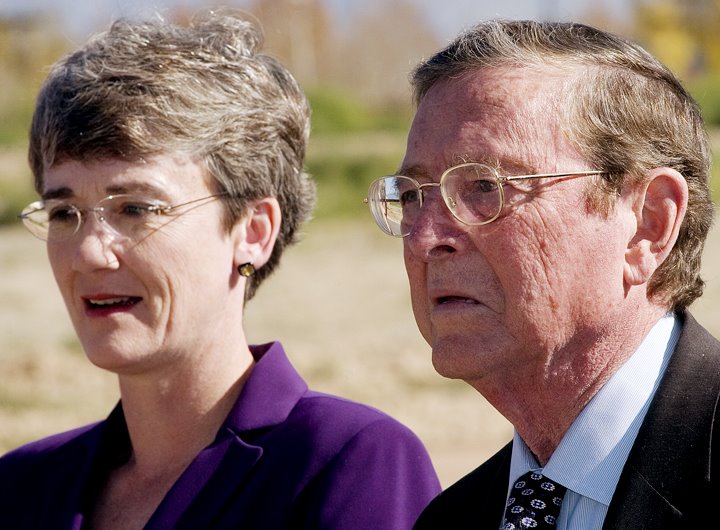
Another point Burgos attempts to make is that because there is proof that Sen. Jeff Bingaman’s office contacted the office of legislative affairs at the Department of Justice about New Mexico’s Election Fraud Task Force in 2004, it was the same thing as what Sen. Pete Domenici and Rep. Heather Wilson did in calling Iglesias directly.

Had Domenici and Wilson called the office of legislative affairs, in the way Bingaman had, shown here on the left, instead of Iglesias in person, this topic would not even be open for discussion.

Monday, April 16, 2007

Perp Walk? Not Quite!

What’s Wrong With This Picture?

This is Albuquerque Journal reporter Mike Gallagher, in 1978, when he was the police beat reporter, interviewing APD Records Sergeant Harold Munsell.

Gallagher became an involuntary model for a program on police – press relations when I was working in the Chief's office. At that time, Public Information Officer Bob Fenton was rewriting the press relation section of the department’s standard operating procedures. I was assigned to photograph and put together a slide-based program for presentation during annual refresher training for officers.

His kid brother, Tim Gallagher, was the police beat reporter for the Tribune at the same time. They were very competitive! They had so many informants and sources in the department that Internal Affairs had nothing on them. An officer couldn't move without the Gallaghers knowing about it.

Tim Gallagher moved from the Tribune and served parent company E.W. Scripps, as mid level editorial staff at the El Paso Herald-Post, then returned to be the editor of the Tribune before becoming editor at the Ventura, Calif., Star.

Mike Gallagher, here interviewing homicide Sgt. William Last at a 1978 violent crime scene. He became an expert at reading search warrant affidavits. He probably has read more of them than any District Court judge. There are 24 judges who review a fraction while Gallagher reads them all.

He's one of the better reporters I've ever met; probably the best researcher, a great interviewer and he can put ink to paper!

As a journalist, Gallagher does not write on a regular basis. He is an “Investigative Reporter.” It means he spends most of his time doggedly tracking down the details of stories that call for more than a day or two of research. Most reporters cannot devote that much time on a story.

Of late, Gallagher has been working on the parallel stories of the U.S. Attorney firings and the Metropolitan Courthouse construction corruption allegations.

He works with a couple of other investigative reporters, Colleen Heild and Thom Cole. Heild has also been a reporter for more than 20 years. When I was president of the police union and there was an effort to create civilian oversight, Heild wrote a weeklong expose entitled “Policing the Police.” She interviewed me extensively. I do not know Cole, but he, Gallagher and Heild, as a unit, serve to enlighten the community of important, if not limited issues.

So what’s wrong with this picture?

Here is Journal Photographer Roberto E. Rosales with Gallagher in front of the Federal Courthouse on Thursday, when former Metropolitan Court Administrator Toby Martinez and his wife Sandra Mata Martinez, two of the four indicted defendants in the Metropolitan Courthouse case, appeared for arraignment.

Rosales is a fine news photographer and he had a good picture on the front page of the Friday Journal of former Senate Pro-Tem Manny Aragón as he broke from the press scrum when he left the courthouse. However, he nailed the event with a second picture, "I'm Completely Innocent," that was posted on the Journal’s website, that showed Aragón arriving at court as he turned a corner with the Bernalillo County Metropolitan Courthouse behind him.

Rosales and I had a minor incident during last year’s election campaign when I inadvertently raised my camera in front of his, after he moved from my left to my right shoulder without my noticing it. He pushed my camera out of his way and later yelled at me. If anybody knows me, they know I don’t react well to being yelled at. I wrote Rosales, apologized, explained myself and reminded him that we, as photographers, all had to work in the same arena and that little incidents will arise. He seems to wish to hold a grudge. It’s unfortunate, but his choice.

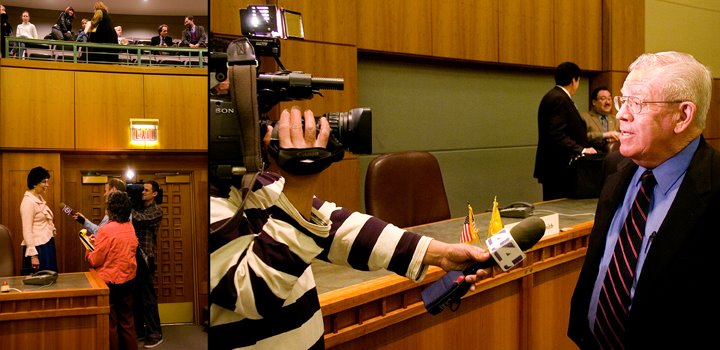
The press was out in force at the Pete V. Domenici Federal Courthouse Thursday morning.

When the indictments came down last month, Joe Monahan wanted pictures for his blog right away to illustrate those named. He had jokingly called for, “the perp-walk, where’s the perp-walk?”, as he had done as an assignment desk editor at a local television station’s news operation.

This was not the classic perp-walk, which means law enforcement’s walking a handcuffed perpetrator to jail through a gauntlet of photographers. You’ve seen the classic shots of gangsters with their coats over their heads or with their hats in front of their face. Police often times will tip off the press as to where such staged events will take place. The perp-walk serves a symbiotic relationship for both the police and press in an effort for the public and victims to put a face to the name.

For the perpetrator however, there is the feeling that the legal concept of innocent until proven guilty is merely a myth when forced before the cameras.

The courthouse stakeout serves a like purpose. No one seemed to have a picture of Sandra Martinez. There is wide disagreement amongst journalists as to the appropriateness of the opportunity to speak with the accused. A former Albuquerque Journal police beat reporter Steve Shoup, said that all he would ask was if the person wanted to say anything and then he would record what they said.
TV reporters, like KOB’s Shelton Dodson, are more aggressive and ask controversial and provocative questions. He asked of Aragón, how he felt at the prospect of possibly spending the rest of his life in prison. This was just after Aragón had said he was totally innocent of all charges. All Dodson got in response was a dirty look.

KOB TV’s Eyewitness News team, above, had three cameras and two reporters, shown here with the competition, KOAT TV's Rod Green.

The Journal had four staffers; Scott Sandlin, the courts beat reporter, joined Gallagher, Rosales and a backup photographer. The Associated Press had two reporters, an assignment editor and photographer Jake Schoellkop present. The other outlets had a more normal compliment of staffers for reporting a major story.


The media seems to be missing a point about this case. Three defendants: former Albuquerque mayor Ken Schultz, architect Marc Schiff and electronics subcontractor Manuel Guara, have agreed to enter guilty pleas to two counts each, conspiracy and mail fraud, and to testify against those indicted. Their guilty pleas have not yet been accepted in court, contrary to what several outlets have reported. Most likely, the pleas are conditioned on their testifying consistent with the statements they have made to investigators and prosecutors.

Though the four indicted defendants, Aragón, Raul Parra and the Martinez’ pled not guilty, there were two separate arraignment sessions. The reason was hinted at by the Martinez’ attorney, that a plea for them was not out of the question. "Any lawyer who tells you that under no circumstances is their client going to plea is lying to you,” Billy Blackburn told the assembled press.

Blackburn left the courthouse without his clients and initially bypassed the press. The Journal’s Sandlin reported that he refused to comment. The TV cameramen didn’t settle for that as they chased him down and Blackburn paused to give his quote.

The possibility of a solid defense is non-existent because three defendants already have agreed to plea and the Martinez’ are publicly contemplating it. The word on the press line was that there was bad blood between the Martinez’ and Aragón.

Contractor Parra, right, is seen here with his attorney, Robert Gorence, left, the former First Assistant U.S. Attorney for New Mexico during the Clinton administration and former son-in-law of Sen. Domenici. He was married to Lisa Domenici. Gorence said that after a trial where Metropolitan Court judges would testify, reporters would be writing a different story.

One could speculate that the defense will be based on the idea that when there were changes or additions to the existing construction plans and an urgency was placed on having all work completed by the deadline, premium payments would be necessary to secure the subcontractors. Part of the dispute, it would appear, will be that the inflated billing was signed off on, all the way up the construction supervision line, which included sitting judges. However, a $4 million inflation of just the audio-visual work for the $86 million project seems reasonably questionable as excessive.

In a discussion with Janet Blair, Communications, Information and Public Outreach Director for the New Mexico Metropolitan Court in 2005, while working on a photo documentation project of the newly opened courthouse, she indicated that the biggest construction problem was in the design failure to provide for wiring for computers and other audio-visual equipment. She said that in spite of the failure, the construction team was able to get all the work done on time.

There seems an unanswered ethical question that may be the crux of this case. Why does the legislator, Aragón, who shepherds the bonding of state money through the legislature, end up with any money, let alone $700,000 from contractors, as alleged in the indictments?

All the defendants, indicted and agreeing to plea are free on their own recognizance.

The next year, until the trials end, should prove very interesting.

Thursday, April 05, 2007

Catherine Ann Hall

What's Wrong With This Picture?

This is Cathie Ortiz-Hall with her husband Allen Hall at the Police Officers Memorial services in May 1979.

Cathie Hall passed Tues. March 20, 2007. She was 54.

She was married to Allen Hall for 28 years and both served full careers as officers with the Albuquerque Police Department.

She was among the young women who joined the department when there was no specific consideration given to women. Prior to the early ’70s, women on the department were limited in their assignments. Hall was among those who, upon graduation from the academy, went to work patrolling the streets.

She was small in stature, but it didn’t get in her way. She took her training to heart and was a solid officer.

She was badly injured in an accident during a high-speed chase. Her recuperation was a long process. It was the kind of incident that would make anyone think about the risks of continuing policing. She returned and finished her career, retiring after 20 years.

Tuesday, April 03, 2007

Wing Nuts

What's wrong with this picture?

Federal grand-jury indictments into allegations of a public corruption kickback scheme during the 2004 construction of the Bernalillo County Metropolitan Courthouse were released Thursday. Current acting U.S. Attorney Larry Gomez, New Mexico Attorney General Gary King, right, and Federal Bureau of Investigations Albuquerque’s Field Office Special Agent in Charge Thomas McClenaghan announced the indictments, naming four people.

Under indictment for: conspiracy, frauds and swindles (mail fraud), money laundering and laundering of monetary instruments, are former Senate Pro-tem Manny Aragón, below left, former Metropolitan Court Administrator Toby Martinez and his wife Sandra Mata Martinez and electrical sub contractor Raul Parra.


Former Albuquerque Mayor Ken Shultz, above right, who is shown lobbying a couple of weeks ago at the State Legislature, architect Marc Schiff and contractor Manuel Guara, have agreed to enter guilty pleas and testify against those indicted.


What’s a wing nut you ask?

It is a hardware fastener that wraps around a hex-nut and is made for temporary use and designed to come off and go on with ease. Once started onto a bolt, a flick of the finger will start it spinning. When it gets to the point it is meant to hold, it can only be torqued finger tight. When one wishes to remove the nut, backing it off to a point of looseness, a flick of the finger in the reverse direction causes the wing nut to spin right off.

A wing nut is also a name attributed to far right wing political operatives who engage in high levels of rhetoric, spinning their message as suits the moment.

Now, I don’t normally like calling folks names, however titles are another thing.

There are two particular wing nuts that I have been watching with some degree of interest in the local area. I’ve introduced them before, in the “Can we see Laura” posting of Dec. 5, 2006. They are Whitney Cheshire, The Wednesday Morning Quarterback, http://www.wednesdaymorningqb.com and Mario Burgos, http://www.marioburgos.com/.

Cheshire is President of Cheshire Communication Strategies, a professional campaign management and public relations firm, http://www.cheshirestrategies.com/. She has made it her recent mission to attack former U.S. Attorney David Iglesias for what she claims was his inability to obtain voter fraud convictions and the failure to open the sealed indictments that were released this week.

I have not met either one, but as a matter of fair disclosure, I have done work for a candidate that Cheshire had as a client at the same time.

Cheshire’s apparent effort has been to provide cover to Rep. Heather Wilson and Sen. Pete Domenici for their questionable phone calls to Iglesias, late in last year’s political campaign. Some believe the calls appeared to have been an effort to get Iglesias to release indictments into allegations of a public corruption kick back scheme during the construction of the courthouse.

Iglesias was asked to resign on Dec.7, 2006, with seven other U.S. Attorneys around the country. Since their release, questions about the motivation for their firings have surfaced. The Department of Justice and White House, in what they have admitted was a poorly handled affair, claimed the former U.S. Attorneys of being released for performance reasons.

The former U.S. Attorneys, and Iglesias in particular, took umbrage with an attack on the professional staff in his office. In DOJ performance review documents, recently released to congress, Iglesias had been rated in the top 10 of the 93 U.S. Attorneys.

Iglesias and other U.S. Attorneys recognized that they serve at the pleasure of the president. However, questions of the true motives surfaced because there was some indication the fired prosecutors might have been released for other reasons; political reasons.

Political observers surmise that the early release of indictments, against the suspected participants, could have been used as political ammunition, against Wilson’s challenger, then New Mexico Attorney General Patricia Madrid.

Ethics and public corruption were major issues during the campaign. Iglesias’ office was prosecuting an ongoing fraud trial involving two former Democratic state treasurers. Republicans attacked Madrid for not having started the investigation. Democrats contended that the Attorney General had started an investigation, but the FBI had taken over the case.

Iglesias’ office, using involved participants who were offered plea agreements to testify against former State Treasurer Robert Vigil, went to trial. A mistrial was declared, caused by a hung jury. Vigil was subsequently retried in Federal District Court and convicted of a single count of attempted extortion from the 24 remaining counts of the original indictment.

Cheshire suggests, there is nothing wrong with elected officials calling a prosecutor about an ongoing politically charged criminal investigation with sealed indictments, in the midst of a heated election campaign. She contends that it is right and proper.

Cheshire asserts that after viewing a couple of local news stories, that she has posted on her site, about allegations of possible voter fraud, it is sufficient evidence to prosecute unknown perpetrators. She claims to have seen the “evidence.” It apparently did not meet any rigorous legal test as evidence. Just because something looks bad, does not mean that one may attach it to an individual who then can be convicted of a crime.

She ignored the fact that there was a case, where a paid voter registration drive worker apparently copied names from the telephone book. One of the names, registered as a Democrat by the worker, was Republican Bernalillo County Commissioner Tim Cummins. Cummins filed a criminal complaint with Republican Bernalillo County Sheriff Darren White, who initiated an investigation, identified a suspect and acquired an arrest warrant alleging voter fraud. The suspect absconded from the state before the warrant could be served.

Cheshire also attributes the failure of any voter fraud prosecutions solely on Iglesias. She ignores the fact that a prosecutor is dependant on law enforcement to present them with a case. They must make decisions on the sufficiency of the evidence and credibility of the witnesses and determine the likelihood of a successful outcome at trial. Prosecutors are granted extraordinary power to make such determinations.

Cheshire also posted a letter to DOJ officials by New York Democratic Sen. Charles E. Schumer that questioned the progress of an investigation and compared it to what Wilson and Domenici did. There are differences. Schumer went through DOJ, in writing, not directly to the local prosecutor by phone.

However, if Schumer’s contact was improper, it doesn’t make Wilson and Domenici’s contacts proper. Any student of law or law enforcement who has taken the basic ethics class knows that you don’t approach the prosecutor except to bring them evidence or information about the case.

Though one might accept Wilson’s lack of legal training, and I won’t assert the fact that she is married to a lawyer, as reason for her not to know what is inappropriate, Domenici is a lawyer and should know better. Domenici has since said he regrets making the call. Wilson claims her call was appropriate and done only after an unnamed constituent asked her to make the inquiry.

Years of operating in the political morass that exists inside the Maryland-Virginia branch of I-495, known as the Washington Beltway, could make one forget that picking up the phone and seeking information might cross the line. Wilson and Domenici are accustomed to accomplishing things through political power by picking up the phone, whether the calls were intended as influence, pressure or not.

Clearly, the result of the Wilson/Domenici phone calls and the other calls for Iglesias’ firing have escalated into the biggest political storm, involving New Mexicans at the national level, since the 1922 Teapot Dome Scandal.

Burgos is also a professional public relations and marketing consultant. He is a strident Republican. He makes no apologies for his full time defense and support for Wilson.

Burgos’ wife is from a long line of New Mexicans, while he proudly hails from New York City. He ran for a State House seat for the East Mountains district and was defeated. Just last week, he ran for Bernalillo County Republican party chair, but lost to incumbent Fernando C de Baca.

Not withstanding Burgos’ Hispanic roots, critics are more concerned with the short time he has lived in the land of enchantment and call him a “Damn Yankee.”

Now I know a little about being a “Damn Yankee,” having arrived 40 years ago after 16 years of living in four different states and another country, I too was a “flatland foreigner.” It took many years for me to settle into and to be accepted as a New Mexican. It didn’t matter that I thought myself a New Mexican; it wasn’t until the natives, even those born after I arrived, accepted me. Some still don’t.

Education, knowledge, experience and political astuteness aside, acceptance into New Mexico politics, both Democratic and Republican, is gained slowly.

Together, Cheshire and Burgos have been teamed up to become the darlings for the left/right political punditry format on local television; they represent the right of course – far right. One or the other is regularly seen in KNME’s, “The Line,” when Cheshire replaced John Dendahl, after he was elevated to be the Republican gubernatorial candidate last year.

Burgos wrote Friday, “What a World of Difference a Change Can Make(?)” attributing the release of the federal indictments on the new temporary U.S. Attorney. “Now, anyone still wonder why neither the former U.S. Attorney or Attorney General have a job. Yeah, I didn't think so,” Burgos wrote.


Steve Terrell, left, of the New Mexican with contribution from the Associated Press reported that, “Guara, who signed his plea agreement Tuesday, said Raul Parra recruited his company, Datcom Inc., as a subcontractor on technology work at the courthouse.”

So what's wrong with this picture?

When I was an adjunct university professor, teaching public administration, my pupils and I examined a number of historic and current topics of public concern. I encouraged open discussion and often we had heated debates.

There were only a couple of ground rules: accurate statement of fact before opinion and that I might change sides, at any time, if I thought the rhetoric needed challenging or that some other viewpoint was overlooked or ignored.

I had an open challenge with the students and told them that, “if you can determine my actual position or opinion, please let me know what it is.” I learned as much from these discussions as did the students.

THE FACTS.

U.S. Attorney David Iglesias acquired a single count conviction of attempted extortion against former State Treasurer Robert Vigil and obtained guilty pleas from all the other co-conspirators.

Rep. Wilson and Sen. Domenici admitted making phone calls to Iglesias, but denied that they were trying to pressure or intimidate him.

Documentation provided to the Senate Judiciary committee looking into the firing of the eight U.S. Attorneys show that Domenici had made repeated complaints of Iglesias to the White House and Department of Justice.

Albuquerque attorney Pat Rogers, right, who has represented Wilson and the Republican Party in the past, also admitted speaking with Iglesias about the stalled indictments and he later contacted members of the Bush administration about removing him. Another Albuquerque attorney, Mickey Barnett, who at one time was a Washington based Domenici aide, later sat on the Republican National Committee representing New Mexico and currently is a presidential appointed Postal Service Governor, also complained about Iglesias to the Justice Department according to e-mails released to congress.

To answer Burgos’ question, “Now, anyone still wonder why neither the former U.S. Attorney or Attorney General have a job.” Madrid was blocked from running for her position by term limits, not by losing that race. She lost her challenge to Wilson’s New Mexico 1 Congressional seat by less than 900 votes.

The emphasis in Terrell’s story is on the fact that Guara signed a plea agreement last Tuesday. It appears that contrary to all the calls for the release of the indictments last year, the confidence in the evidence for the U.S. Attorney to proceed to trial may not have come together until as recently as last week.


Attorney Randi McGinn told Albuquerque Journal investigative reporter Mike Gallagher in a Nov. 23, 2006, copyrighted story, that she represented former state District Judge W. John Brennan, left, who had been questioned by the FBI in an investigation into the construction of the Bernalillo County District Courthouse. Brennan had been chief judge during the planning and construction of the building. Brennan’s name did not appear in the recently released indictments. McGinn said Brennan was only questioned as a witness.

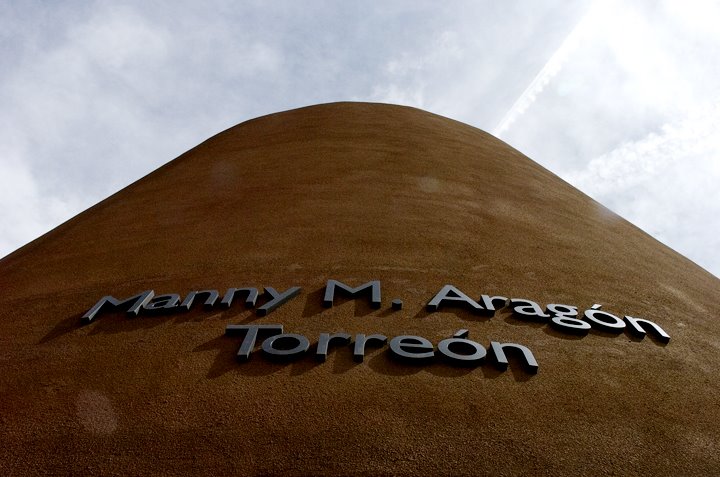
There is some indication through Journal reports that there may be at least two other public buildings constructed in the past few years: the District Courthouse, the Metropolitan Detention Center and possibly the National Hispanic Cultural Centre, where the Manny M Aragón Torreon is located and named after the defendant.

Of course, the wing nuts could simply be engaging in hyperbole, balderdash or humbug, all age old and honored journalistic traditions.

The only problem with that possibility is, if one holds themselves out to be taken seriously, then they don’t engage in hyperbole, balderdash or humbug, for it attacks their own credibility.

It may also be beyond their grasp that facts and statements that seem in stark opposition to each other may not be. The concept of holding more than one radically different idea at the same time should not be discounted. It is possible that when Wilson and Domenici made their phone calls, they did not think they were or would be interpreted as trying to influence, interfere, or pressure Iglesias. It is also possible that Iglesias chose not to report his mentor and political allies out of a sense of loyalty to them. Perhaps he thought he could put his feelings of being pressured aside, and through his own convictions, find a way through it.

It seems easier for wing nuts to engage in attacks of personal destruction, demonizing those who do not march in lockstep with them.

It is my humble opinion that public relations and political consultant professionals along with advertisers seem to have skipped, slept through, forgot or simply ignored what is taught in any basic ethics class.

The administration of justice is predicated upon the independence of the prosecutors’ offices, at every level. When one can’t see that it is not appropriate for an elected official or anyone else to make an inquiry into the status of an ongoing criminal investigation, then the elected official or public figure runs the risk of crossing more than the ethical line and might interfere in the administration of, or even obstruct justice.

Ultimately, I believe these events will remain in the political arena and not move into the criminal sphere for a couple of reasons. Though there might be a political component, it is the duty of the FBI and the DOJ to pursue them. We already know that these cases lead inside the White House. It is easier for those who wish to continue this matter to do so as a classic congressional – executive branch battle, therefore political in nature.

If the White House persists in resisting open and on the record sworn testimony of presidential aides before congress, the appointment of an independent counsel is not out of the question. The last time the White House faced an independent counsel, Patrick Fitzpatrick, look at them, they lost Vice President Dick Cheney's former chief of staff, I. Lewis "Scooter" Libby, who recently was convicted of lying to the FBI.

It’s not that I object to opinions being stated; it is that they are not based on the accurate stating of facts.

Bernard Baruch may have said it best, “Everyone has the right to his opinion, but no one has a right to be wrong in his facts.”

Saturday, March 31, 2007

Metropolitan Courthouse

What's wrong with this picture?

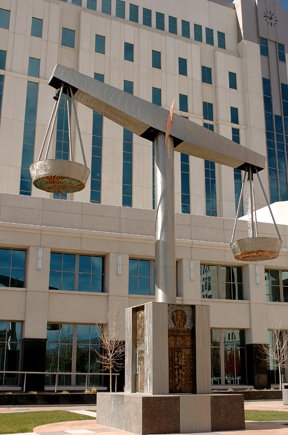
This is a sculpture of the scales of justice in front of the Bernalillo County Metropolitan Courthouse.

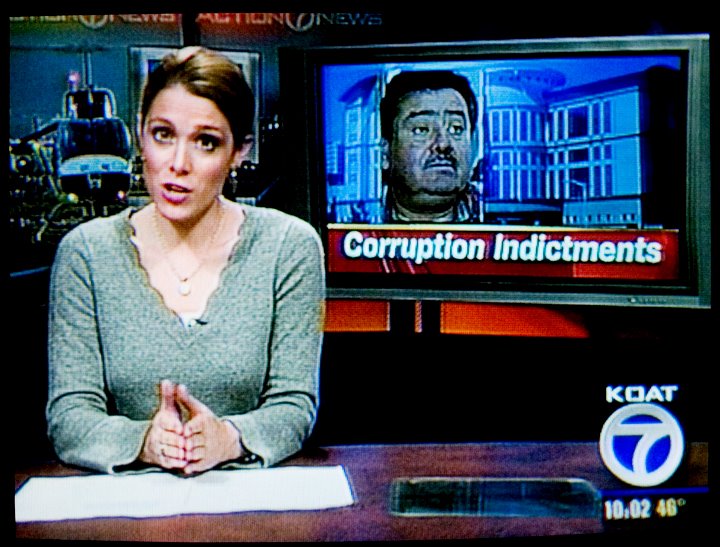
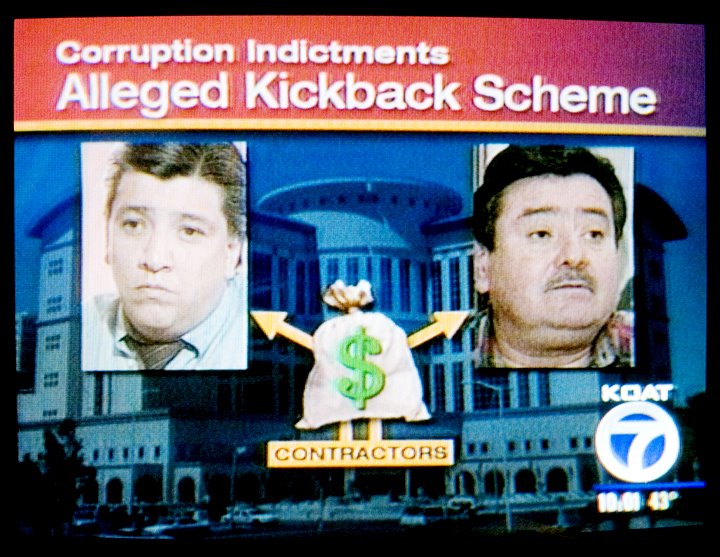
This is a graphic shown Thursday night on KOAT TV’s coverage of the federal indictments into allegations of a public corruption kickback scheme during the construction of the courthouse.

Local newscaster, newspaper reporters and bloggers went into a near feeding frenzy over telling this story.

So what's wrong with this picture?


The graphic depicts the Bernalillo County District Courthouse, which was not the topic of the news story.

The sculpture of the scales works backwards. The pans on the scales have water poured into them through internal plumbing. However, the water enters the lowered pan, the one that would already indicate the greater weight of evidence. When the water fills the pan the scales tip the opposite direction than the laws of physics dictate.

Contrary to what appears in these pictures to be happening to the scales, the upper pan should accept water and then move downward. Not as it is now, where the lowered pan accepts water, then rises.

So what does it mean? Is it any indication of how justice actually works in New Mexico? Or is the public supposed to be blind to justice?

Wednesday, March 28, 2007

100th Blog

What's wrong with this picture?

This is the 100th posting on this blogspot. It also happens to be one year old.

A celebration? No.

I thought I might review and look back at what the experiences have been writing a blogspot.

Francisco Roque “Rocky” Nogales has been my friend for over 25-years and my editor for 22-years.

He joined the police department in 1980 and we worked along side each other for several years.

We had similar political philosophies, especially about law enforcement, the Albuquerque Police Department and in particular, officers’ issues of hours, wages, working conditions and safety. He became my campaign manager when I ran for president of the Albuquerque Police Officers’ Association in 1985. Nogales served on the executive board of the APOA and in 1989, he became president for a one-year term.

He was promoted to sergeant and lieutenant before retiring in 2002.

Here he is editing a posting of mine a few months ago while he took a break from work as a GEICO fraud investigator.

I give much of the success of this site, thus far to Nogales. He places commas for me, is my sounding board, grammarian and the one who says, “this is a little confusing.” He keeps me from going too far astray.

This blog started as a requirement for an electronic publishing class I took in the 2006 spring semester through the Communications and Journalism track at the University of New Mexico, taught by Zac Van Note.

I developed a formula for my postings based on how I photograph. I look for the unusual or what is out of place. That which stands in contrast to what is projected or meant to be perceived.

I do not use all of the technology available through the blogosphere. To the contrary, I approach this as a blank sheet of paper that allows me to be an electronic pamphleteer.

I do not use hot links and try to maintain some degree of journalistic professionalism. Though I follow many of the standards of news papering, I am more of a columnist and you will get a face full of opinion after I give you the news or history of an event.

I attempt to give you a perspective beyond just the facts and try to avoid allowing spin masters to distort the meat of an issue. I avoid being constrained by the journalistic rules under the guise of fairness that calls for offering an opportunity to respond to a particular issue. Such rules can actually allow for manipulation by public information officers, politicians and those pushing their agendas against facts and realities.

Yes, I have my own agendas, but I try to let you know what they are. They are: the First Amendment, fairness, open government, and due process.

I would like to get both sides of an issue but when confronted by a lack of access or met with spin that avoids the question, I forego the unresponsive answer. I believe, as Linda Elerbee, journalist and author of “And So It Goes: Adventures in television,” who thinks the audience is smart enough to know or figure it out.

By way of example: the City of Albuquerque’s PIO will not return a phone call, the city refuses to respond to requests for inspection of public records. Those city officials who do make comments, sometimes are instructed by department directors not to answer particular questions. There are a number of governmental and political officials at the state and federal levels who also refuse to recognize citizens who are involved in journalistic efforts because they are not the big commercial mainstream media.

Paul Livingston, a lawyer, has had some major influence on this site.

I have known him for about 15 years and we have teamed up on a number of political and social issues in the community.

We approach topics in slightly different ways, but in the collaborative effort, we make a pretty good team.

I met him when he was representing individual city employees and the bus drivers union in labor and personnel issues. We teamed up to oppose the steamroller mentality of the assistant city attorneys and department representatives at labor and personnel board meetings. With my background and experience, Livingston has often used me as a consultant and expert witness on the history of city labor relations.

We have on occasion, recognized events and issues at the same instant, which cried out for public opposition.

Some of the bigger issues have been:
Opposing the closing of public meetings in violation of the state’s open meetings act, involving the police oversight commission.
Seeking to make records public, when the mayor refused to identify the names of applicants for chief of police.
Fighting the lack of due process and jurisdiction in the city’s automated enforcement for red light and photo radar program.
Pursuing the ethical violations of Mayor Martin Chávez’ ABQPAC.
And representing Sandoval County Clerk Victoria Dunlap, when the attorney general and county commissioners sought a unilateral injunction to bar her from the continued issuance of gender neutral marriage licenses.

We’ve had some successes and some failures, but we have always been able to bring a different look at public issues.

We occasionally have our differences, but we get past them.

This is City Attorney Bob White, the highest-ranking city official who will openly deal with me, seen here with Livingston at the recent town hall meeting on red light cameras.

Livingston thinks I should chop up my analysis pieces into smaller bytes because I will run out of material to post. However, as long as a person like the mayor is within earshot of an open microphone, I will have an abundant supply of blogging material. The City Council, Albuquerque Public School board and other governmental entities also provide an inexhaustible source of fodder.

Chávez really dislikes me. It goes back a long ways, into his first term when I, along with some other union leaders, mounted a successful effort to defeat a quarter cent “Public Safety” tax. Chávez will not answer my questions.

Chávez is seen here with his PIO Deborah James and Detective Vince Harrison, Mayor's Detail, a plain-clothed police officer, who is assigned as part of his personal security team. Chávez sicced Harrison on me, telling him that I was a “trouble maker.” I got a wink from my former peer.

James, right, consciously turned her back to me at the end of this January 12, 2006, special meeting of the Mid-Region Transit District’s Metropolitan Transportation Board, on widening the Montano bridge. She will not put my name on the list of journalists to be contacted for press conferences or photo opportunities and does not return phone calls or e-mails. They may wonder why I give them no good press coverage. Could it be that they won’t let me cover any?


For the time being, I’ll continue to write and photograph.

I know I have a dedicated audience that doesn’t generate a great deal of comment. I do post commentary, except multi-page missives from political activist pushing their own agendas’ web site.

I want to thank my small, but loyal following. I am always looking for information, leads or problems that might be the spark to another story.

Monday, March 26, 2007

Kumbaya, Then Good Bye

What’s Wrong With This Picture?

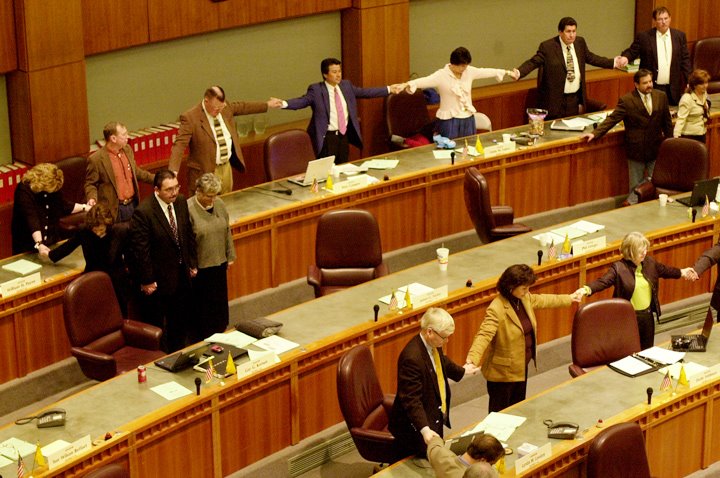
This is the New Mexico Senate, Saturday as they joined hands in prayer lead by Rabbi Leonard Helman. The Rabbi’s invocation was the longest part of the session.

Senate Majority Floor Leader Michael Sanchez called for announcements and Senate Minority Floor Leader Sturat Ingle moved to adjourn. Senate President Pro-Tempore Ben Altamirano called for a voice vote and after the shouting match, declared the nays had carried the day. The Republican side challenged the ruling of the chair, calling for a roll call vote.

Several Senators were not present, on the Republican side: Carroll Leavell, Steve Neville and Bill Sharer. Missing on the Democratic side were: Cisco McSorley, Cynthia Nava, Mary Kay Papen and Jerry Ortiz y Pino.

Democratic Sens. John Arthur Smith, Tim Jennings and Linda Lopez joined the Republicans in voting against the chair’s call.

Sen. Altamirano reads the roll call vote 17-18 overruling his call and ending the session.

So what’s wrong with this picture?

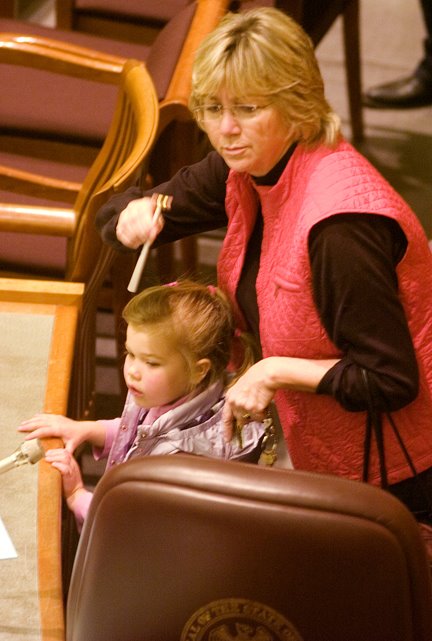
This is Lt. Gov. Diane Denish holding up a miniature gavel that one of the Senate clerks gave her. She is showing her granddaughter, Sadie Rittneberry, age 4, where she usually works. Denish did not sit in the chair, as president of the Senate, but was acting Governor on Saturday. Gov. Bill Richardson was off in California raising money for his presidential campaign.

The legislative drama continues. The regular session ended Sat. March 17 and within minutes, Gov. Richardson called a special session wanting issues that were either killed outright, resurrected or those that were left on the table moved forward.

Sen. Jennings told the press that two votes of the Senate to adjourn should be enough. He was anxious to get back to the real emergency caused by 13 tornados that struck the Eastern side of the state including parts of his home district counties of Chaves, Eddy, Lincoln and Otero, rather than the manufactured emergencies of Gov. Richardson.

Sens. Lopez and Smith also spoke to the press about their votes to adjourn.

Frustration was evident on both sides of the aisle as Phil Griego D – Los Alamos, Mora, Sandoval, San Miguel, Santa Fe and Taos counties, contemplates what happened. Joseph Carraro R - Bernalillo and Sandoval counties, rests. “We’re all still exhausted after the 60-day session,” Carraro said. He was frustrated that the open conference committee bill had not gotten through. He said it was a major part of the ethics reforms package that was missing. He explained that during the regular session he had voted for a campaign contribution limits bill. It then went to a closed conference committee. When it came back, the guts had been torn out of it. He had to change his vote.

If the House does not adjourn, but stays in recess the next three days, then, by the State Constitution, the Senate must reconvene on Thursday.

Thursday, March 22, 2007

So Right, Yet So Wrong!

What’s Wrong With This Picture?

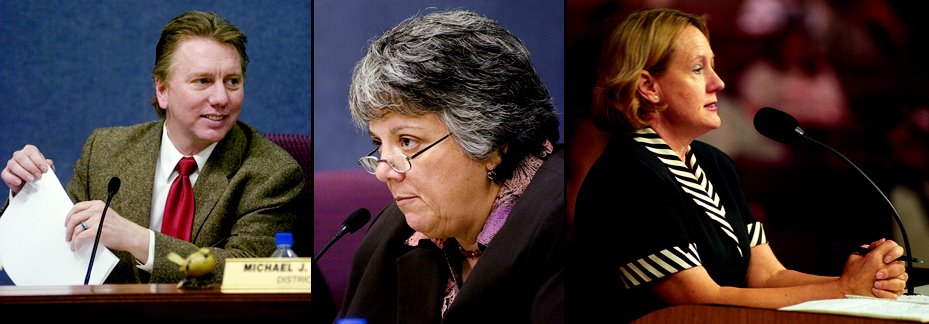
Seen above, in archive photos are: Councillor Don Harris, left, when he first deferred his rules amendment on March 5; Council President Deborah O’Malley, center; and Sally Mayer, right. In the picture, citizen Mayer is seen exercising her right to give public comment before the May 1, 2000, city council meeting, a couple of years before running for office.

At Monday’s session, Councillor Don Harris again deferred his rules amendment. The amendment will move general public comments from the seventh item to the final item on the council’s meeting agendas.

“Sometimes people get confused about the purpose of public comments at city council,” Council President Deborah O’Malley said. “The purpose of city council is to do the work of city council.”

Council Vice President Sally Mayer and former Councillor Tina Cummins, during the last term of the council, successfully changed the rules, placing a cap on the length of meetings. Mayer whined about having to stay up late to do the work of the city. She wanted to stop by 10 p.m., but agreed to adjourn by 10:30. It now takes a vote to suspend the rules to go beyond 10:30.

Mayer joins Harris in wanting to have the general public comments moved on the agenda to the last item. She argues that she doesn’t think the state and federal legislative bodies take public comments, though she has never been to Washington. She’s correct; they don’t, not in the way city council does.

So what’s wrong with this picture?

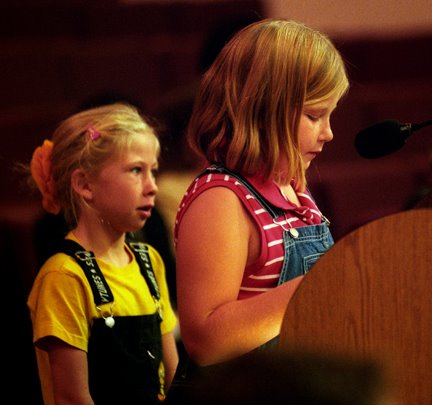
This young citizen, and her even younger sister, spoke at the Oct. 4, 1999, City Council meeting to support the school bus seat belt veto override. It didn’t help; school buses still don’t have seat belts.

President O’Malley could not be more right, nor more profoundly wrong in her statement, “sometimes people get confused about the purpose of public comments at city council.” The people who seem most confused are the City councillors wishing to adopt this rule change.

The purpose of the city council is to do the work of city. The work of the city is the work of the people. The peoples’ concerns should be paramount to the writing of legislation and should be part of the process. Before, not afterwards!

O’Malley suggested that maybe there should be more town hall meetings like the one held a couple of weeks ago on the issue of automated enforcement. The red light cameras have been in operation for two years and it is only now, after the citizenry became outraged that a town hall meeting was held.

I felt very lonely over the years when I continually spoke out against one sort of scheme or another involving automated enforcement, starting about a decade ago with photo-radar. Chief of Police Ray Schultz, who was then a Lieutenant, presented the project. The 1996 council had the wisdom to kill the program.

Even in William Shakespeare’s Julius Caesar, at act 3, scene 1, just shortly before “Et tu Brute!” citizens and soothsayers alike approached with petitions, making pleas, and offering words of advice, warning Caesar and senators while on their way up the steps of the Roman capitol.

Shakespeare got it right! Petition is an ancient concept dating back to the earliest of recorded times, where the governed have asked those who govern for relief.

The First Amendment of the U.S. Constitution provides that: “Congress shall make no law respecting an establishment of religion, or prohibiting the free exercise thereof; or abridging the freedom of speech, or of the press; or the right of the people peaceably to assemble, and to petition the Government for a redress of grievances.”

The city charter and ordinances call for citizen participation.

Harris’ amendment smacks of arrogance; of knowing better what the citizen wants and needs are. Moving public comments to the end of the meeting is a means of avoidance.

Governing bodies use a technique that I have particularly noticed has been utilized by organized labor unions and political parties. It is the habit of taking the most controversial items and placing them at the end of the agenda to wear out the constituency. It is not beyond possibility that a meeting might well drag to 10:30 and adjournment before public comments can be heard. Another favored trick of former presiding officers of this council is to require citizens wishing to speak to sign up, and do so before the meeting begins.

There are other governmental entities that recognize the value of public input and request comments, allowing those interested to queue up behind the podium and take their turn. It’s that simple!

Harris has also suggested limiting what citizens may address in their moments before council. He mentioned to the Journal, in particular, a couple that had approached the council to speak about what they perceived was a lack of fair treatment in a child custody case in state district court. On its face, it might seem that the topic is something in which the council has neither interest nor jurisdiction. However, there is a good chance that the police or the Family and Community Services Department would have a role in such cases.

More importantly, the general public comments section allows citizens a chance to bring their concerns onto the public square, clearly and with a minimum of confusion.

In a representative form of government, the first obligation of representatives is to fulfill the wishes and needs of their constituency. In order to do that, the representatives must be informed. Listening would help; paying attention might also be a good starting point. Being fully informed is crucial to good governmental decision-making.

It’s not often that young citizens speak before the council and I hate using a cheap shot line that Mayor Martin Chávez has used to raise the emotional level. What the heck! If 10:30 is past Mayer’s bedtime; then according to Chávez, “What do we tell the children?” They also want to say their peace or "piece."

Sunday, March 18, 2007

Green Flash

What’s Wrong With This Picture?

What’s a Green Flash you ask?

A Green Flash is a meteorological phenomenon associated with the Middle East, in particular, the Saudi Arabian Peninsula, were there is a green flash of light just as the top of the sun sets into the desert. Though I had been in the Gulf of Aqabah about 10 years ago, while sailing towards Jordan at sunset, looking across the Saudi Arabian desert, I did not see it. It was later explained that the reason was the atmosphere was too calm.

It was featured in the ship’s daily newsletter and a traveling professor working for the cruise line, lectured on the existence of the green flash. The color green is significant to several countries in the Muslim world where it has cultural and religious meaning. Most notably is the use of green in the Saudi Arabian flag.

Saturday, I was in the far Northeast Heights at sunset. A great deal of dust was in the air and the setting sun appeared to have rings around it of varying intensities.

Immediately after taking this picture, a slight but distinctive green tint appeared in one of the rings. Before I could get the camera back into action, it was gone. Gone in a flash!

The dust, kicked up by the breezy day, unfortunately didn’t take the pollen away in the same flash. Welcome spring back to New Mexico.

Gesundheit!