Thursday, August 10, 2006

Shadows of Manzanar

What's Wrong With This Picture?

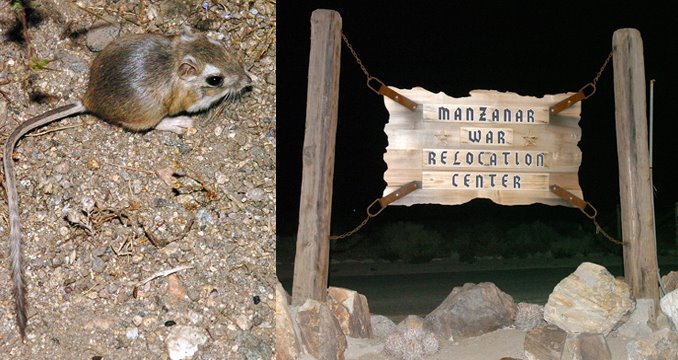
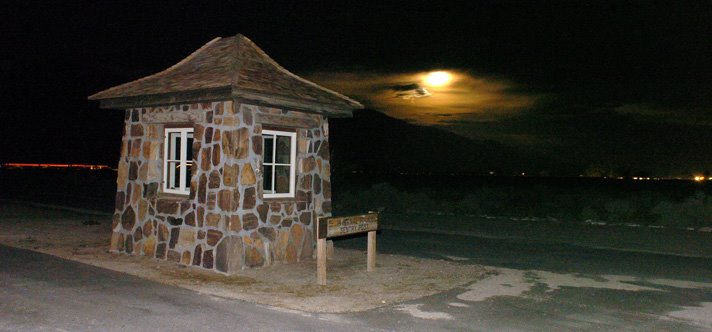
This is the Military Police station at the Manzanar War Relocation Center.

It is now a National Historic Site located at Independence, Calif., in the Owens valley near the Inyo range of the Sierra Nevada mountains.

Manzanar was one of ten locations where American citizens of Japanese descent were interred during World War II. At its peak population of 10,046, mostly Californians from Los Angeles were held till the last was released on November 25, 1945. One hundred seventy-four men and women joined the United States Military service directly from the camp.

It is now populated only by desert wildlife like this Kangaroo Mouse.

This is the cemetery at the Manzanar War Relocation Center.

The inscription, seen here, is on the back of the obelisk and reads, "Erected by the Manzanar Japanese August 1943." On the front translates as, "Monument to console the souls of the dead."

Ansel Adams visited and photographed Manzanar in the fall of 1943, then wrote a book; Born Free and Equal: the story of loyal Japanese Americans. In his introduction he penned:

“…I trust the content and message of this book will suggest that the broad concepts of American citizenship, and of liberal democratic life the world over, must be protected in the prosecution of the war and sustained in the building of peace to come.”

In the chapter, “The Problem,” Adams wrote about what was going to happen after the war with regards to residual antagonisms and, “The spirits of Jim Crow walks in almost every section of our land…” He continued, “ Hatred is a perfectly natural complement to fear and to the war spirit; and it is difficult to assure otherwise solid and sincere people that ancestral relations to the enemy does not prove disloyalty.” Finally Adams noted, “The fatal phrase, ’A Jap’s a Jap’, might well have poisoned the course of racial tolerance for many years to come.”

Adams was a sage man and an inspirational photographer.

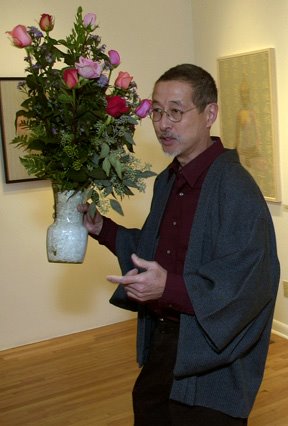
This is University of New Mexico Art and Art History Department’s Regent's Professor of Photography Patrick Nagatani at a 2001 Santa Fe opening of his one-man show. As a graduate student at the University of California, Los Angeles, in 1978, he and two fellow students were curators of an exhibit: Two Views of Manzanar by Ansel Adams and Toyo Miyatake, at the Frederick S. Wight Art Gallery.

Miyatake was a camp resident who had been a Los Angeles artist and photographer. Adams smuggled him a lens, film holders and film. Miyatake photographed Manzanar with his contraband camera until it was discovered and confiscated. The camp’s commander made Miyatake the “official photographer.”

So, what's wrong with this picture?

President George W. Bush made remarks upon arriving at the Green Bay, Wisconsin Austin Straubel International Airport, today. Talking about Great Britain’s foiling of terrorists plot to destroy airliners. Bush said that it was, "a stark reminder that this nation is at war with Islamic fascist who will use any means to destroy those of us who love freedom, to hurt our nation."

Bush angered American Muslims by his inflammatory rhetoric, lumping the terror actions of individuals as fascists and applying it to an entire religion.

The Muslims are rightfully fearful that just because they practice a faith, they are presumed to be fascist.

Adams was right. It would be wrong for all Americans to be lumped together for the violent act of, say the Ku Klux Klan, American Nazi Party or the Skinheads.

Condemn the individual, root them out if you can and destroy them!

I have always believed that when you declare war on a societal ill or on an idea, you have already lost the war because the war mentality overlooks the complexities of the problem and tries to simply destroy anything that looks like, smells like, sounds like… the problem.

Think about how this started. President Lyndon Baines Johnson declared a war on poverty; President Richard M. Nixon, a war on crime; President Ronald Reagan, a war on drugs; and now Bush’s war on terror. None have succeeded; we still have poverty, crime, drugs, and terror with no victory in sight for any of them.

Tuesday, August 08, 2006

More Than A Double Take!

What’s wrong with this picture?

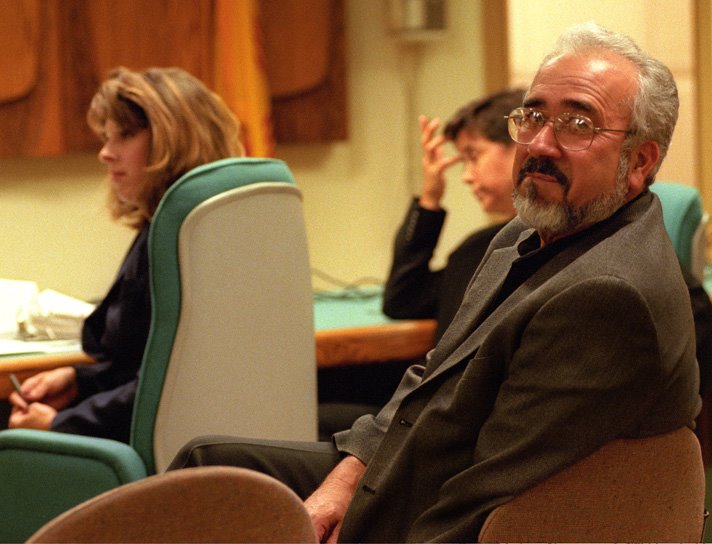
This is John Martinez.

He was the Director of Personnel and Employee Relations Department for many years. From the inception of the city government’s dealings with organized employee labor unions, Martinez was the point man of the management philosophy until he retired in 1988, and beyond. He now owns Management Associates, a contracting company that deals with governments in New Mexico, consulting on labor management issues.

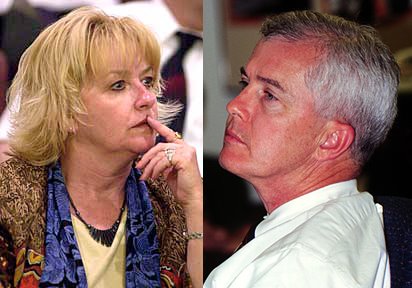
He is seen here with his daughter, an attorney, Dina Holcomb, along with Director of Employee Relations Peggy Hardwick, also an attorney. They were at a July 11, 2000, Labor-Management Relations Board hearing where Management Associates was contracted by the City of Albuquerque to handle a labor issue.

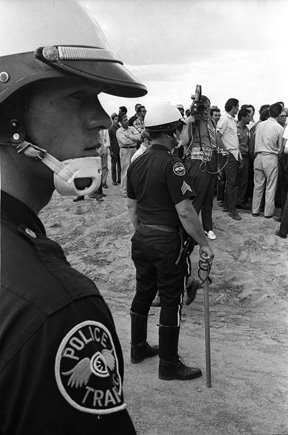
Thirty-six years ago, City refuse collectors staged a wildcat strike blocking the entrance to the City’s Pino Yards on September 17, 1970.

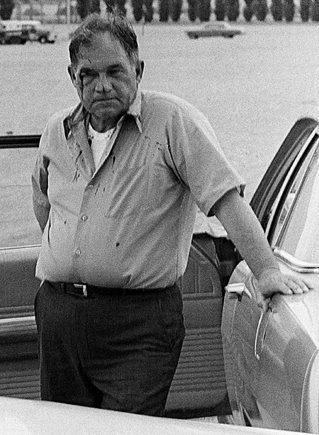
Deputy Chief of Police Albert Swallows was on his way home and went to the Pino Yards with a couple of officers to try to talk the workers into clearing the area. Chief Swallows, at the time, knew most of the leaders of the blue-collar workers and felt he could talk them into reopening the gate.

Two of the Chief's sons had been assistant managers of both the Refuse and Sewer Divisions. Some of the laborers apparently did not care who the Chief was and attacked him. He was hit in the face and the gate was pushed over on top of him. The other officers were able to get him out from under the fence and called for assistance. Additional officers arrived and the crowd was dispersed.

Chief Swallows retired in 1975 with more than 39 years of service.

Here is Officer Tim Kline standing with Sergeant Nicholas Bachis and other officers who responded to Pino yards to assist Swallows after strikers attacked him. Officer Kline retired as a lieutenant in 1988. He was elected to the City Council in 1989-1993 for one term and elected again to another single term on the council - 1997-2001.

Another son of Chief Swallows, Scott, is an Albuquerque police officer currently assigned to the Southeast area command working day shift.

Martinez was the Director of the Personnel Department, what is now called Human Resources, which included labor management. According to Martinez, he split labor management from personnel and became Director of Employee Relations, “around 1974 or 75.“

Martinez retired in June, 1988. His assistant was Jim Swan who had been an American Federation of State, County and Municipal Employees union leader. Swan replaced Martinez as acting director.

Bob Brown was also an AFSCME Council 18 organizer, hired by Martinez, who became the second Director of Employee Relations about 1989.


Peggy Hardwick, right, was an Assistant City Attorney who also became Director of Employee Relations.

Joe Chavez, a former staff representative of AFSCME Council 18 for the City's blue-collar workers' Local 624, became Director
of Employee Relations for a short period of time.

Former AFSCME White-collar President Barbara Martinez-Chewiwi-Keiser, below left, was promoted out of her bargaining unit to a supervisory position. She would later become Director of employee relations until retiring several weeks ago.


This is Employee Relations contractor Paul Broome, above right. He was a former Labor Board city-management appointee, 1995-97, and had previously served as a business manager for a teacher’s union. He was recently appointed education consultant to Mayor Martin Chávez to implement Chávez' attempted take over of Albuquerque Public Schools.

This is Lawrence Torres who was recently appointed Director of Employee Relations by Mayor Chávez. The job brings with it an $80,000 salary.

Are congratulations in order? Not today!

Torres is a former President of the Albuquerque Police Officers’ Association. He was an Open Space Ranger who was elected Vice President of the APOA before replacing President Jeff Remington, who stepped down when he was promoted to sergeant.

Torres was a member of several APOA negotiating teams, most recently serving as lead negotiator in the negotiations that concluded only a couple of months ago.

So what’s wrong with this picture?

The Mayor’s offer, and Torres' acceptance, of an $80,000 job is an unconscionable act. Torres is to the man who negotiated the current contract; he is now required to enforce the contract. How can he do that? When questions of an unfair labor practice arise in the implementation of the contract, it is often the chief negotiator who testifies to the meaning of the document and what the discussion and background was in hammering out specific provisions.

As Director of Employee Relations, he is now duty-bound to take the opposing position. It is a clear conflict of interest from two points; he cannot fulfill either role of former chief negotiator or employee relations director.

Chávez places Torres in an impossible position. Torres cannot pass up the opportunity to almost double his salary, but it is unethical for him to even consider taking the job. The blame belongs to the mayor for corrupting the process.

This, in and of itself, is an unfair labor practice where Torres would have to defend the City against himself!

Thursday, August 03, 2006

Traffic Cops versus Technologies

What’s wrong with this picture?

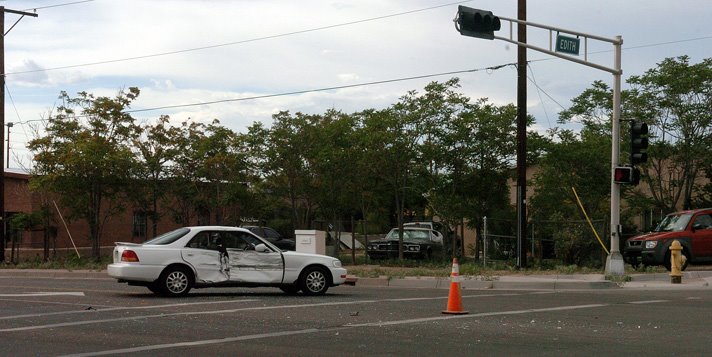
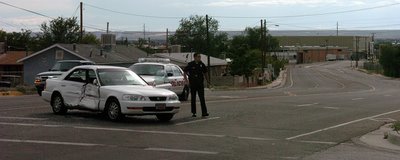
I came upon this scene of a hit and run accident at Edith Blvd. and Odelia Rd. N.E. at 5 p.m. on Sunday, July 23. The car was westbound on Odelia and was struck by a southbound vehicle that ran the red light on Edith. A single orange traffic cone was in the middle of the road east of the car.

The white car, with the right two doors crushed in, appeared to have no one in it, but, the driver’s door was open. It blocked two lanes of traffic.

I went into “cop mode.”

I looked for the second car, but it wasn’t there.

I had my cellular phone out and dialed 911.

I got a recording putting me into a queue. It is better than years before when the phone would continue to ring and ring and ring. At least it didn’t have elevator music playing. I waited only a few seconds for 911-Operator 63 to come on the line.

I walked into the intersection and looked in the car. The keys were gone and there was no blood or sign of injury. There were post collision skid marks but no skids leading up to the point of impact.

I told 911 that I was at the intersection and she interrupted me saying it was probably an accident. I noticed a minivan parked off the road on the northwest corner with two women in it. I approached and found the driver and her adult daughter, who had come to pick her up.

I asked if the driver was injured. Answer, no. Wrong answer. An injury would have gotten an immediate response from police and fire rescue. I didn’t believe her. She was putting on a good front. However, she appeared to me that she may have actually been injured, but she would only admit to shakiness.

The operator told me that there were no officers available. The daughter said the accident happened more than an hour earlier, just before four and at least four calls had been made.

I ratcheted up my cop mode. I used my name and said that I was a retired officer. I told the operator that the damaged car was a traffic hazard and needed to be dealt with.

“ No units available.” But over an hour wait?

“This is unacceptable,” I took it up another notch. “Who is the sergeant?”

I was placed on hold. About a minute later the operator came back and said the dispatcher had told her that this call was the next one to be dispatched. She asked if I wanted to talk to the dispatcher. I said no, not if the call was the next to be dispatched.

Success, but at what cost? How many calls were jumped because I knew how to play the game?
It was almost another half-hour, 5:27 p.m. before an Albuquerque Police car turned off Broadway towards the intersection.

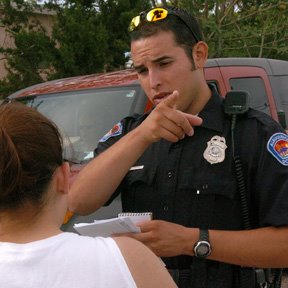
This is Officer J.P. Gallegos, interviewing a quasi-witness, a neighbor who had heard the crash, but did not see what happened leading up to the collision. She offered information about the vehicle that left the scene and gave a description of its driver. She was more than just a good witness, because she had gotten the name and phone number of a witness who had seen the entire incident but wasn’t willing to wait more than an hour and half.

The officer, dispatcher and operator all did their jobs appropriately. They approached their duties one call at a time.

Non-injury accidents are not life threatening, requiring an emergency response, but a hit and run accident with a vehicle left in an intersection by a very shaken, middle aged woman poses a traffic problem beyond a minor fender bender. In minor accidents where the participants may pull to the side of the road, they may exchange driver, registration and insurance information and may not even require police intervention. It is the criminal aspect of one driver leaving the scene without identifying themselves that calls for a proper police investigation and pursuit of the offender. The victim of this accident is entitled to prompt service and other motorists should not have to be confronted by wreckage in the roadway.

A man in a pickup truck pulled into his driveway. He asked that I pull my truck deeper onto his property because his elderly mother was returning home and needed all the space she could get.

The man asked about the accident.

He recalled when he was 12-years old; there had been what sounded, “like a bomb.” His father told the children, who were watching television, to stay in the house, while he went out see what happened. The man said, that as kids, we knew all the back ways to the corner, and snuck down to observe that the woman’s car was pushed deep into the Springer warehouse complex parking lot, west of Broadway.

The man shook his head about this hit and run as he drove to his house.

The man was talking about an infamous and horrific accident in Albuquerque’s history. It happened about 35 years ago at Odelia and Broadway, one intersection west.

Doug Lovelady, the son of the local Dodge dealer Wayne Lovelady, got into a high-speed chase driving his new corvette in 1970. Officer Jinx Jones started chasing Lovelady at around Royene and Washington NE. They wended their way east to San Mateo, then to Constitution turning west, proceeding through the four-way stop at Washington and then the signals at Carlisle and Girard. Lovelady turned north on Stanford; Jones didn’t, as he crashed through the fence of the University of New Mexico Golf Course and came to a stop on the 18th fairway.

At Indian School Rd., Lovelady turned west and the chase was taken up by Officer Jim Lehner. They proceeded on Indian School Rd., crossing over Interstate 25 where the road changes names to Odelia. At Broadway, Lovelady broadsided a car at about 100 mph. The crashed killed the woman driver and her young daughter. A horrific scene due to the carnage and infamous, in that Lovelady eventually only served about 90 days in the penitentiary. But that is a story for a different day.

So what’s wrong with this picture?

Mayor Martin Chávez promised to have 1,000 police officers on the force 10 years ago. Where are they?

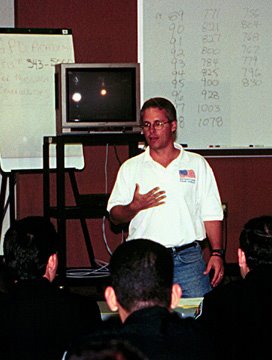
This is Chávez at an illegally held political meeting where Chief Joe Polisar ordered Field Services Officers to attend a city-wide briefing to hear the Mayor extol the virtues of the then proposed quarter cent “Public Safety” tax that the union and I opposed. Polisar wrote the numbers on the board behind Chávez showing the projected growth of the department, reaching 1,000 within two years.

The tax proposal died. A couple of years ago a new quarter cent “Public Safety” tax passed, yet the day count, the number of actual officers on the payroll, is still less than 1,000.

So what does this have to do with photo red lights and photo radar?

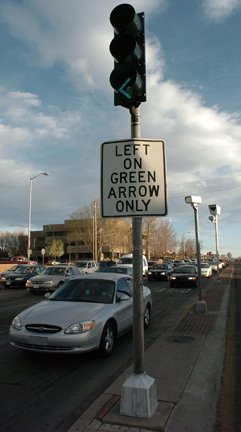
There is no photo red light camera at the Edith and Odelia intersection. The theory is that having cameras at some intersections changes driving habits, having a carry over affect to other intersections.

Not true this day.

The finding and intent section of the Safe Traffic Operations Program or STOP ordinance declares running red lights and speeding a nuisance and states:
“...City Council finds that the current penalty under state law for running a red light is inadequate to meaningfully address the nuisance and that the City of Albuquerque must implement meaningful civil remedial measures that will stop red light violations and save lives.”
“...City Council finds that state law against school zone violations is inadequate to deter those violations in Albuquerque and that such violations are a nuisance that must be abated by or through civil remedial measures.”

The laws are inadequate?

No, the laws are clear, concise, narrowly directed toward offending drivers and enforceable.

The City of Albuquerque’s Code of Ordinances § 8-2-2-2 Traffic Control Legend.

"Whenever traffic is controlled by traffic control signals exhibiting colored lights or colored lighted arrows, successively one at a time, or in combination, only the colors green, yellow and red shall be used, except for special pedestrian control signals carrying a word legend and the lights indicate and apply to drivers of vehicles and pedestrians.

...(E) Steady Red.

(1) Vehicular traffic facing the signal shall stop before entering the crosswalk, on the near side of the intersection, or if there is no crosswalk, then before entering the intersection shall remain standing until green is shown….

§ 8-2-4-3 Posted Speed Zones.

....(A) No person shall drive a vehicle on a public way at a speed in excess of the lawfully posted speed limit."

It’s not that the laws are inadequate, but it is the enforcement of the laws that is inadequate.

This is a revenue-generating question versus a manpower management problem.

Deciding to use technology rather than law enforcement personnel is the product of a flawed cost benefit analysis. Assumptions were made without regard for legal rights because a formal analysis was not done.

There are 582 intersections with traffic control light signals in town. Only six intersections have permanently affixed photo red light cameras.
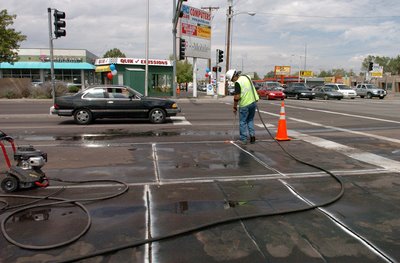
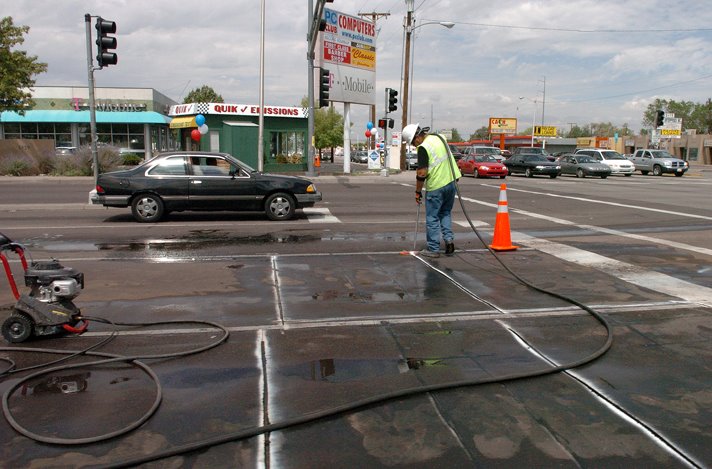
Here, a contractor works on electrical sensors at the photo red light controlled intersection of San Mateo and Menaul N.E.

By using cameras with photo red light intersections and photo radar vans and then bypassing the Metropolitan court system, the city can generate a higher percentage of profit from its $100 to $450 fines than they can make through the percentage they receive by using the state’s court systems.

The STOP legislation emphasizes that; “The City Council declares that this article is a nuisance abatement article enacted pursuant to the city's inherent authority under state law and that the remedies are purely civil and not criminal in nature.”

This is a legal fiction; a sidestepping of the requirement to use the state’s court systems to adjudicate traffic violation enforcement.

STOP is predicated on violations of the state and city’s traffic laws, but as soon as they cross that legal threshold, all requirements for law enforcement are suspended, rejected and replaced with a unique and novel philosophy.
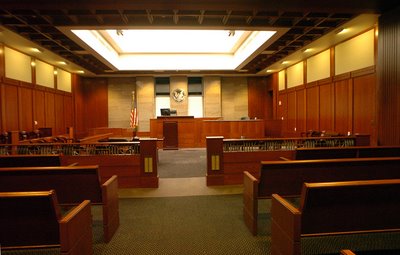
Constitutional guarantees; of separation of powers, the right to have an independent judge, to have a fair trial, to confront witnesses, to cross-examine witnesses, to have the minimum burden that applies to traffic offenses, which is the standard criminal burden of proof, that each and every element of a statutory violation is proven “beyond a reasonable doubt” and the right to appeal to a higher court are abandoned.

The state retains the judicial power while the city is limited to declaring what a public nuisance is, setting a penalty that does not exceed that of a misdemeanor and it has no other inherent authority under state law to process challenges to the allegations of a violation of any of its city ordinances.

When the city council declared that traffic triggered violations were a nuisance calling for abatement, adjudication in District Court is required. A respondent is entitled to a jury trial in front of a panel of their peers. STOP is an abuse of the legal theory underlying nuisance abatement laws.

By setting up a city administrative hearing officer and by not requiring; a uniformed police officer from personally observing the offense, arresting, through a traffic stop, then issuing a citation and appearing in court to prove the case, the city can save a great deal of money and instead of sharing its profits with the state, it only has to share with the cameras’ vendor.

Municipal governments are not supposed to be a profit making operation. Government is a zero-sum proposition. Government may not spend more than it takes in through taxes, fines and fees.

Officers are given discretion and they may exercise it appropriately. An officer may write a citation that he feels will deal with the problem that may not even address the initial violation that caught his eye.

Society accepts this all the time. Driving while under the influence of narcotics, drugs or alcohol is a prime example. Many DWI drivers are stopped for minor infractions, such as; failure to maintain a traffic lane, or not proceeding immediately when a traffic light changes, or driving well below the speed limit and in some cases simply driving the speed limit while the traffic flow is going faster than the speed limit. All of these examples, absence the DWI, probably would not result in even a ticket. The officer, in exercising discretion, is empowered to talk to the driver and may give a verbal or written warning, if he is satisfied that the driver will heed.

Experienced rational officers do not function as automatons, but have adopted a feeling, thought and theory about when to pursue a driver who entered a controlled intersection late, against a just changed red light. The officer takes at least three things into consideration about the “offending vehicle:” Was the vehicle really late, more than the split second that the photo red light system registers? Did it interfere with the traffic that just received a green light? Was it speeding at the time it entered that intersection?
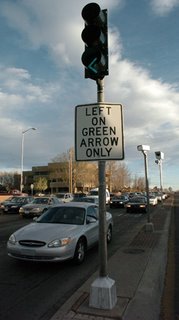
Officers do not function in a vacuum, they do not read the traffic code out of context and they are realistic about the concept of defensive driving that requires all drivers to act with due care and caution. As the basic federal rule of aviation requires that pilots shall see and avoid other aircraft. This applies equally to drivers as outlined in the City of Albuquerque’s Code of Ordinances § 8-2-2-2 Traffic Control Legend.

“(F) Red with Green Arrow.
(1) Vehicular traffic facing the signal may cautiously enter the intersection only to make the movement indicated by the arrow, but shall yield the right-of-way to pedestrians lawfully within a crosswalk and to other traffic lawfully using the intersection; and….”

Isaac Newton also proffered the notion in his laws of physics that two objects may not occupy the same space at the same time. It is the duty of every driver to ”cautiously enter the intersection” making sure that they do not test Newton’s laws of physics by driving defensively. As an old axiom goes; you may be right, but dead right and that makes you wrong.

STOP doesn’t recognize the exercise of discretion. Stop is an anvil upon which technologies’ hammer strikes. Horseshoes are made of steel, heated then pounded into shape. Humans are more pliable; logic and reasoning can change their behavior without physical or economic force or violence.

Fines, upon conviction or plea, are designed to alter performance and hold drivers responsible for their individual acts of inappropriate and or illegal behavior. STOP doesn’t target the responsible individual, it declares the vehicle a nuisance and holds the registered owner liable for the actions of the vehicle.

This vehicle, having crossed the thick white "stop line" before the crosswalk at the photo red light enforced intersection of San Mateo and Montgomery N.E., is technically in violation of the law against running a red light. Note the grooves cut into the pavement. The set of grooves from the center of the "stop line" to just before the crosswalk is the sensor, seen here under the rear door. It reads two separate ferrous metal masses, supposedly the front and rear axels, triggering the photo red light camera. This car should not have been sent a notification because the rear axel should not have been sensed, but even if it was, it had not proceeded through the intersection against the red light signal.

So, do I have a suggested alternative solution?
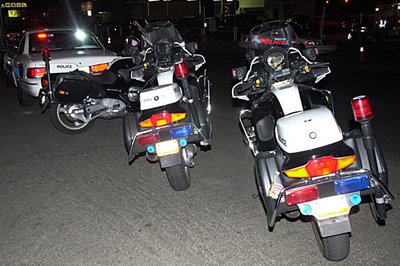
Yes, increase the traffic division to 50 officers.

The Europeans have an approach to traffic control at intersections. Even with traffic lights, they assign one or two officers to busy and problematic intersections.
Hire thirty retired, "white-stripers," former traffic officers; issue each a motorcycle, assign them their own intersection, or radar zone and give them all the ticket books they can write. Take 15 officers and assign them to handle “their intersection.” Do not assign them to any other duties and let them handle all traffic, including accidents at 15 intersections, as needed. With the remaining 15, create three five-man flying squads, made up of one laser radar unit and five officers who saturate a particular speed zone.

Benefits: additional charges including: no seatbelts; no drivers licenses, suspended or revoked licenses; no proof of insurance; no valid registration; stolen vehicles recovered; felony and misdemeanor warrants through NCIC; DWI arrests….

All of these benefits and more can be identified through the personal contact during traffic arrests and cannot be accomplished through the use of photo red light and photo radar. Officers can be deployed to any intersection or speed area as needed.

The presence of a uniformed motorcycle officer has an immeasurable, yet profound effect on crime.

Specifically, residential burglars can be moved from a neighborhood through the use of traffic enforcement saturation patrols, or “writing everything that moves,” for any and every violation. The photo red light and photo radar technology does not and cannot have such an affect.

Fifteen to 30 additional officers, retired or active, equipped with motorcycles, laser radar units and all the ticket books they can stuff into their saddle bags would cost between one to two million dollars a year. The revenue generated through tickets would be about the same as the current photo red light and photo radar. However, the judicial process would pass constitutional muster. Of course the high revenue, low drag process now in use under the STOP ordinance would produce less money per incident if it had to go through the state’s courts.

Thirty additional officers are already authorized and would help surpass the 1,000 officers “magic” number, as promised.

One other thought that arose about the penalty phase of the city’s administrative hearing officer’s options. He has none. Unlike Metropolitan Court, where a first offender is usually offered traffic school, or placed on a deferred sentence, or the case taken under advisement, or the defendant may agree to do community service in lieu of paying a fine, or the fine may be reduced, the hearing officer may only impose the $100 fine. There is no humanity or leniency allowed under STOP. It is arbitrary, imposes strict liability and is oppressive.

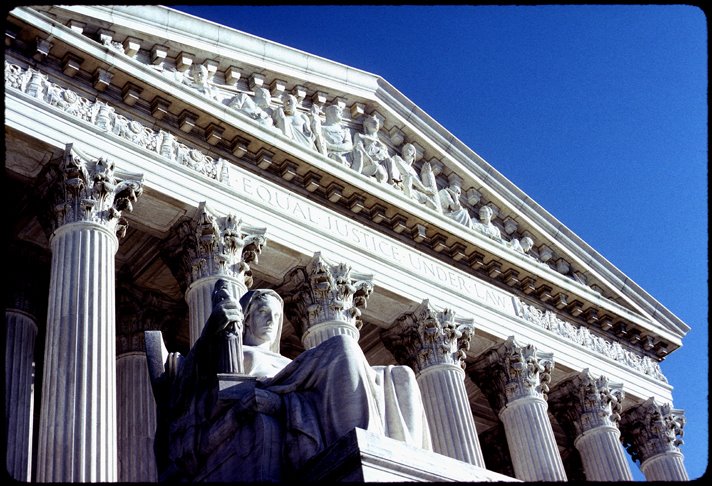
Which raises the question of where does one find justice? Like “Equal Justice Under the Law,” as is found over the doors to the United States Supreme Court.

Don’t ask the City of Albuquerque, for they don’t know the meaning….
Tuesday, July 25, 2006

Mayor Calling for Conflict of Interest Reform???

What’s wrong with this picture?

The Albuquerque Journal’s city hall Staff Writer Jim Ludwick wrote that the Mayor wants the ethics reform bills, now before city council, to contain strict conflicts of interest restrictions.

Hooray! I applaud him!! Just a second!!! I don’t see where the mayor is willing to have those conflicts of interest restrictions apply also to him….

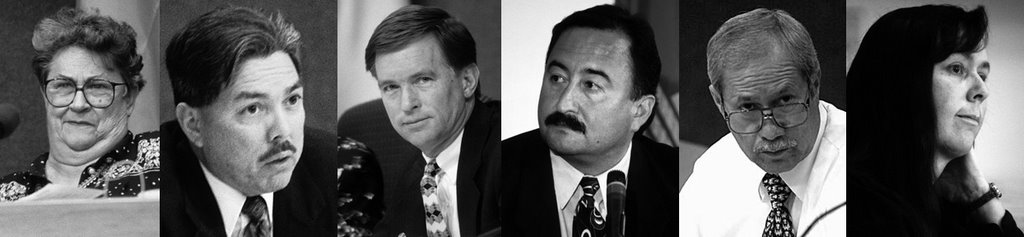
Ludwick suggests that there is a battle brewing between Mayor Martin Chávez, left and Councillor Brad Winter, an Albuquerque Public Schools employee, over the mayor’s efforts to take control of the school system.

Chávez defeated Winter in last year’s mayoral race. At the beginning of the mayor’s 2001 term, his now Chief Administrative Officer Bruce Perlman, below, was then treasurer of Chávez’ campaign and he continued to gather money forming ABQPAC, “as a neat and nifty way to,” funnel money to Chávez for personal expenses.

Chávez and the ABQPAC were charged and found to have violated several sections of the city charter’s ethics rules.

Chávez received a public reprimand and returned some $69,000 to the ABQPAC. Clearly the ABQPAC was conducting illegal activities, though the Attorney General refused to look into the matter and the District Attorney failed to take jurisdiction.

Current Councilor Ken Sanchez also received a campaign contribution in his unsuccessful bid in the Democratic primary for New Mexico State Treasurer.

Ludwick quoted Perlman, about adding to the existing ethics proposals saying, “It's a big concern of the mayor. It also is a big concern of some of the councilors."

The city council has a long history of councillors working for other government agencies outside of the city while serving and voting on issues concerning conflicts of employers, family or personal interests without so much as publicly disclosing their connections during the particular debate.

Councillors Ruth Adams, Alan Armijo, Michael Brasher, Steve Gallegos Vince Griego and Angela Robbins.

This is not an exhaustive list, but during two terms, the 11th and 12th councils from 1994-97, Councillors Alan Armijo, Michael Brasher and Angela Robbins were all employees of APS. Armijo lobbied for the schools at the state legislature. Brasher’s wife also worked for the city. Vince Griego worked for Bernalillo County and had several sons on the city’s payroll. Steve Gallegos was sergeant at arms for the State Senate.

I always thought that such cross-governmental relationships were conflicts of interest.

The most brazen conflict of interest on the council I ever saw displayed was by Ruth Adams. There was a discussion about a zoning waiver on a particular downtown city block. A citizen was testifying about a particular apartment building and he indicated a certain number of units in the building. Adams questioned him about how he had determined the number. He responded that he had counted the mailboxes. Adams told him he was wrong, He asked how she knew he was wrong and asked what the right number was because he wanted to be precise in his testimony. Adams said the number of units was two higher than he said and she knew because she owned the building.

The council dais was thrown into nothing less than a dither. The following discussion of the council gave a fascinating insight to how that particular term viewed conflicts of interest. Adams never perceived herself to be subject to any conflict and didn’t recognize it until it bit her and then she was shocked and surprised when her fellow councillors voted her to be in conflict. She left protesting that she still had the right to vote.

Here is Ruth Adams, after leaving the council with Sally Davis of Common Cause monitoring the Chávez-ABQPAC ethics board hearings. Common Cause was one of three complainants who filed charges of ethics violations of Chávez and the ABQPAC. Davis is now a council recommended member of the city’s ethics board.

Let’s not forget those who have potential conflicts of interest who sit on the current council.

The aforementioned APS link with Winter and Sally Mayer’s association with real estate and developers are examples. There are other considerations that many might try to dismiss having to do with councillors’ past associations with the city; Issac Benton’s architecture firm formerly being under contract; Don Harris having been an assistant city attorney and Loy having retired as a captain from the police department.

Councillor Michael Cadigan, left, should be singled out as frequently recusing himself from participation from matters where he, as an attorney or his firm, represents an interest that is or might give the appearance of being in conflict. This should be to his credit by removing himself, but it raises a question. If he has to recuse himself so often for potential conflicts, is he too close to begin with?

Councillor Craig Loy’s amendment reads;
“No member of the City Council shall… During their term of office participate in any debate or vote on any matter which will likely result in any benefit to the member which benefit is greater than the benefit to the public in general. A benefit for purposes of this paragraph shall mean a financial benefit or a benefit conferred by the City Council member’s employer as a direct result of the member’s participation in the matter.”

The mayor is not similarly constrained in such a way by the current proposed bills. He is only required to disclose any possible conflicts of interest by association with a campaign contributor when he recommends that person who has applied for a professional/technical services contract in excess of $55,000, when they are other than the top recommended offeror. The requirement to disclose is only limited to one and a half years after the contribution.

This neither provides full disclosure nor maintains a degree of political balance. By shifting the balance of political power towards the mayor and eliminating councillors participation in a debate or vote where there is a conflict, this does not hold the mayor to the same standard of disclosure.

At the right is Councillor Loy, whose amendment is possibly a step in the right direction. However, its implementation without the inclusion of the mayor to equal prohibitions will make matters worse, not better.

Ethics is a fine line. Determining campaign contributor and employer conflicts of interest can get tricky.

What is sorely lacking from all these proposals is any meaningful commitment to ethics in our community!

The Cub Scouts have a better ethics handbook than does the City of Albuquerque; and they teach it.

What is needed are serious discussions before drafting a comprehensive piece of legislation with accurate definitions, concise and precise prohibitions, guidance and an educational component for all elected officials, appointed committee members, city staff and employees at every level. A system of ethics counselors or ombudsmen that encourage all to determine, clarify and resolve ethical questions without threatening employees with punishment for seeking to do the right thing in exposing mischief, errors, inappropriate political influence, wrongdoing, corruption or illegality.

It’s time to scrap this knee-jerk reactionary approach to ethics reform that the city repeatedly engages in. Start from scratch with a diverse group of citizens and a few politicians to accurately study ethics, to find the best examples of programs around the country that work effectively. Take the burden off those who may be tempted by their elected and appointed positions to manipulate the rules to create personal and political advantages, loopholes, exceptions and privileges that can be exploited against the public good. Put the matter to a public vote so the people determine how their officials and employees should behave.

You do know what the difference is between the Cub Scouts and the City of Albuquerque? The Scouts have adult leadership!

Sunday, July 23, 2006

Down the Drain!

What's wrong with this picture?


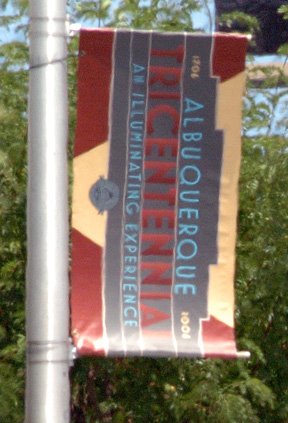
Happy Tri-Centennial!

The City renamed Tiguex Park just east of Old Town to Tiguex Tricentennial Park.

During the city council debate about the placement of the controversial Juan de Oñate statues at Tiguex Park, several Native American speakers told the story of the Tiguex pueblo. The story goes that when Oñate arrived in what is now New Mexico, in 1598, a pueblo was flourishing in the region. Twelve years later, when the pueblo revolt ran Oñate out of New Mexico, the people of Tiguex had vanished.

You see banners and logos everywhere. I’m not a party pooper, but are we taking this a bit too far?

Did you know there is an official online store at the City of Albuquerque governmental website? I thought government was about providing services in exchange for tax dollars and actual fees.

So why is there an Albuquerque City Store on the tax paid website? The store is an internal link to a city vendor, Zia Graphics, a local screen graphics store on Carlisle N.E. http://www.albuquerquecitystore.com/. Enough of a free plug for them.

They sell T-shirts, caps, mugs, patches, pins and souvenirs of all shapes and manner. You can even buy an old parking meter. The tricentennial logo is a hot item.

Three hundred-years ago, Spanish settlers built the first church where the San Felipe de Neri Parish church now stands in Old Town. Since then, Albuquerque has had several flags fly over it as displayed on the plaza across from the church.


From the left are; the Spanish, Mexican, United States of America, New Mexico and Confederate States of America’s flags.

Mayor Martin Chávez has made the Tricentennial Celebration a major occurrence for the city with parades, parties, art and cultural events. Though there is a token recognition of Native American arts, the focus of the year and a half long party is the domination of the landscape by mostly Europeans, specifically Spanish Conquistadors over the local indigenous people.


Why is the logo associated with waste, as it appears here on a public trash receptacle?

So what's wrong with this picture?

The domination of one people, celebrated over another people, from the same community, stinks.

I guess that’s why the tricentennial logo is on the “sanitary” manhole cover. In other words, it covers the sewer.

Why is He Here?

What's wrong with this picture?

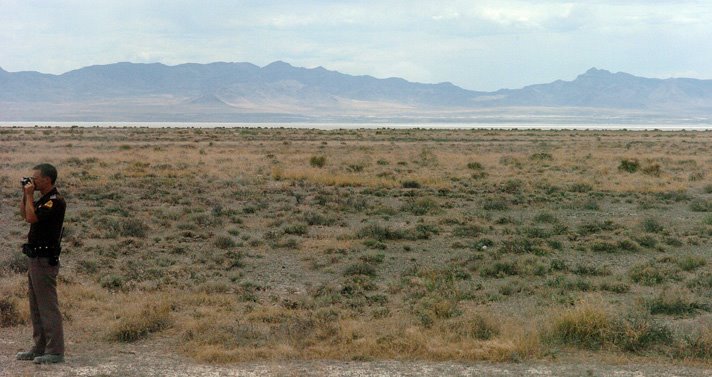
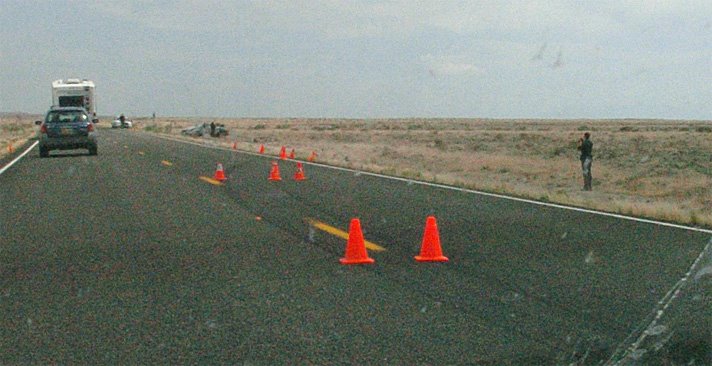
Here is a picture of Utah just east of the Nevada State line on US 50. It is known as "the loneliest route in America," with good reason.

The reason you haven't read anything here lately is because I was on an extended road trip around the Southwest.

So why is a Utah Highway Patrol officer standing in my vista shot?

He was investigating a one-car rollover pickup truck accident.

It was 12:20 pm. It appeared that the accident may have occurred under the cover of darkness and no one noticed it until first light. These kinds of accidents happen with some degree of regularity in the West where the closest town may be more than 80 miles away.

There were three officers and a sergeant at this scene. It must have taken them a couple of hours for all of them to arrive, even running full speed, with lights and sirens.

There were a couple of heavy skid marks that swerved off the road. I could not tell what the cause of the accident was; whether the driver swerved to avoid wildlife or livestock on the road or if it was falling asleep, awakening and finding themselves heading into the opposing lane then over-correcting and driving off the pavement and subsequently rolling over. Result, it was a bad accident.

Utah is one of the few states that openly admits to the problems of drowsy drivers and encourages them to do something about it.

Tuesday, July 04, 2006

Fourth of July and Flags

What's wrong with this picture?

OK, I’ve eaten my hot dogs and engaged in my annual self-imposed ritual of reading the Declaration of Independence; I read the Constitution on New Years day. Now I can go on and listen to the illegal fireworks in the neighborhood. It seems that every neighborhood has its own bad boy pyrotechnic freak. At least mine doesn’t fire guns.

I got to thinking about the flag and the meaning of the Declaration, the Constitution and the Bill of Rights. This past week the Senate failed to approve a flag-burning amendment by a single vote.

I don’t have a problem with the act of flag burning as a political protest. Read “Flag” at theblueflyer.com. I have problems with a protester stealing someone else’s flag. I have problems with a protester burning the flag when it constitutes disorderly conduct by starting a fistfight. I just don’t have a problem with it being a demonstration of an act of free speech.

I have a bigger problem with those who profess their support for the flag and at the same time disrespect it.

There is a congressionally approved flag code. It carries no criminal penalties, yet it sets out proper conduct regarding the flag.

The code dictates that it shall not, among other things, be used in advertising, or worn as clothing, or that it should be flown at night unlit, nor be displayed soiled.

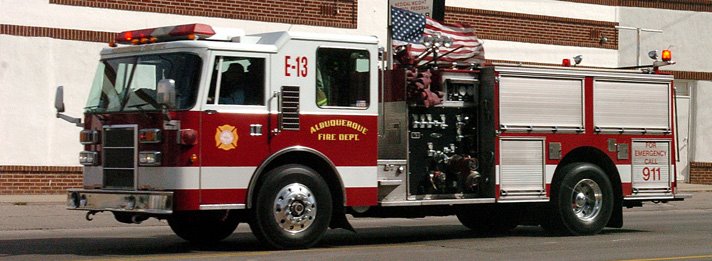
So what's wrong with this picture?


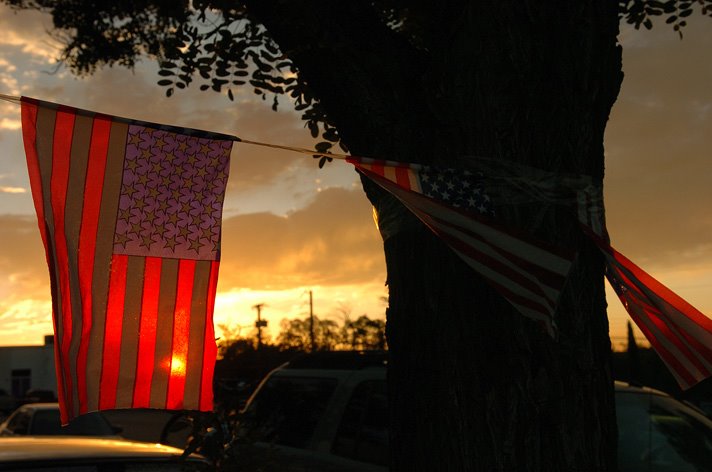
Albuquerque Fire Department’s Engine 13 flies an American flag night and day. It is dirty and frayed.

According to the code this display violates the code's requirements:

"When the flag is displayed on a motorcar, the staff shall be fixed firmly to the chassis or clamped to the right fender.

The flag, when it is in such condition that it is no longer a fitting emblem for display, should be destroyed in a dignified way, preferably by burning."

The hypocrisy of claiming to respect the flag by flying it improperly is as disrespectful as burning it in protest.

Sunday, July 02, 2006

Break! Zoom!! Click!!!

What's wrong with this picture?

The United States Air Force’s precision performance flying team, the Thunderbirds start their signature final maneuver, the “starburst” on the command of their flight leader. Flying identical F-16’s, Saturday afternoon over Kirtland Air Base, Lead Pilot Lt. Col. Kevin J. Robbins in the number one airplane barks, “Break!”

Pilot of the number three right-wing position, Maj. Nicole Malachowski, raises the left wing to start her move to the right. Maj. Scottie Zamzow, pilot of number two left-wing position, is a split-second late breaking to his left. If it weren’t for the high-speed nature of this photograph, the faux-pa was otherwise imperceptible.

Flying in the number four slot position below and behind the lead in the diamond formation is Maj. Steve Horton. He is followed by Lead Solo Pilot Maj. Brian Farrar in number five. Farrar spends so much time upside down during the show that the number five is inverted on the side of his aircraft. Opposing Solo Pilot Maj. Ed Casey in number six followed well behind to spiral upwards through the “starburst.”


Casey is shown here landing.

So what's wrong with this picture?

I have to admit that this is simply flying envy. They also get paid to fly fast! It has to be the ultimate flying “dream job.” I’m sure the recruiting tent did a brisk business.

Since first seeing the Thunderbirds when my dad took us to his Amarillo Air Force Base Headquarters office building in the early 60s, when they were flying F-100 Super Sabres, through the F-4 Phantoms, the T-38A Talons and now the F-16 Fighting Falcon, “electric jets,” they have always put on a jaw-dropping show. WOW!

Saturday, July 01, 2006

Scattered Thoughts and Thunder Showers

What's wrong with this picture?

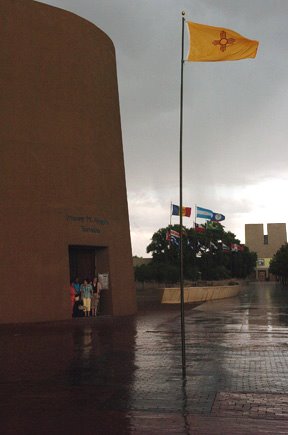
This little boy, in front of the National Hispanic Cultural Center of New Mexico, covers his head as he unsuccessfully tries to protect himself from what looks like a famous New Mexico six-inch rain; a rain drop every six-inches.

The activity Thursday evening was a demonstration and performance of healing sessions by curanderas and other traditional healers.

The rains came! It was the same cloudburst that hit the airport and the National Weather Services’ official rain gauge, which recorded 0.74 inches in less than an hour and a half. That more than doubled the amount of rain to date this year.

The center is a beautiful, relatively new facility, dedicated to education, preservation, research and showcase of traditional and contemporary forms of cultural arts, crafts, music, humanities and other interpretive aspects of social life.

It has an impressive list of supporters whose names are attached to their funded projects. They range from; the Intel Center for Technology and Visual Arts, to the Roy E. Disney Center for Performing Arts, to the Bill & Melinda Gates Foundation gallery, to the Albuquerque Journal theater and the Pete V. Domenici Education Building. Other major contributors include Sandia/Lockeed.

The facility is now slightly troubled. It has had six executive directors in its six-year history. The director of the visual arts program was recently forced to leave. Now it seems that three quarters of the visual presentation staff has left.
Part time contractors have filled the void and new permanent staff will be hired this month.

There are little indications of problems. This is part of the row of national flags honoring countries in front of the center just south of downtown Albuquerque.

Note the flags in clockwise order from the top; Paraguay, Peru, Philippines Portugal, Argentina and Venezuela. Besides already being tattered, in the first gust before the rain, they indicate a loss of direction.

Look at the green and red Portuguese flag which has a heraldic shield in the center surrounded by gold straps and ring. It has been metaphorically described to represent a compass rose in honor of their adventurous seafaring tradition.

So what's wrong with the picture? The flag is upside down.

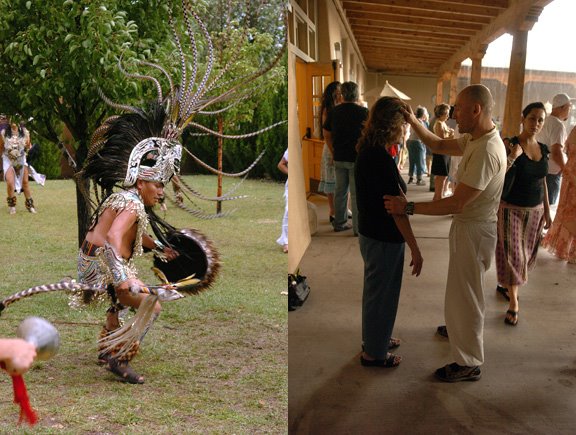
Despite the rain, a troupe of Aztec dancers danced and the healers healed through it all.

Though a bit tattered and temporarily losing its direction, like the cleansing rain and the healing, I am sure the center will also just dance through it all. A new set of flags should help make it all better.

Friday, June 30, 2006

Ugliest Thing I Ever Saw!

What's wrong with this picture?

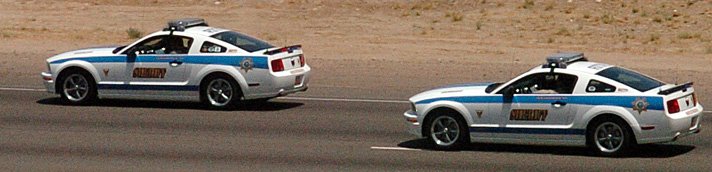
Sheriff Darren White ordered a new paint scheme for the Bernalillo County Sheriff’s Department’s marked units.

He said he wanted feedback on what the deputies thought. Here are two of the current Sheriff’s Traffic units. No, I’m not a deputy, only a resident. I am not an art critic, having dropped out of an art history class when I had a personal crisis.

But I’m going to borrow a quote from President Lyndon B. Johnson who said of his official portrait, painted by famous New Mexico artist Peter Hurd; “That’s the ugliest thing I ever saw!"

As police cars go, in my opinion, Johnson got it right.

White thinks that the California Zebra car is the epitome of police car styling.

It’s time for the Sheriff to head west.

Now it’s true that every Sheriff wants to leave his mark on the public. This one is best demonstrated by the yellow streak down the car. The public may view this as the big dog hiking his leg or misperceive it as a sign of cowardice.

For what its worth, I’m voting for keeping the classy blue and white over the butt ugly…