
NOTE: I got behind on my blogging, while writing a series of case studies from the last election cycle, but I have continued to cover events. So, here are some.
What’s Wrong With This Picture?
During the month of May a couple of powerful women from Washington, D.C. visited New Mexico.
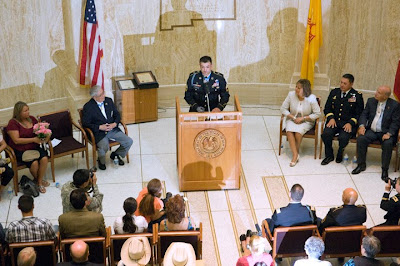
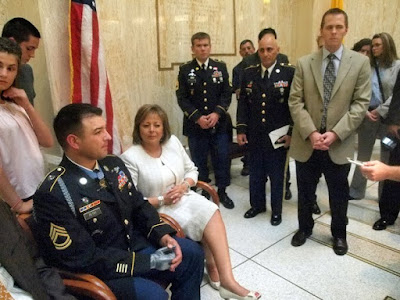
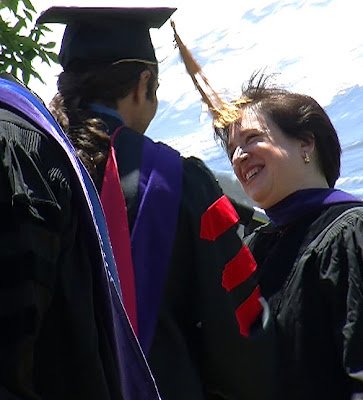
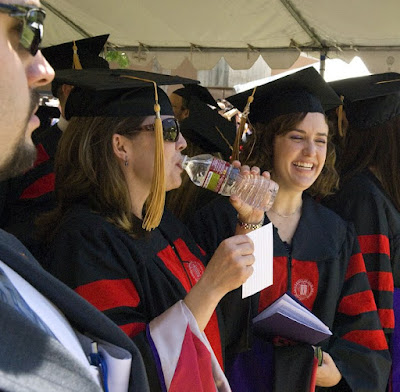
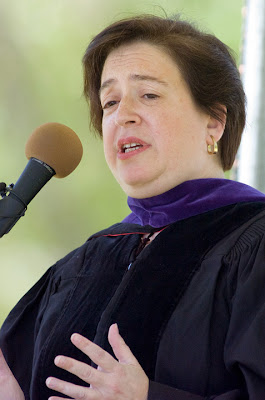
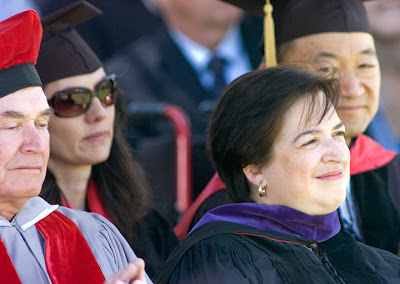 The newest appointed member of the United States Supreme Court, Associate Justice Elena Kagan, gave the commencement address to the 60th graduating class of the University of New Mexico Law School. She is seated with
 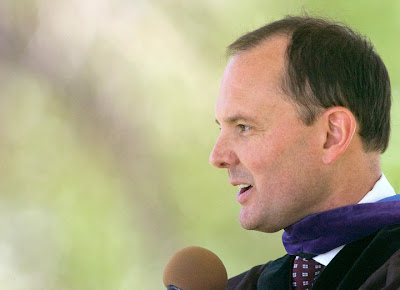 Professor of Law, and the Dean of the School of Law Kevin Washburn, introduced Justice Kagan by reading her biography, as posted on the Supreme Court’s webpage.
“We’ve had other justices visit UNM School of Law,” Dean Washburn said. “But, the last justice to actually give the commencement address was William O. Douglas. And I know that you now hold his seat,” Washburn said.Elena Kagan, Associate Justice, was born in New York, New York, on April 28, 1960.She received an A.B., summa cum laude, in 1981 from Princeton University.She attended Worcester College, Oxford University, as Princeton’s Daniel M. Sachs Graduating Fellow, and received an M. Phil. in 1983.In 1986, she earned a J.D. from Harvard Law School, graduating magna cum laude, where she was supervising editor of the Harvard Law Review.She served as a law clerk to Judge Abner Mikva of the U.S. Court of Appeals for the District of Columbia Circuit from 1986-1987.She served as a law clerk to Justice Thurgood Marshall of the Supreme Court of the United States during the 1987 Term.And she worked as an associate in the Washington, D.C. law firm of Williams and Connolly, from 1989-1991.She became an assistant professor at the University of Chicago Law School in 1991 and a tenured professor of law there in 1995.And about that time she left the University of Chicago to join the White House where she was associate counsel to President Clinton and then served as deputy assistant to the President for Domestic Policy and Deputy Director of the Domestic Policy Council.She joined Harvard Law School as a visiting professor in 1999 and became professor of law in 2001.She was the Charles Hamilton Houston Professor of Law and was appointed the 11th dean of Harvard Law School in 2003.She was the first female dean of Harvard Law School.While there, she earned a reputation, deserved, as the most transformative academic leader of our time.President Obama nominated her to serve as the 45th Solicitor General of the United States and the first woman in that role of the United States, and she was confirmed on March 19, 2009.President Barack Obama then nominated her as an Associate Justice of the Supreme Court on May 10, 2010, to take the place of retiring Justice John Paul Stevens and she assumed this role on August 7, 2010.
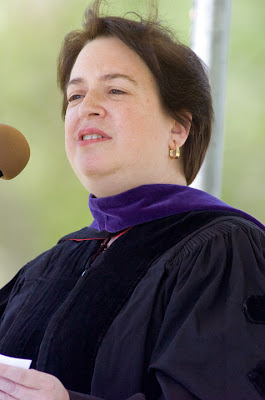 "You know from that introduction that Dean Washburn gave me, the secret to my career, or ah, the secret is, I can’t keep a job,” Kagan said, “But, I think I’ve solved that now,” referring to the lifetime appointment to the federal bench.
 “I understand Albuquerque is sometimes called the city at the end of the world,” Kagan said, “because it’s the city in America located furthest away from any other city; and perhaps that is why you treat your guest so well.”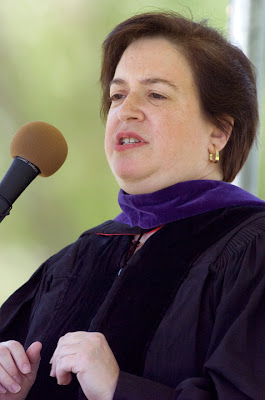
“You know how far we travel, and let me tell you, it took a little bit of time yesterday on Southwest Airlines,” She said to knowing groans and laughter.
In fact, this address is something of a momentous occasion for me as well, because this is my very first commencement address as a Supreme Court Justice.
And in fact, it’s my first public address as a Justice of any kind whatsoever.
So, you know, we’ll see how I do, you know.
Kagan told the crowd the reason she accepted the invitation to UNM was because Dean Washburn had taught at Harvard during her tenure as Dean.
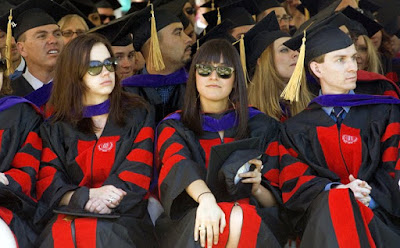 There was nothing political about her speech; only encouragement and advice.
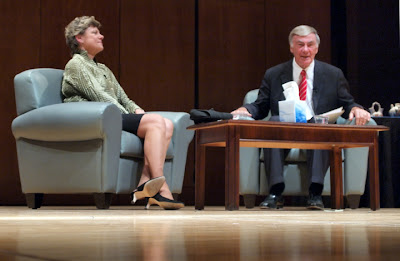
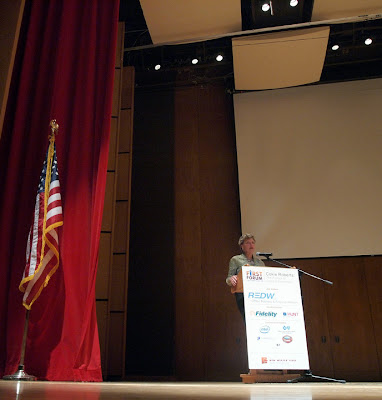 Mary Martha Corinne Morrison Claiborn Boggs – Roberts. You would know her as, Cokie Roberts was the featured speaker at New Mexico First’s First Forum Lecture Series, and the awarding of the “Spirit of Bipartisanship Awards,"
The topic, Cokie Roberts: The Politics of Good Government.
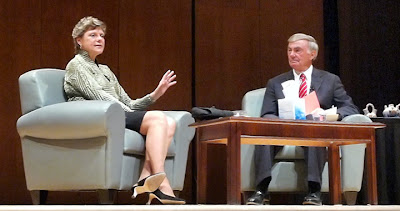
 Roberts and Donaldson appear to enjoy each other’s company and during the question and answer session, it felt like you were watching a couple of pretty smart and well-informed people having a living-room conversation, and you were a silent guest, taking it all in.
 So what’s Wrong With This Picture?
The outstanding things instantly apparent are that Kagan and Roberts are both smart and have wry senses of humor.
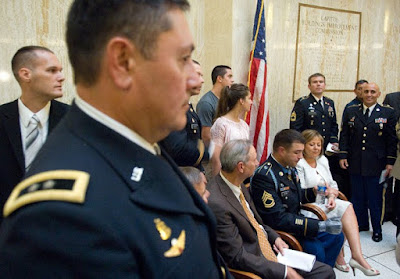
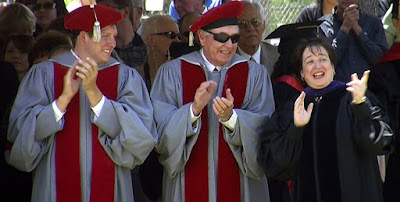
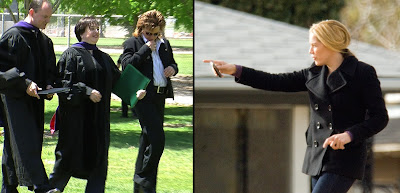
 Justice Kagan was under the protection of the United States Marshal with local assistance of the United States Secret Service, above left, the Albuquerque and University of New Mexico Police Departments.
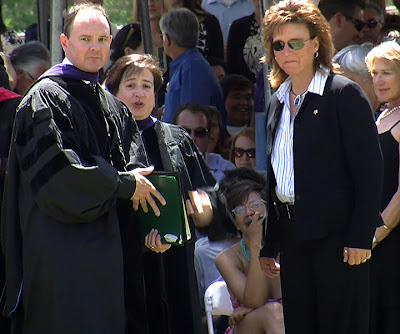 I display the above picture more as art imitating reality, or the fact stranger than fiction impressions. The woman to the right, in the mirrored sunglasses is the Deputy U.S. Marshal accompanying Justice Kagan.
 Right here in the Duke City, we are host to a TV production, "In Plain Sight," starring Actress Mary McCormack, above, as U.S. Marshal Mary Shannon of the Witness Protection Program, with Actor Steven Weber, who played FBI Special Agent Mike Faber.
 A mult-box, seen above the knee of the television, cameraman, seated in the center of the photo above, is an electronic device with multiple outlets that delivers an audio signal form the master control board of an event, especially for audio dependent press of television and radio, but also used by journalists who more often use recorders as auxiliary note taking devices.
Roberts comes from a unique place, her parents served in Congress for some combined total of 50 years according to her.
Her father, Thomas Hale Boggs Sr., a Democrat, served 14 terms as a member of the U.S. House of Representatives from Louisiana’s 2nd district, New Orleans. He was first elected to one term, January 3, 1941 – January 3, 1943, when he was defeated in his reelection bid. He joined the Navy and served out the remainder of World War II. He was reelected and served from January 3, 1947 – January 3, 1973.
Boggs was the 16th Majority Whip of the United States House of Representatives from January 10, 1962 – January 3, 1971. He became the 17th Majority Leader of the United States House of Representatives from January 3, 1971 – January 3, 1973. He presumably died in a twin-engine airplane crash over a remote area of Alaska on October 16, 1972, the wreckage has never been found, and he was not declared dead until January 3, 1973,
Boggs' widow, Marie Corinne Morrison Claiborne Boggs, known as Lindy, also a Democrat, was elected in a special election and served from March 20, 1973 – January 3, 1991, six terms, just under 18 years. She served as ambassador to the Vatican, appointed by President Bill Clinton in 1997–2001.
Roberts says her role is to try to explain politics on radio and television.
The moderator for the evening was New Mexican Sam Donaldson. He has served 37 years as an ABC NEWS reporter and commentator.
Roberts and Donaldson appear to enjoy each other’s company and during the question and answer session, it felt like you were watching a couple of pretty smart and well-informed people having a living-room conversation, and you were a silent guest, taking it all in.
Donaldson asked several questions and read some from the audience:
Roberts was talking about the polarization in the legislative process, “… it’s destructive, but it’s not new.”
"But it didn’t again use to be that way,” Donaldson said. “When I came to Washington 50 years ago, to think of your father, people assumed that people in Congress were trying to serve their constituents, assumed they were honest, which is not always true, and assumed they were good people….”
I’m from Louisiana,” Roberts said. “It wasn’t always true at all. Our most recent jailed governor just got out. But, there was a much more strong assumption of that period,But again I’ve come to believe again that that period of from about 1946 to 1974 was really the aberrant period of…. But, was aberrant in a lot of ways and a lot of it was because of World War II and in fact if you look at the graphs, of when the Congress was most, was least polarized, it was in that period of our history.You know, the men that were in, and it was men in Congress at that point, had literally been in the trenches together.And they, and the whole country lived through it, you know we, the whole country had been on rationing, sacrifice and America understood the enemy was the dictator across the ocean not the guy across the aisle. And so that carried over for a very long period time.And then it ended.
“Do you see any way, or ways, to lessen the influence of big – big money, and lobbyists, and PACs on our elections,” Donaldson asked?
“Uh No,” Roberts said. “In a word,…
“What are the prospects of a Constitutional change for term limits,” Donaldson read an audience question?
None. And that’s a good thing. I speak as a daughter of people, with combined terms of about 50 years.
Term limits don’t get you anywhere. The problem in Washington is not that people stay forever, and are set in their ways. Those people who are actually the ones who are willing to do some compromising and try to get things done. It’s people who arrive fresh and new who have never, you know spend the first few years looking for the men’s room. They’re worrying about their voters at home and don’t have the security to do the right thing beyond that.And it’s not as if they served for six years and go home, they serve six years and have plenty of experience in state legislature. They serve and then run for something else. It’s not like they’re not running for something, and therefore not paying attention to what the electorate has to say.And, by the way, why shouldn’t they pay attention to what the electorate has to say?We are their bosses, they should pay attention to what we have to say…And the truth is, if you have members of Congress who don’t know the system and don’t have institutional memory, and don’t know, and frankly lots of piece of legislation, Secretary Lujan can tell you, can take 10, 12 years to get passed; because, it takes a long time for some of these changes.
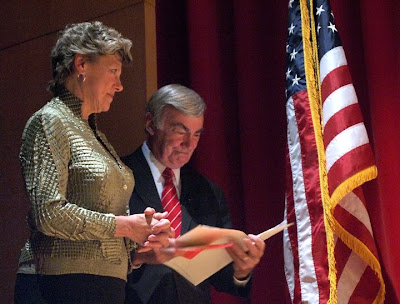
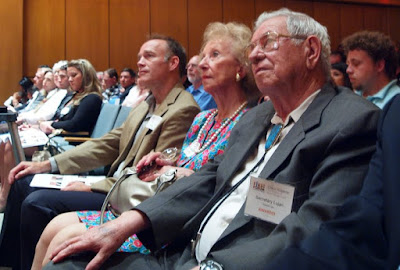
Former New Mexico 10-term U.S. Congressman and Secretary of the Department of Interior Manuel Lujan, below, with his wife, Jean, was awarded a life time achievement for bipartisanship.
And so, if you don’t have people there who can do those kinds of things. The power devolves on to staff, the bureaucracy in Washington, and us, the press.…Having weakened elected officials has, in fact, strengthened bureaucracies.
So what’s Wrong With This Picture?
Where was C-SPAN for Kagan's first speech as a Supreme Court Associate Justice. How could such an opportunity be lost. Getting a Justice to a college campus is neither a small nor insignificant feat.
 Justice Kagan and Cokie Roberts don’t make the pictures wrong.
 Justice Kagan and Cokie Roberts don’t make the pictures wrong.
The outstanding things instantly apparent are that Kagan and Roberts are both smart and have wry senses of humor.
Justice Kagan was under the protection of the United States Marshal with local assistance of the United States Secret Service, above left, the Albuquerque and University of New Mexico Police Departments.I display the above picture more as art imitating reality, or the fact stranger than fiction impressions. The woman to the right, in the mirrored sunglasses is the Deputy U.S. Marshal accompanying Justice Kagan.Right here in the Duke City, we are host to a TV production, "In Plain Sight," starring Actress Mary McCormack, above, as U.S. Marshal Mary Shannon of the Witness Protection Program, with Actor Steven Weber, who played FBI Special Agent Mike Faber.
You met McCormack, below right, who lives in Albuquerque, in a post a couple of years ago, while filming in the neighborhood.
Someone has the look of a U.S. Marshal down pat, I'm just not sure which one pulls it off better.
From a media standpoint there was a problem with the delivery of sound from the podium microphone to what is known as a mult-box.
A mult-box, seen above the knee of the television, cameraman, seated in the center of the photo above, is an electronic device with multiple outlets that delivers an audio signal form the master control board of an event, especially for audio dependent press of television and radio, but also used by journalists who more often use recorders as auxiliary note taking devices.
You may note that there are no plugs attached to the box, as the media present were unable to obtain any signal through the box. So, the reason for using a mult-box, to avoid cluttering the podium with several wireless microphone units and recorders failed.
However, the apprehension of the media, was completely averted when Kagan placed the binder with her speech in it, at the side of the podium, letting the left side, of turned pages, hang over the edge, and not covering any of the microphones.