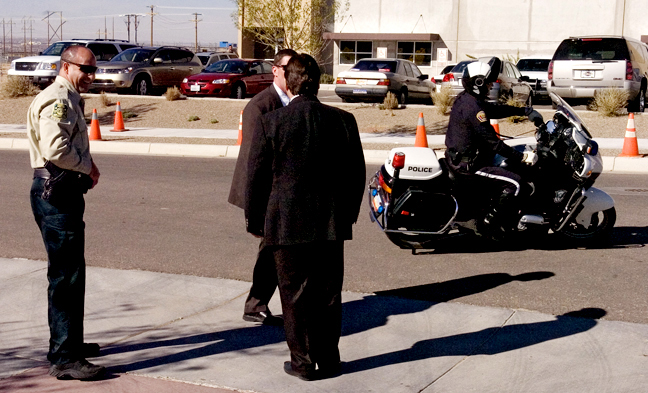
What’s wrong with this picture?
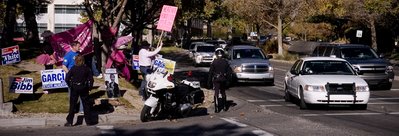
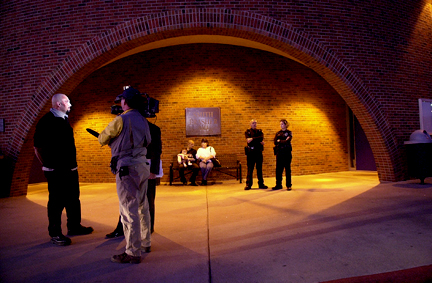
First Lady Laura Bush came to Albuquerque to campaign for incumbent Republican Congresswoman Heather Wilson on Nov. 3. However, this is about all you could see of her, as she sped by protestors in her mini-motorcade.
Does this sound vaguely familiar? It should. ”It’s déjà vu all over again,” as Yogi Berra once said.
This opening is based on the same opening of my June 17 posting, “Can We See George?”
The conclusion was the same: “No… you can’t see Laura either.” That is unless you are associated with people who say only nice things about Wilson's campaign.
Two days before the First Lady’s visit, I covered the Nov. 1 opening of the Department of Agriculture’s Forest Service’s newly consolidated Albuquerque Service Center for the Human Capital Management Office. I learned of the event from a non-campaign related governmental source.

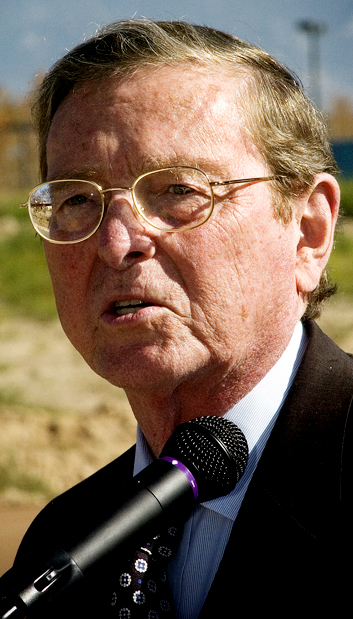
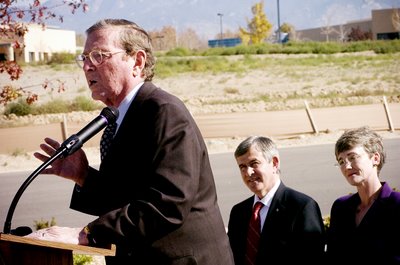
U.S. Department of Agriculture Secretary Mike Johanns, New Mexico’s senior Sen. Pete Domenici and senior Rep. Wilson, along with Undersecretary Mark Rey, who is in charge of the Forest Service, spoke at ceremonies at the newly established office.
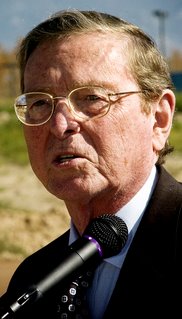
In Domenici’s remarks he skirted the non-partisan line.
“So let me say that this is also a good time because it’s a time just before an election and everybody is clearly anxious and working at, to see who’s going to win and to work hard to see that next Tuesday reflects in each of our states the will of our people,” Domenici said. “That will be an exciting event. My hope, that many of you will be participating, even though you are not long lived New Mexicans, you will find that politics in New Mexico is truly not a spectator sport; it’s far more than that. You really get into it all the way. And that’s what you’re going to find here.”
“Having said that, good luck to you Heather in your up coming election,” Domenici said.
After photographing the USFS opening, I went to the New Mexico Republican Party headquarters to talk with Executive Director Marta Kramer. I had tried to reach her by phone but was redirected into a go-nowhere-fast terminal telephone loop. I thought if I could speak with her face-to-face, then I could get a schedule of Republican Party campaign events. Little did I know!
When I arrived at Party headquarters, there was a press conference about to start. The receptionist, seeing my camera, directed me back into the main room where the press was gathering. I said I had come, wanting to talk to Kramer, but the receptionist pointed to Communications Director Jonah Cohen who was standing in the lobby, talking on his cell phone.
I identified myself by name, as a university journalism student, a personal blogger, and a freelance photographer, with Joe Monahan.com as one of my clients.
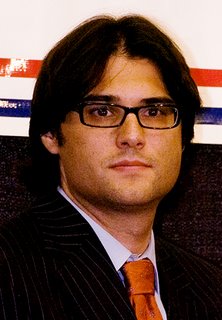
Cohen said, "We (the New Mexico Republican Party) don’t like Joe Monahan.com, because he suggested that we’re racists." Cohen told me that if I wanted to photograph in my role as a journalism student, or personal blogger, I was welcome to stay. I told him that no one dictated with whom I associated or how my journalistic efforts were directed.
I asked Cohen if I still could speak to Kramer. He had me wait in the lobby as he went back into the bowels of the office. I could hear him talking to Kramer, just around the corner. She exploded, saying that we will have nothing to do with Monahan or anybody working with Monahan. “Get him out of here,” she said. Cohen returned, before he spoke, I told him I heard and left.
At the press conference, Domenici called on the Secretary of State to hire an independent auditor to canvass the upcoming election, according to a Party press release. “’All New Mexicans, whether Democrats, Republicans, members of the Green Party, Independents, every last voter in New Mexico must have confidence that their votes are going to count,’ said Senator Domenici. ‘I would respectfully request that the Secretary of State immediately commit to an open and transparent state canvass with the media and interested parties in attendance.’”
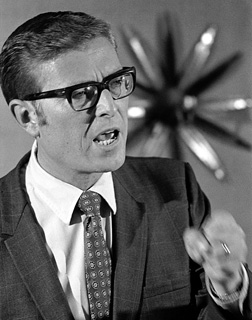
What really irritated me was that in 1970 I had photographed for Domenici's campaign when he ran for governor, but lost to Bruce King. Now, I'm considered persona non-grata.
It now seems that Republican Party bureaucrats and supporters of Wilson had come to dislike Joe Monahan.com, and in particular, its editor and namesake, Joe Monahan. They dislike him so much that they attempt to discredit and demonize him, and by direct association, to also discredit and demonize me.

Maybe I shouldn’t take things so personally; however, in this case I have.
There is that old saying, “Don’t argue with fools; someone might not know the difference.” However, there comes a time when even I must risk being foolish because in the public square, as James Madison proposed that bad speech or wrong ideas must not be censored, but challenged by more speech, not less speech.

Wilson's campaign and other Republican supporters and operatives engaged in efforts to demonize Monahan included: Whitney Cheshire’s The Wednesday Morning Quarterback, http://www.wednesdaymorningqb.com, Mario Burgos’ http://www.marioburgos.com/ and New Mexico for Sale.org, http://www.nmforsale.org.
Whitney Cheshire, president of Cheshire Communication Strategies, posts a political blogspot, The Wednesday Morning Quarterback and in 2003 produced a related Web site for New Mexico Victory.com, http://www.nmvictory.com.
She managed Republican Steve Pearce’s successful 2002 primary campaign for U.S. House of Representatives for New Mexico’s District 2.
According to her online biography, Cheshire served as the 2004 and 2005 communications director for the Republican Caucus of the New Mexico House of Representatives during the legislative sessions. In the 2004 election year, she was communications director for New Mexico's Bush-Cheney 04 re-election, and provided communications assistance to the Republican National Committee and New Mexico Victory.
Cheshire was campaign manager for Albuquerque City Council candidate Mike McEntee’s successful run in 1997.
In 2000, Cheshire campaign managed a State Senate race and was State Representative John Sanchez’ press secretary in his unsuccessful 2002 gubernatorial bid against Bill Richardson.

In an Oct. 16 posting of The Wednesday Morning Quarterback, Cheshire reported what she later claimed to be a scoop; that Republican Senate candidate Dr. Allen McCulloch was involved in a two-car accident that injured six people in the other car. “We’re told that there was no one at fault – the accident caused by weather and bad road conditions,” she wrote.
One need not be a law enforcement officer to recognize the extreme spin applied by Cheshire.
Accidents are not without fault. In this case, McCulloch exceeded a safe speed for the bad weather and road conditions. The posted speed limit was voided by the rain and hail. The fact that the vehicle the candidate struck was reported to have pulled to the side of the road attests to the severity of the conditions. McCulloch was reported as telling investigators that he was talking on his cell phone when his car hydroplaned off the marked roadway.
Weather and bad road conditions did not cause the accident; they contributed to it. Accidents are the culmination of a series of events and in this case, once the investigation was complete, McCulloch was cited with careless driving. Once the accident happened, McCulloch apparently helped rescue the injured from the other vehicle.
I’m neither condemning nor judging McCulloch. However, I am questioning Cheshire’s spin tactics in trying to protect him and his probable responsibility for the collision. Do you remember how the Republicans loved Chappaquiddick?
Cheshire openly attacks Republicans who do not agree or join in lockstep with her view of what the party must be!
In her Oct. 17 blog, Cheshire attacked Monahan and Republicans who question the direction of the current Party leadership.
“If there were anybody with LESS credibility to bash the state GOP, we don’t know who they’d be…Maybe former Gov Dave Cargo? Anybody remember the last time he said ANYTHING good about a Republican who actually took up the fight for the Great Elephant?
BUT! We won’t give up on Joe Monahan. If there’s a less credible GOP BASHER out there, he’s sure to find them…”
There is something reprehensible, about attacking a lifelong Republican, a former two-term governor, and a loyal and a dedicated Party member. Cargo sees his party in more moderate terms than the current leadership. However, that is no reason to savage him and again, by association, those of us who sometimes tend to believe as he does.
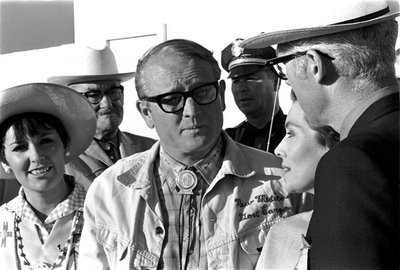
I have known Cargo since 1967 and have photographed him over the years. I don’t always agree with him. However, I respect his right to say what he thinks. Despite our occasional differences, I have also have agreed with him. I like him as a person, and I have done legal battle at his side.
Cheshire and others chose to label Monahan a “Dem blogger,” just because he posts information that comes, most likely, from Democrats or from Republicans that do not hold the same sense of the Party that she and those for whom she is fronting do.
She has condemned Monahan for working as a spokesman for a group that has a member who is a high dollar contributor to one of the political action committees of current State Attorney General and Democratic candidate for N.M. Congressional District 1, Patricia Madrid.
Cheshire suggests that there is something wrong with the ability of people to hold more than one conflicting idea in their mind at a time.
There is a phrase I have heard from within the “new Republican Party:” that some individual members are not Republican enough. I know what those who say it mean: you don’t think exactly as I do. It seems that the “Big Tent” isn’t big enough to hold more than one elephant, or idea, anymore.

Name calling, labeling and demonizing is a long held practice of a faction of the extreme right-wing of the Republican Party. It’s best exemplified by the late and infamous Wisconsin Republican Sen. Joseph McCarthy with his unsubstantiated claims of communists in the federal government during the beginning of the Cold War era, in the late 1940s and early 1950s.
Instead of attacking ideas, attack people, is the new mantra. Kill the messenger!
Mario Burgos writes under the title, “Clear thinking and straight talk from the top of a mountain.”
By early January 2004, Burgos had announced his intention to run for incumbent four-term Republican State Legislator Ron Godbey’s District 22 seat. Godbey, representing the East Mountain area of Bernalillo County, didn’t appreciate the intentions of the young, 34-year-old newly arrived transplant, originally from New York City.
According to his blogs' biography, Burgos has lived in more than a handful of locations, including Ecuador and California. Godbey called him “one of Mickey's Boys." Godbey was referring to then Republican National Committeeman Mickey Barnett, who had been a legislator and earlier led the struggle to control the state’s Republican Party -- previously chaired by John Dendhal.
On the last day of the 2004 legislative session, Godbey rose in the chamber to announce that due to his wife’s ill health, he would not seek reelection.
Burgos was then an unsuccessful primary candidate, running against two other Republicans. He garnered only 40.3 percent, against 50.3 percent for Kathy McCoy and 9.60 percent for Charles Mellon.
In reporting the primary results, the Albuquerque Journal indicated that Barnett, who represented the far right-wing of the Republican Party, had supported four candidates for legislative seats. Barnett said that he, “believes in competition, or ‘the marketplace of ideas.’"
Barnett, who is an Albuquerque lawyer, is shown here, left, when he worked as a legislative assistant for newly seated Sen. Domenici in 1973. He is with Press Secretary Grace Marie Prather and the Senates’ Republican Policy Committee photographer Arthur E. "Scotty" Scott, looking at photographs of the second Nixon inaugural ceremonies.
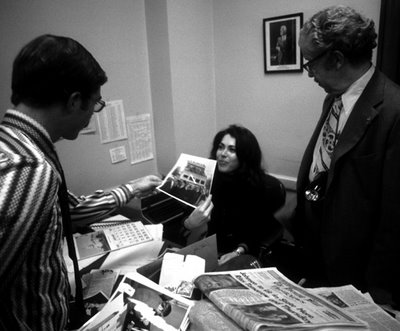
I originally ran into Scott, when I was in junior high and living in Arlington, Va., in the mid '60s. During the summers, I would explore the U.S. Capitol building. Deep in the bowels, on the Senate side, I came upon an open door, emitting the fragrances of darkroom chemicals, the buzz of photo equipment and the sound of fresh prints dropping off a rotating drum print dryer. Every inch of available wall space was covered with 8x10 black and white prints of United States senators, mostly in staged pictures. There was only one spot that had no prints; it was a blackboard and cork bulletin board covered with times, dates and locations of upcoming events. This was "Scotty’s" domain.
Scott was willing to talk to me about what he was doing. I had little respect for shooting the grip and grin, the traditional staged handshake publicity photos, so popular in that day and earlier. He had an occasional picture of un-staged events on Capitol Hill documenting an actual news or historical situation. I had little regard for the fact that he was still using a 4x5 Speed Graphic and fill flash for illumination; but there was no arguing with the beauty and quality of the final prints. I knew instantly that 90 percent of his work was boring and mundane. However, the other 10 percent of the time, he had a catbird’s seat to history.
The impact of his historical and news work was filed in the back of my mind, only to creep forward into my work later. The pictures of the USFS dignitaries and of Cargo, above, are throwbacks to Scott's influence.
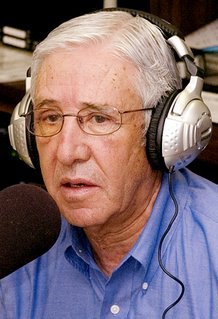
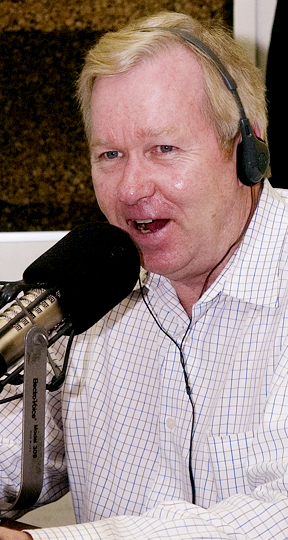
Barnett‘s office manager, Justine Fox-Young, was successful against incumbent Bob White. Incumbent Republicans, State Rep. Larry Larranaga, of Albuquerque, seen here as a guest political commentator with Monahan during his 2006 KNAW FM's election night coverage, and Sen. Gay Kernan of Hobbs. Both Larranaga and Kernan were re-nominated.
McCoy was unopposed in the general election and after the primary Gov. Bill Richardson appointed her to fill out Godbey’s unexpired term.
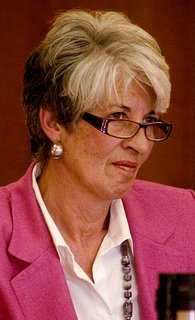
Burgos is rather prickly about the issues and when Monahan pointed out the Burgos-Barnett effort to attack a staunch opponent of the Barnett-Dendhal faction of the state’s GOP, Godbey, Burgos claimed:
“Wait a second Joe. I ran in the 2004 primary for House District 22, the seat formerly held by Ron Godbey -- my neighbor at the time. The thing is, I didn't run against Mr. Godbey because he didn't run. As was widely expected at the time, he retired due to his wife's health issues and then moved back to Texas. So, the 2004 race was between Representative Kathy McCoy, Charles Mellon, and myself.
However, I can tell you that Mickey Barnett did not 'spearhead' anything in my race. He did give me a $200 contribution, and although it was greatly appreciated, it was a very small amount compared to the $20,000 plus raised and spent in the race.
So Joe, how about you stop peddling that story? It's getting a little old.”
Burgos conveniently rewrites history, for he announced before Godbey dropped out.
On the 2004 primary election night, Barnett attempted to downplay his involvement according to the Journal, giving full credit to the successful candidates.
Though the Journal had previously reported Barnett’s involvement in backing the four candidates, they backed up the claims with analysis from their “political experts," University of New Mexico political science Professor F. Chris Garcia and pollster Brian Sanderoff.
"Mickey Barnett and the governor clearly had influence in these elections," Sanderoff said, according to the Journal’s election wrap-up.
Burgos further attacked Monahan for his sourcing, or more accurately, what Burgos claims, is a lack of sourcing.
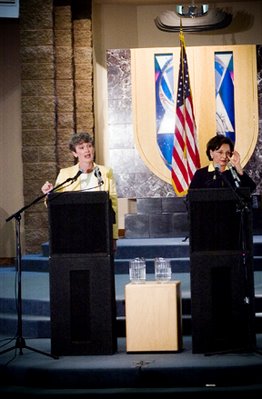
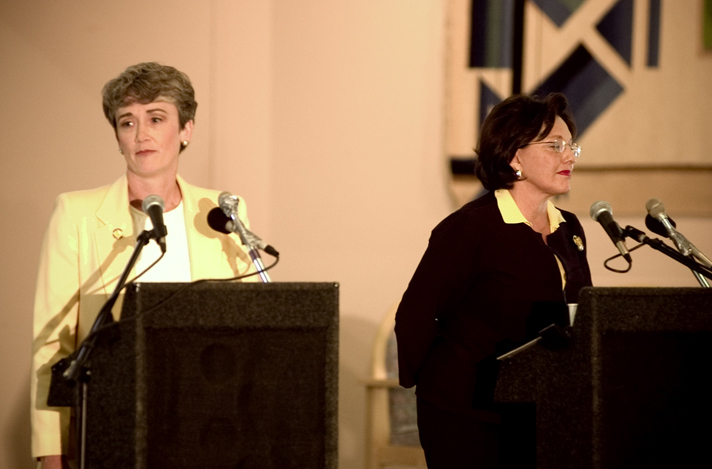
In one particular incident, the first Wilson-Madrid debate, held at Congregation Albert Sept. 17, Monahan relied on a television news account for reporting a quote.
The candidates were asked, “Have you ever used illegal drugs and do you support the legalization, including medical marijuana?” Madrid, who had previously admitted to use during her college days asked, “Is this the question that is suppose to kill the campaign?”
The moderator said the question had jumped out of the basket at her.
"Well I grew-up, I went to college in the '60s…" Madrid said, as her words were drowned out by the laughter that filled the room.
When given the opportunity to ask Madrid a direct question, Wilson asked about an upcoming event put on by the New Mexico Black Political Action Committee, where the Rev. Al Sharpton was scheduled as the keynote speaker.
"Sharpton is a racist, anti-Semitic, rabble rouser. So what I want to know is why doesn't it bother you to stand next to him when he endorses your candidacy for the Congress?" Wilson asked. The question made me cringe because of its racial and ethnic implications and the appearance of pandering to a religious group that has felt the sting of Sharpton’s own racial and ethnic attacks.
Madrid answered that she had accepted the invitation, was unaware of Sharpton’s role when she accepted, and Sharpton had not endorsed her. She added that she was going to stand next to blacks, especially in light of the arrogant response of this (the Bush) administration to the survivors of Hurricane Katrina.
"You accepted the invitation - I did not!" Wilson told Madrid in her rebuttal, "You are judged by the company you keep."
Madrid reiterated that Sharpton had not endorsed her candidacy.
The TV station had edited the “Is this the question that is suppose to kill the campaign?,” with Wilson’s Sharpton question, and Monahan relied on it in his posting.
I failed to proofread his posting until the morning, but I wasn’t the first to inform him of the error. Monahan changed it immediately and posted a correction the next day.
Burgos would make as much of this event as he could. He condemned Monahan for not being present. He also was irritated by the selection of the photograph of Wilson I took that was used in the next day’s post. Burgos Wrote:
“That's right, the man with the 'inside line' to everything political in New Mexico came up with his indepth political analysis by watching the evening news. He didn't even have enough decency in the process to check out the whole debate which is streaming on this site before making his ‘political analysis,’” Burgos wrote of Monahan. “If he had, Monahan would have realized how ridiculous it was to put the pictures he chose to represent Heather and Patsy on his site. Watch the first few minutes of the candidates on stage, and you'll see:
1. Patsy licking her fingers
2. Doing weird things with her tongue (cotton mouth?)
3. Looking down to see if her stool is showing
4. Primping her hair
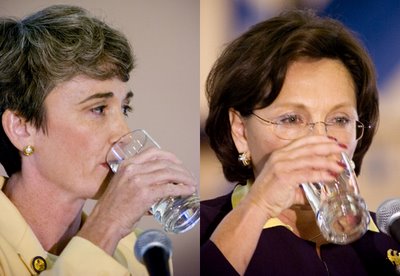
But hey, I guess whatever makes the boss happy.”
In his blog, Burgos attacked Madrid’s personal mannerisms, characteristics, idiosyncrasies and foibles, but specifically he picked on her physical height and the fact that she uses a step to stand on because podiums are made without much consideration of the height of speakers.

The queen of England is also short and she also stands on a step at podiums. Once, while visiting the White House, an aide forgot to put the step behind her podium when she and the president met the press. Maybe you saw the picture taken of her. It showed the top of the podium, two microphones and her large hat.
Burgos’ bias blinds him. He sees Madrid in nothing but negative terms while not being able to see any of Wilson’s own flaws.
I was present at the debate; I heard what was said and took measure of the room. I also captured Wilson’s expressions, in what I saw as a nastiness emanating from her during her attacks on Madrid.
As a still photographer, that’s my job; I respond to emotions in front of my lens. It’s not about supporting one candidate over another. It’s about capturing the sense of the person and of the room. It is the definition of the age-old question of what is news? The old adage of man bites dog… The difference between what is said and what is done.
Consider what would be a most compelling image a photographer might capture, yet one of the most difficult. I offer the fear that most humans’ have of being bitten by a poisonous snake. How fast can a rattlesnake strike its victim? A successful photograph of it would be the instant before the rattler sinks its extended fangs into the flesh.
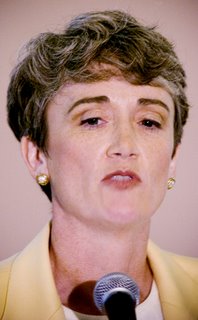
Burgos’ take was that Wilson won this first debate hands down. He believes that Wilson’s question of Madrid’s acceptance at the Sharpton event was proof of her victory in the debate. Yet the question was the snakebite. The photograph was capturing that event. He can’t have it both ways. She struck: it was captured. Burgos can’t complain that the image should have made her look nice in the very act he says was victory. The nastiness of the question; was just that, nastiness.
In 1960, Vice President Richard Nixon met Sen. John Kennedy, in a televised presidential candidate debate. People who heard the event on the radio were sure that Nixon won; they heard an articulate, knowledgeable, better-prepared Nixon. However, those who watched the debate rated Kennedy the winner. Nixon had bad makeup, needed a shave and was visibly sweating. Kennedy’s interaction with the audience was obvious.
My take was that the Madrid-Wilson debate was as close to a draw as it could get. Madrid stumbled a couple of times, but Wilson came off as condescending, pompous, arrogant and superior.
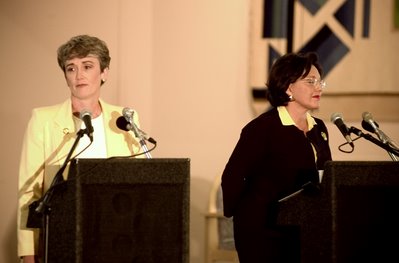
A couple of comments by Wilson: brought her own credibility into question “I live my life based on an honor code that I learned at the United States Air Force Academy: We will not lie, steal or cheat - nor tolerate among us anyone who does,” and "You are judged by the company you keep."
Wilson’s company has not always been stellar. Now I don’t believe that persons who have been in public service most of their adult life are going to have lived a monastic existence. Madrid was a lawyer, a state district judge and attorney general. Many of her contacts have not been with the most reputable people. Wilson was an Air Force Academy graduate, officer, was Director for European Defense Policy and Arms Control and was a member of the National Security Council. She negotiated with people who had their finger on the Soviet nuclear button. She served as Secretary of the New Mexico Children, Youth and Family Department before being elected to Congress. Her contacts have also been fraught with less than the most honorable of people.
Why Wilson would not be willing to sit down with someone with whom she does not agree, like Sharpton, and take the opportunity to discuss their differences, makes me believe her rhetoric is disingenuous.
Madrid survived by a whisker. However, in the Oct. 24 televised debate on KOB-TV, the outcome was clearly different. Madrid imploded on a couple of occasions. Wilson was not flawless, but came off better. That is the topic of a forthcoming blogspot.
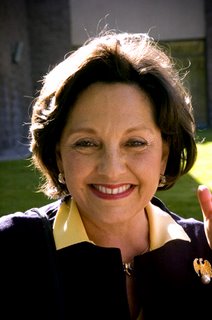
There is also an irony that should not be overlooked. From Aug. 12, when I first photographed Madrid at a Democratic rally, she was almost paranoid of my camera. She asked several times if I worked for Heather’s campaign to take those awful pictures of her that were used in the negative TV commercials and fliers. I told her no, but she didn’t seem to believe me. This is the photograph I took at the end of her question when Madrid arrived at Congregation Albert for the debate. This was the photo I suggested be used if she had won the election.
At the end of the Oct. 9 Madeline Albright event, her son, Giancarlo Messina and I had a conversation while Madrid did an interview with Bloomberg Television. She again asked if I was photographing for Heather. “No Mom, he’s with Monahan,” Messina said. After that, things were different; Madrid still seemed leery of the camera, but no longer visibly paranoid.

Burgos is a skillful researcher, though he relies on public statements as reported, mostly in the Albuquerque Journal. He has a command of the language and the art of rhetoric. However, he seems to have limited ability to place his thoughts in any rational context.
In his Oct. 19 blog posting, Burgos suggested that Monahan follow a standard. “It's called the Bloggers' Code of Ethics.” He wrote, as he linked to it. The irony of his comment was that the code of ethics was nothing more than a total plagiarized copy of the Society of Professional Journalists’ document. The only difference is that everywhere the word journalist(s) appears, it is replaced with blogger. The first dictate of the code is; “Never plagiarize.…”
Burgos is often on the edge of outright plagiarism himself, by lifting multiple paragraphs from Journal articles. Even though he then links to the original source, he clearly does not understand the limits of plagiarism and that merely linking after copying, does not make his work appropriate.
I have not detected any acknowledgement of any possible weakness or flaw in the positions he supports. He comes off as an all knowing, 24-7, all Heather - all the time, rabid chauvinist. Not the female chauvinist, but the Napoleonic.
Burgos does not practice what he preaches. He does not, himself, follow the "Bloggers' Code of Ethics.”
I admire him for taping the first debate. Madrid had refused to appear in a live televised debate before early voting started. Burgos streamed his videotape on his site using "You Tube" on the Internet, a couple days after the event. Though I applaud him for taping the event, his hand-held camera technique was amateurish and nauseating, not because the topic was sickening, but the jerky and unmotivated zooming was. He counter emphasized how he looked at the candidates. His political leaning motivated his poor in-camera edits, not allowing the actual content to dictate his camera work. This makes for an ineffective communications product.
KRQE Television 13 had three cameras and set up lights to record the entire debate to be aired at a later date. The moderator was one of their anchors, Deanna Sauceda. However, KRQE never aired the debate. At least Burgos and I agree that it is unacceptable for a candidate to demand conditions that don't allow for the widest possible audience to hear their positions.
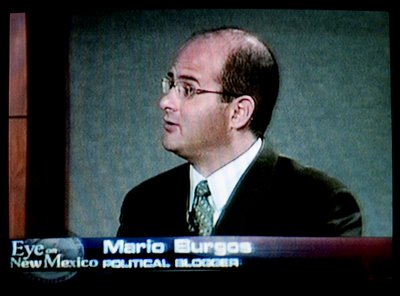
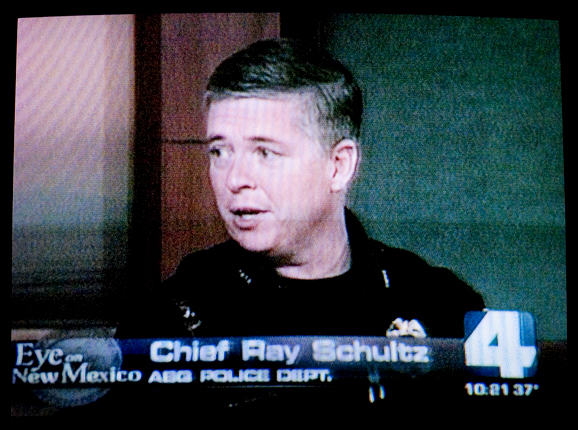
Burgos is currently basking in his proverbial “15 minutes of fame” as he has found a niche as a local political pundit, representing the far right, on the left-right verbal ping-pong weekly TV talk shows. He has appeared on KNME’s “The Line” and as seen above, KOB’s “Eye on New Mexico.”
New Mexico for Sale.org, www.nmforsale.org, is a blogspot hosted by the New Mexico Republican Party and written, in part, by Jonah Cohen, communications director for the New Mexico Republican Party.
I have no problem with the existence of citizens using the power of the internet to put forward their beliefs, whether as random thoughts, gossip, political blogging, or in a more traditional form of journalism.
About 10 years ago, I was approached by a former elected Republican official who had read one of my op-ed pieces published in the Journal that was critical of, then first-term Mayor Martin Chávez. The Republican offered to pay me to ghost write for him. Because I wanted to maintain my own thoughts, and I was not willing to be assigned to write someone else’s opinions, I passed. Now there is weblogging and obviously, other Republicans have now found their propagandists.
The Democrats have their own cheerleading squads; however, they did not attack me and their Party and campaigns allowed me access.
The next day, I contacted the Wilson campaign office and asked to speak with Communications Director Enrique Carlos Knell, Wilson’s official house and campaign spokesman. He was unavailable. I asked to talk to someone handling press passes for the Wilson-Bush rally the next day. I was told that the Wilson campaign was not handling press passes but New Mexico Victory was. I called NM Victory and was directed to “the White House.” I was given the number of Chad Von Luehrte. When I spoke with Von Luehrte, he requested information for credentials; specifically my name, date of birth and social security number to be forwarded to the Secret Service for a background check.
This is standard procedure and has been a routine that I have gone through since, at least 1968, when I covered Republican Vice Presidential candidate Spiro Agnew.
The next day, Von Luehrte called and told me that my name had passed the Secret Service background check, however I was not considered an “accredited” member of the press and would not be issued a pass. I asked him who had removed my name? Von Luehrte would not name the person, but said it was neither the White House nor NM Victory.
I informed Monahan, who at that moment was on the other phone with State Republican Party Chairman Allen Weh. Weh told Monahan that he knew Von Luehrte as a local Republican volunteer who probably was tasked with the administrative duty of gathering the information for the White House. Weh said the State Republican Party was not responsible for removing my name from the list and he would do what he could, when he got to the rally site, to assist in getting me access. Weh assured Monahan that the Party was not adverse to him, or his blogspot and would support facilitating my photographic access.
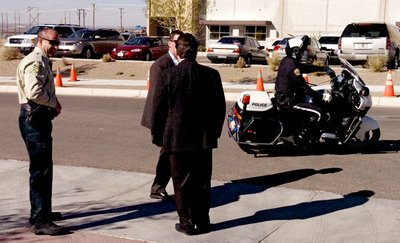
I arrived at the rally site and was directed by a Forest Service officer I had met two days earlier to a Forest Service parking lot across from the warehouse location at the Journal Center on Masthead St. in Northeast Albuquerque.

As I approached the media check-in table, a Secret Service agent confronted me and asked if I had press credentials. I told him that I was to meet the state chairman who was going to rectify a misunderstanding over the credentials. The agent walked me to the check-in table and introduced Von Luehrte, who asked what I was doing there because he had told me earlier I was not accredited and would not be issued a pass.
It took several moments to get him to even be willing to listen to me. I told him that Weh was going to speak with him about the matter. Von Luehrte said he did not know Weh. He told me to wait; said he would look for him and then went into the building.

While Von Luehrte was gone, Republican gubernatorial candidate John Dendhal and his wife, Jackie, arrived, and I photographed them. The Secret Service Agent confronted me again saying I was going to have to leave. I told him that the matter was not yet resolved. He hesitated and said that I could wait but could not take pictures until I had a press pass.
Von Luehrte returned saying he had not found Weh. The Secret Service Agent also returned and told me I had to leave the property. He said I could wait across the street until the matter was resolved.
I walked across the street to my vehicle and was soon approached by a Forest Service Law enforcement officer who immediately said that he knew I was a retired police officer, but I was going to have to leave. I had not made my retired status as a police officer an issue; he raised it. I explained the situation and said I was told to wait across the street until Weh was consulted.
He asked me to prove that I was a member of the press. I told him that neither the City of Albuquerque nor the State of New Mexico issued press credentials anymore, but I could show him professional membership cards from the National Press Photographers Association and the Society of Professional Journalists. I also showed him my UNM ID card telling him I was a currently a journalism student. He reluctantly accepted them. He then told me that he could evict me from the government-controlled parking lot, but he would let me stay as long as I didn’t take any pictures. I asked him under what theory of law he thought allowed him to prohibit me from photographing in a public place?
He said because I was on the government’s parking lot without a White House approved Bush-Wilson Rally press pass, I could not take pictures and that I could not even take pictures from the public sidewalk or street because my truck was in their parking lot and that it wouldn’t be fair to the photographers who had credentials. I quit! His reasoning defied any attempt to make logical sense.
Sen. Domenici arrived; I didn’t take his picture. Chairman Weh arrived and was approached by Von Luehrte and the Secret Service agent. There was some conversation with a couple of different groups of men. Weh approached me and asked if I was Monahan’s guy. I said he and I were associated; that I didn’t work for him, but with him.
Weh said he had tried to straighten things out, that it was not the State Party that had stricken my name from the list, but it was the Wilson campaign that would not issue accreditation to me. He said he had no power or influence over them.
We shook hands and I left. I was escorted out of the area by an Albuquerque police car that had been waiting for me, parked on Masthead. As I drove away, I pulled in behind a parked car. The officer spoke over his PA system, telling me I had to continue out of the area. I went to the corner of Jefferson and Masthead, parked and photographed the mini-motorcade as the First Lady passed several blocks away.
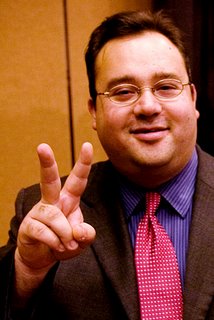
On election night, at the Republican victory party, I was greeted by name, by Wilson’s campaign spokesman, Knell. He recognized me, though I did not recognize him, having never met him. He said he had heard that there was a problem with credentials at the Bush-Wilson rally. He wanted to assure me that it had not been the Wilson campaign that had struck my name. As far as he and the campaign were concerned, I was welcome to cover the event, he said.
So what’s wrong with this picture?
During the New Mexico congressional District 1 televised debate, when Madrid said that campaign contributions only bought access, Wilson made a very emphatic statement that all New Mexicans had open access to her without having to pay for it. Not true.
The actions of agents of the federal government, the Secret Service and the Forest Service law enforcement officers, in their statements prohibiting my photographing at a public event without possession of a government controlled press pass, not only is a measure of denial of access, but is also a license. The basic tenent of the free press phrase of the First Amendment was quashed that day and governmental censorship raised its ugly head.
Other analysis:
When a political party denies open access to their candidates and incumbent office holders, they expose their true intentions to not uphold their prospective or existing office’s oath to the Constitution. To do so is for them to become an “enemy within.”
What does accreditation even mean, and who gets to grant such accreditation?
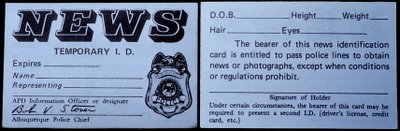
In 1978, I was assigned to the chief of police’s office with the public information officer. At the time, PIO Bob Fenton was rewriting the Standard Operating Procedures on police press relations. I successfully argued with doing away with police issued press passes. It is not governments’ role to determine, or formally recognize, which citizens are or are not members of the press.
You, my readers, are the ones who grant me accreditation.
New Mexico Politics with Joe Monahan.com relies heavily on unnamed sources that he calls alligators. Monahan’s use of these sources allow for a broader dissemination of information than there would be if he followed the more traditional news gathering methods associated with mainstream news media.
Traditional journalistic methods call for the identification of sources and confirmation of their information. Monahan’s blog doesn’t; but he lets his readers know that up front. He allows his readers to exercise their own intelligence. The information is similar to listening to the gossip at the office water cooler.
Inherent in Monahan’s approach is a reality; democrats are more open in their discussions of their internal politics than are republicans. Republicans are more disciplined in their open criticism of fellow party members. They often follow Ronald Reagan's 11th Commandment: "Thou shalt not speak ill of a fellow Republican."
To some, and in particular to the hard-core Republican bloggers, this reality is perceived as a demonstrated bias directed against them. These bloggers have no problem disregarding Reagan's 11th Commandment themselves; while within the leadership, there is a wish to enforce the edict. However, much like Reagan, the reason was to keep criticism of being heaped on those in power.
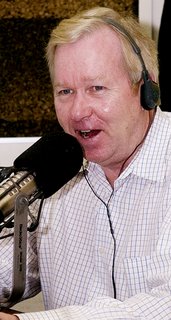
Monahan makes clear what he is doing. In working with him, I have gained some insight to his approach as a blogger, a journalist and political analyst.
Politically, Monahan is an independent. His professional history is that of a radio news reporter.
I met him around 1978 and have been acquainted with him off and on since.
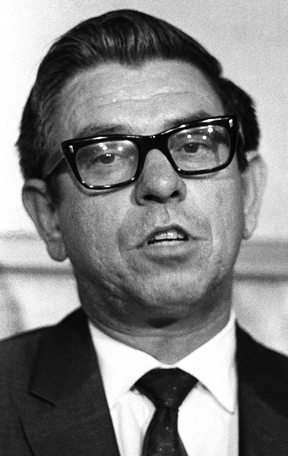
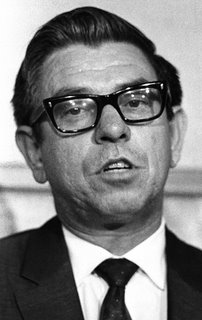
From 1979 to 84, Monahan was press secretary to Republican Manuel Lujan, seen here, the first representative from New Mexico’s Congressional District 1, on Capitol Hill. When Monahan returned to New Mexico, he continued his radio and television news career and then also became a consultant, with several political clients over the years.
Knowing this, I choose to work with Monahan, and I wouldn’t if I thought he had an expressed and/or an overt bias.
I had contacted Monahan this spring, offering him access to my extensive archives of state political figures and offered to capture images of current political figures for him. At the time, Monahan passed. After posting theblueflyer.com Web site and this blog, he called, and we talked about providing photographs of the top post-primary candidates. He said he recognized that allowing campaigns to provide formal handout portraits might not be the most telling, and he wanted to bring the flavor of the campaign trail to his readers.
Monahan admits that he is not the most visually oriented journalist, and he and I have the classic photographer-editor differences. I want all my pictures run, and I want them run big. As an editor, he has space constraints and doesn’t always want to use a picture, even though it’s available in his archives.
Monahan is about as good an editor as I have worked with. He listens. As the season went along, he started using pictures of the events rather than just the ear-to-ear mug shots.
I wouldn’t lend my work or name to the three aforementioned bloggers because of their overt bias. I am sure that in the future I will support candidates and photograph them in their efforts to be elected. If history is any indication, more of those candidates will be Republicans than Democrats. I am an equal opportunity employee, just as I am an equal opportunity critic.
Now, about Weh and Knell; whom do I believe? Who struck my name? I think each man believes that they told me the truth. I think they believe in open access; however, one or both men were lied to, or were unable to learn the truth and didn’t realize it. I believe my name was stricken on orders of an overzealous Party bureaucrat, who either would not admit it to Weh or Knell, or lied, to either one or both of them.
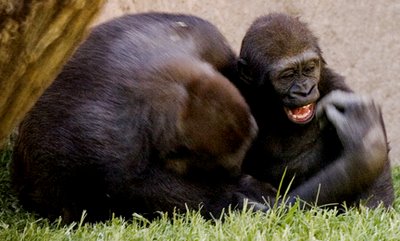
As I wrote in my Sept. 14 posting, “Matt Farrauto,” the Republicans seem to also have their own abusive 900-pound gorilla, though it may not actually weigh 900-pounds, doesn’t sleep wherever she wants, nor has young ones disturbing her rest.
For the record: Monahan posted 52 pictures of mine during election season. Twenty-eight of those pictures were of Wilson and Madrid. Thirteen photos of Madrid, two that were duplicated and 13 of Wilson, none duplicated. He also ran one picture twice, of the two candidates together at the Congregation Albert debate.
I covered 22 events, 14 exclusively Democratic and four exclusively Republican. There were two events that included candidates from both parties. I went to one event at the scheduled time for Wilson, but she had attended earlier and had already left. I generated five images from two TV events.
In spite of the closeness in numbers, I would have wished to have a greater choice of images from Wilson events. To my readers, I apologize for not having very much material from the Republican side of this political season. It wasn’t for a lack of trying. No Republican campaign may accuse me of not being fair or balanced when they stonewalled, refused to return calls, misdirected me and failed to update their own websites, for a lack of coverage. None can tell you that they had notified me and that I failed to show up.
Monahan’s site may have visually had a Democratic leaning, in spite of the attempt to equalize the image count. That doesn’t make him a “Dem blogger” as Cheshire, Burgos and Cohen insist. The lack of coverage belongs solely to the Republicans.
Enough of this foolishness!
 Nothing today for this city employee talking on his cellular phone while driving. However, City Councillors Isaac Benton and Ken Sanchez have introduced a piece of legislation changing the city traffic code; § 8-2-1-24 Driver’s Prohibited Acts.
 Using a hand free microphone and earpiece would be acceptable, Benton said, on KOB-TV’s Sunday morning talk show, “Eye on New Mexico,” hosted by Dennis Domrzalski and Nicole Brady on Dec. 17. However, that is not what the section reads. The words, “or otherwise operating a hand-held cellular phone,” do not establish that exception. Because there is one listed exemption, to call 911 about a roadside emergency or crime, then any other exemptions also need to be listed.
 Benton and Sanchez are considering withdrawing the section as a traffic offense and applying the newly favored nuisance abatement theory, citing that the courts are overloaded.
 When I was president of the police officers’ association, 20 years ago, computer aided dispatching was just coming into use.
 Voice communications takes up a lot of time and repetition of messages eat up precious moments. The small screen would display text and it reduced radio use. That allowed for more time for voice communications, especially for emergencies.