We are not afraid to entrust the American people with unpleasant facts, foreign ideas, alien philosophies, and competitive values. For a nation that is afraid to let its people judge the truth and falsehood in an open market is a nation that is afraid of its people.
John F. Kennedy

You may have noticed there were no pictures, video, audio, or written reports by me from the 2010 campaign trail after the primary.

Why?
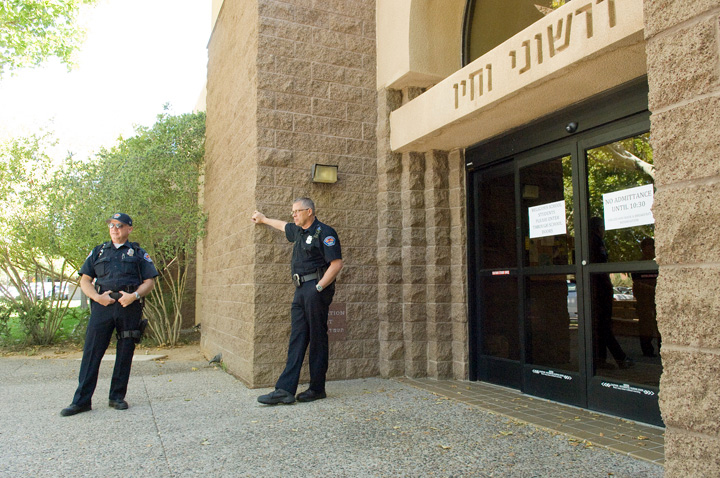
My efforts to cover joint events of the various candidates were stymied by the refusal of campaigns to provide any information or grant access. I was effectively shut out.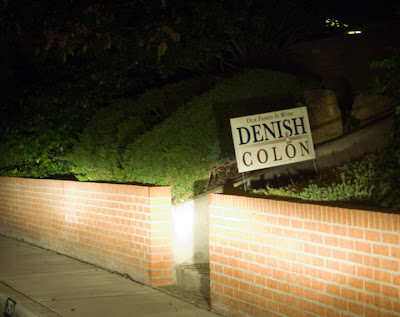

Even our own former governor Gary Johnson, above, has appeared in only two televised debates because large media interests have deemed him, and others as insignificant to the electoral process.
This is the complete extent of my coverage of Diane Denish’s campaign; her yard sign on the first night that it could legally be posted.
I was unable to cover Albuquerque Public Schools’ gubernatorial candidates education debate, Friday August 19, 2010, or the Congregation Albert’s gubernatorial candidates debate Sunday September 29, 2010, because of the campaigns and organizers’ efforts to control who got to cover such events.
Problems covering public governmental activities have intensified and are widespread.
Covering public events such as fires, mayoral press conferences, and APS board and committee meetings, are met with access challenges that not only violate the spirit of the law, but the laws themselves.
Amongst: candidates' campaigns, elected officials, public information officers, and police officers, I have met a wall of resistance. In the two major parties; at the gubernatorial candidate campaign staff levels, I was deemed persona non-gratis.
The issue of who is the press has become more confounding recently, especially for governments, with the proliferation of online journalists. Part of the proliferation results from the number of journalists who are going online and into the social media as an extension of their corporate work or because they have had to change from their traditional media model.
Note:
Note:Amendment I
Congress shall make no law respecting an establishment of religion, or prohibiting the free exercise thereof; or abridging the freedom of speech, or of the press; or the right of the people peaceably to assemble, and to petition the Government for a redress of grievances.
The Constitutional word, “press” may be interchanged throughout this series with such words as: media, newspapers, mainstream media, radio, television, magazines, pamphlets, internet websites or weblogs (blogs), and any other forms of communications, which could apply as broadly as possible to be covered by the word press.
In all cases where someone in government tries to define who are, or what is the press, even in and especially in statute, refer back to the First Amendment’s “Congress shall make no law respecting an establishment of... or abridging the freedom of speech, or of the press...”.
The number of daily papers continues to decline or alter. The recent decision by USA Today to change directions is an effort to stay in touch with their consumers caused by rapidly changing reliance on technology. Papers like: the Santa Fe New Mexican and their Political Reporters Steve Terrell's Roundhouse Roundup and Kate Nash's Green Chile Chatter, and Albuquerque Journal Reporter Dan McKay, has a blog, ”the City Hall Beat”, The Journal also maintains several blogs augmenting their print versions.
The magazine world is no exception, as US News & World Report is changing from a weekly to eight issues a year, while increasing its online presence.
There is another aspect to be considered: mainstream media, newsprint, radio, and television offer advertising space to campaigns. Though campaigns and the media would deny it, the amount of money to be made by publishing and airing political advertising may weigh on the decisions of how deeply the media delves into the positions candidates hold beyond the limited talking point issues designed for 30-second advertising.

During the 2011 regular legislative session, Sen. David Ulibarri (D) Cibola, Socorro, and Valencia Counties, above right with Sen. Linda Lopez, Introduced Senate Bill 147, entitled, Providing for Alternative Publication of Legal Notices on an Authorized Web Site.
Chapter 14, Article 11 NMSA 1978; provided that the requirement of publication may be satisfied by posting on the authorized web site. Each qualified radio or television station shall without charge at least once a day between the hours of 5:00 a.m. and 10:00 p.m. announce the availability of legal notices and advertisements on the authorized web site. The New Mexico broadcasters association shall be responsible for establishing and maintaining the authorized web site, www.nmlegalnotices.com, which shall be promoted by members of the New Mexico broadcasters association."
… (2) by posting on the authorized web site, which electronic posting shall be archived and accessible for a period of not less than five years.
The action was postponed indefinitely in the Senate Judiciary Committee. It is a proposition likely to reappear in the legislature.
The problem of access can be boiled down to the mistaken Constitutional interpretation that government somehow gets to define who is media. Government officials take a further step by excluding those who may tell the truth on them or are perceived as being less than always favorable towards them. Journalists are sometimes demonized for accurately reporting information that a candidate views as damaging to their tightly controlled image and message.
I wrote about how alternative media emerged when forced to do so, in the fall of 2003 for a Media History class:
Existing media outlets do not always represent the diverse interests of peoples. Often existing media outlets are diametrically opposed to the position taken by particular groups. They will include events (marches, strikes and demonstrations) in which groups participate, but present a slanted stereotypical view of groups' positions and ridicule and stereotype the dissenting groups.
Historically, prime examples were abolition, woman's' suffrage and civil rights. The position of existing media in the slave states was to perpetuate the ownership of slave as an intricate part of the South's economic system along moral, patriotic, and religious grounds. Woman's' suffrage was opposed by existing media because they represented the status quo of the time, which was dominated by men with their belief that women were incapable of being responsible with the rights held exclusively by men. The political and economic interests of people, who were and maybe still are, against recognizing equality, based on race, opposed to civil rights.
Existing media outlets exclude the group(s), their ideas and goals from the popular marketplace.
Alternative media are confronted by challenges through:
 A lack of money,A lack of patrons,A lack of sales and advertising,Small or a one-person staff,
Early alternative media were political and later focused on abolitionist, voter, and other civil rights.
Violence against the groups was directed towards those represented by the alternative media.
Existing media and those in power marginalized ideas propounded by the alternative media.
Before computers, a person who wanted to get a message out usually started with a blank sheet of paper. The end result might have been a scribble, or a coloring by a child, to a personal note, letter, or into published documents that were, and still are reproduced on any number of technologies.
Now the starting point is, as often as not, a blank computer monitor. The output is often an image on the same computer monitor.
Computers are just a new technology equal to the printing press known by the first United States Congress when they penned the word “press” in the First Amendment. There is no question today that the word applies to technological advances that the scientific minds of the likes of Ben Franklin and Thomas Jefferson could never have imagined.
However, the use of the term blogger is often used to marginalize those who use the internet for journalistic purposes, as was done against the alternative media. Such online journalists are engaging as an internet based media.
Bloggers are now particularly vulnerable targets for government actors who wish to suppress this new breed of a free press for several familiar reasons:
internet based media usually work alone, often unpaid,they are unattached to commercial news organizations,they don’t know what legal rulings have been made that might help them,they don’t have the resources to take on government in court.Government actors believe they can suppress internet based media for the same reasons used to suppress the alternative media, because of their own ignorance of internet based media’s Constitutional rights found in the First Amendment’s freedom of the press;
they believe it is within their power to select who in the media should or should not be granted access to their events;they don’t know what legal rulings have been made that prohibit or limit their ability to restrict access to any journalist;The two recent gubernatorial candidates and most incumbents, disregarded the fact that they were already elected state officials, who were paid through taxes, a large amount of money to serve the public and they were not able to distance themselves from their official duties and though they were candidates, they retained their public titles and duties;
as pubic officials, and those candidates are still running for governmental office are duty bound to be open with the public;
they think it is more important to control their campaign message rather than uphold the Constitution;campaigns fear “the question” that forces their candidate off the scripted message, possibly breaking open the election by answering, botching the answer, or refusing to answer the question.Political campaigns don’t limit their refusal to deal with journalists only to bloggers. In Nevada, the Republican Party nominee for U.S. Senate Sharron Angle, banned a Las Vegas television station, 8 NEWS NOW, the CBS affiliate from election night coverage. Angle refused to answer directly or through phone calls or e-mails, so the station and the NBC affiliate KSNV News 3 staked her out at the airport.
Angle would later claim that the presence of two reporters and three cameras made a scene and caused a security concern.
There is another aspect to be considered: mainstream media, newsprint, radio, and television offer advertising space to campaigns. Though campaigns and the media would deny it, the amount of money to be made by publishing and airing political advertising may weigh on the decisions of how deeply the media delves into the positions candidates hold beyond the limited talking point issues designed for 30-second advertising.
There is another aspect to be considered: mainstream media, newsprint, radio, and television offer advertising space to campaigns. Though campaigns and the media would deny it, the amount of money to be made by publishing and airing political advertising may weigh on the decisions of how deeply the media delves into the positions candidates hold beyond the limited talking point issues designed for 30-second advertising.The journalist of traditional media may well attempt to cover candidates accurately. However, those decisions are being made, when editors and news directors decided not to cover certain issues and refuse to cover down ballot races at all.
During the early televised debates for the 2012 Republican Presidential Primary nomination, we saw major media in the form of joint newspaper and (cable) television networks fail to invite candidates who have met the legal requirements for their names to appear on various state primary ballots.

Johnson is on the cusp of announcing that he is leaving the Republican Party to run as an Independent.
Few bloggers, who are independent of party partisanship, have a direct economic or political interest to pull their questions. So those bloggers may well ask questions burrowing into issues that candidates regard as toxic.
Contrary to any rhetoric, candidates and their campaign staffs offer about answering to the press, they do not do so at open events where a truly free press has access.
So what’s wrong with this picture?
So what’s wrong with this picture?
I hadn’t officially seen my neighbor Lt. Gov. Denish since the last day of the legislative session on February 18, 2010.

The last time I talked with her, left was over two years ago at the mayoral polling site in October 2009.
 I saw her with a group of people in a local coffee shop, shortly after US Sen. Jeff Bingaman’s retirement announcement. She shifted her position at the table so a corner of the wall blocked my view; it was an acknowledgement without ever even making eye contact.
She and her husband, Herb, (seen to the right of the two photos above) were in the audience at the New Mexico First’s First Forum Lecture Series, the Spirit of Bipartisanship Awards.
Denish was at an Albuquerque Public Schools District Goals Community Meeting at Jefferson Middle School, at right.
 Now more than a year after the gubernatorial election, things have changed slightly in Governor Susana Martinez’s camp.
With the hiring of Communications Director Scott Darnell, right, after he graduated with a Master in Public Policy from the Harvard Kennedy School of Government, access to the Governor’s office vastly improved; from locked out, to some degree of openness. I get press releases and have been able to cover all the events that I have chosen based on those releases.

Darnell was the former Director of Communications for the Republican Party of New Mexico before going to Boston. He was able to spin the party line at the GOP, but was also able to relate details when pressed.

With Huffman Ramirez’s recent departure from the Mayor’s office, returning to TV news, his replacement as Berry's new Communications Director Dayna Gardner adopted the same attitude: that she could unilaterally determine what and who the press were and deny access to city events, even though Berry acknowledges and speak with me as a member of the press.
 When Mayor Berry travels without his executive protection detail of Albuquerque Police Officers, he is open and accessible to me for photographs and questions. However, in the presence of the APD officers, I am subjected to efforts, by them, to control my movements in photographing him where other, “recognized media” have free roam.
In a recent period of just over two weeks I covered four events of Mayor Berry. At three of them he had staff, but no police officer. He greeted me by name and shook my hand. At the fourth event, the state of the city report, attended by about 250 people, the vast majority being city employees, mostly mayoral appointees showing their personal loyalty; including more than 20 command level or above police officers, and at least two officers from the executive protection detail, access was greatly restricted.

On October 30, 2011, Berry attended a Republican event of a group called Club 66. A single staff member, then Director of Constituent Services Tito Madrid, accompanied him. Berry was open and accommodating to my photographing and videoing him.

On November 14, Berry was the guest speaker at the Albuquerque Press Women’s luncheon. A staff member to run his computer and projector and a senior staff member accompanied him.

He was again accommodating in letting me capture still and video images and audio record his presentation.
On November 15, Berry was the guest speaker at an Albuquerque TEA Party meeting where he presented part of his power point slide show to try to explain why the proposed bond for reconstructing the intersection of Interstate Highway 25 and Paseo del Norte, coupled with a sports complex was defeated by city voters.

He arrived alone, passed several people, walked up to me, and I was the first person with whom he shook hands.

His computer and projector staff member arrived on his own earlier to set up his equipment.
On November 25, Berry presented his state of the city report.
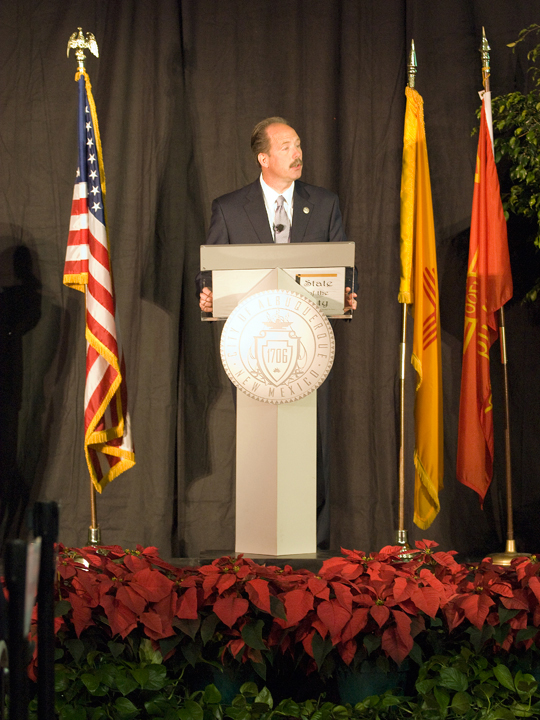
I moved to a spot more than 20 feet from the edge of the stage and at least 35 feet from Berry to get a wide-angle picture of the mayor and his audience.

Albuquerque Police Officer Chris Lucero, below right, assigned to his protective detail, called me by name and told me I had to move. Thinking he might have considered me to be blocking his line of travel to the mayor, I got my shot and backed away to the wall.

Immediately, a member of the city’s GOV TV – Government Television cable access station, above left, moved from Lucero's right, setting up his tripod and video camera in the exact spot I was forced to move from.

Apparently it was not about the media being in that specific location, it was about me being there.
 The Albuquerque Public Schools Communications Department, headed by Executive Director Monica Armenta, Communications Director Rigo Chavez, and their staff are recalcitrant in dealing with requests for information.
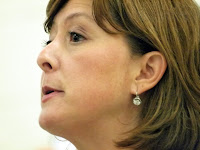 Armenta, right, in particular, attempts to thwart any coverage of her, by stating she wishes not to be recorded at public events and states that she does not grant permission to have photographs of her used in any way.
Armenta fails to recall that she is a public person, and when in a public place, doing public work, is subject to strict scrutiny; capturing her public utterances, and being recorded, on audio, video, and through still photographs.
 APS has withheld documents requested under the inspection of public records act. From other sources, I obtained partial records I had specifically sought from APS, but even their existence was not acknowledged.
As custodian of public records, Chavez, left with APS School Police Lieutenant Karl Overmyer, skirts the requirements of the public records law to provide records that are instantly available by ignoring the provision and slow rolling compliance to the excepted limits of the law. He does so to those not recognized by APS as press, probably in the hopes that any information might become stale news in the two-week delay.

Some APS police officers are not always welcoming to coverage of their presence at public functions. Others have no problem physically throwing members of the "free press" from meetings for covering them and banning them from future public meetings.
I will present these issues, the limiting or denial of access to government activities that some media get invitations, while others don't, in a series of posts as personalized case studies.
The next installment will be: Part One: Republican Party gubernatorial candidate Susana Martinez’ June 10, 2010 visit to Conspiracy Brews, Martinez’ August 11, 2010, Education Reform Press conference.


